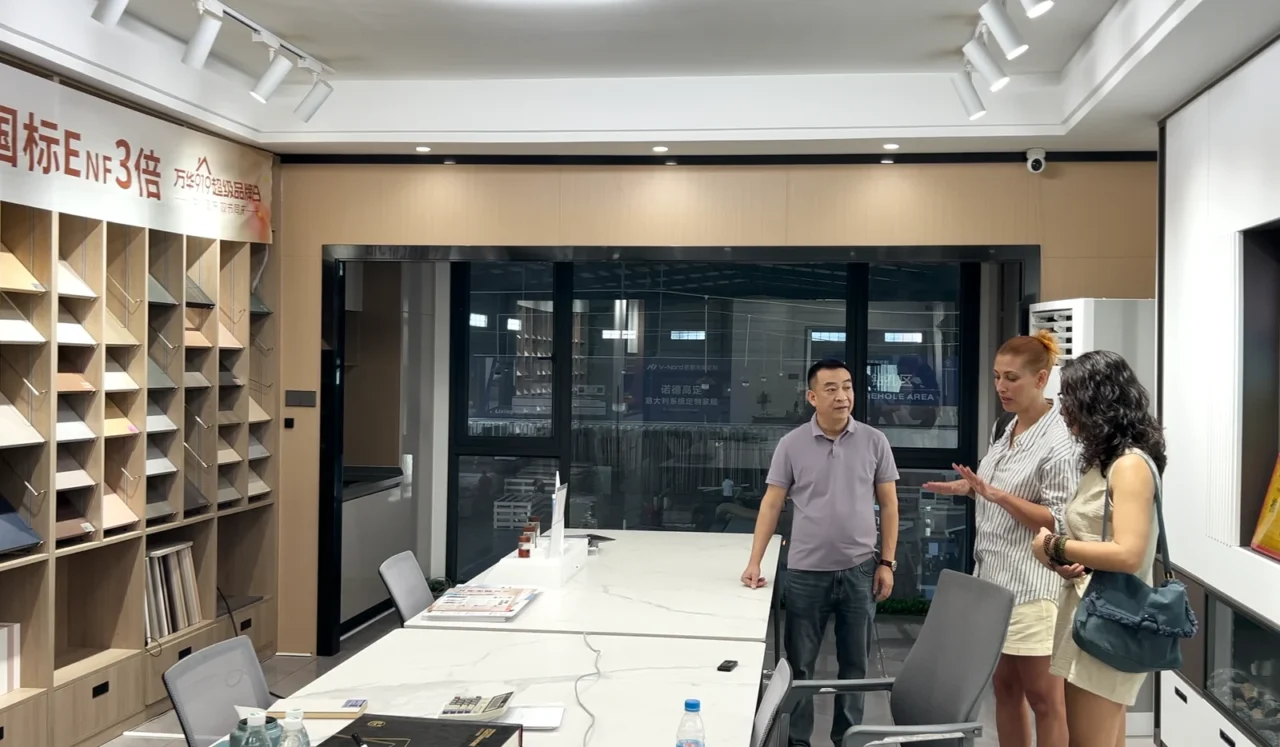
A reference image becomes an orderable custom furniture specification only after the buyer has approved its dimensions, materials, finishes, interfaces, drawing revision, sample and acceptance method. Keep each decision tied to the version sent to production.
Project-control toolkit · No unverified client approval or installation outcome
In a 33-page Source Foshan casebook, an entry console is shown through reference images, marked issues, stone preparation and an installed view (PDF pp. 27-30). These stages help a buyer locate the next question.
The stage captions do not identify a dated approver, the drawing revision released to production or the disposition of each marked issue. Record those in a decision register before describing a step as approved or closed.
1. Turn the image into a brief a factory can price
Separate what the reference communicates—shape, proportion, finish mood—from requirements it cannot show: overall dimensions, substrate, weight, installation interface, visible-face standard and destination constraints. Mark unknowns as decisions to be made. A supplier’s visual match may still be wrong if the item must pass through a doorway, align with another product or accept on-site installation.
2. Use five approval gates
Each gate should have an owner, dated artifact and open-issue list. A gate passes when the buyer has reviewed the actual item or document, not when someone writes “looks good” in a chat detached from the revision. If a later choice changes cost or lead time, record the effect before releasing the next version.
3. Make a revision log that answers what changed
A usable revision log carries the previous version, the proposed change, why it was needed, who approved it, and which documents or parts are affected. Keep rejected options too: they prevent a discarded idea from reappearing in production as an unexplained alternate.
| Field | Record |
|---|---|
| Identity | Project/SKU, drawing number, revision, change ID |
| Change | Old requirement → new requirement, reason and affected parts |
| Decision | Approval owner, date, approved/rejected/open status |
| Propagation | Updated quote, BOM, sample, packing and installation instruction |
| Evidence | Link to drawing, sample photo and sign-off |
4. Release one coordinated package
Before fabrication, reconcile the quote, drawing, material sample, bill of materials and schedule against the same version. A change to the metal finish or stone edge may touch packing, weight or site installation as well as appearance. The buyer should know which items are confirmed and which remain provisional.
5. Write down supplier defaults and requested exceptions
A material name is not an agreement about how a door or cabinet will be built. One undated supplier material application manual in our source set gives two useful examples of why a buyer needs an exception field. These are that supplier’s stated applications, not limits or test results for all factories. Confirm the current specification, drawing and price effect before release.
| Decision to expose | Stated in that manual | Record before release |
|---|---|---|
| Cabinet back thickness | The manual’s special instructions name a 9 mm veneered plywood back as the default for one cabinet construction; an 18 mm finger-jointed back requires an explicit request (p. 18). | Project SKU, actual back material/thickness, drawing revision, price and approver. Do not treat a photograph of the face as back-panel consent. |
| Tall flat-door reinforcement | The OSB application page and special instructions call for a rear straightener above 1600 mm on specified flat-door configurations (pp. 16, 18). | Exact door dimensions, substrate, straightener detail, hardware compatibility and a current supplier confirmation. No anti-warping performance is inferred. |
These examples also show why a later material substitution can reopen a door, hardware, packing or installation decision even when its visible finish appears unchanged.
6. Carry decisions through inspection and installation
The final check is not whether the finished piece resembles the inspiration image. Inspect against the approved drawing and sample; retain pre-shipment photos tied to item IDs; then record site fit, installer observations and any open snag. Keep a visual process gallery separate from a verified delivery case when those records are missing.
7. Three questions before a deposit or production release
- Which exact version is being approved? Name the item ID, drawing revision, dated sample and accepted dimensions. A message saying “looks good” without those joins remains an open decision.
- Who can close an exception? Record the approver and what the exception changes in price, lead time, fit or function. A supplier’s default is not automatically the buyer’s choice.
- What will prove completion? Link the release to item-level QC, packing and site evidence. A finished photograph shows appearance; the installation or snag record establishes the final status.
Decision register prompt
For this item, list every open dimension, material, finish and installation decision; attach the latest drawing and sample IDs; name the approver and deadline; and state whether the supplier may fabricate before each item is closed. Mark any cost or programme change explicitly.
Method: Source Foshan’s local project-casebook structure and blank handover worksheets were converted into a buyer decision record. All five diagrams are original; no client-specific drawing, image or performance result is reproduced.
Source and limits. The evidence-path observation comes from Source Foshan’s 33-page Project Casebook, especially pp. 2 and 27-30; its stage captions do not themselves supply dated approvals or drawing revision IDs. The cabinet-back and tall-door examples are transcribed from an undated supplier sales material application manual, pp. 16 and 18, and must be rechecked against a current item-level specification. No supplier performance, client acceptance or installation outcome is claimed here.
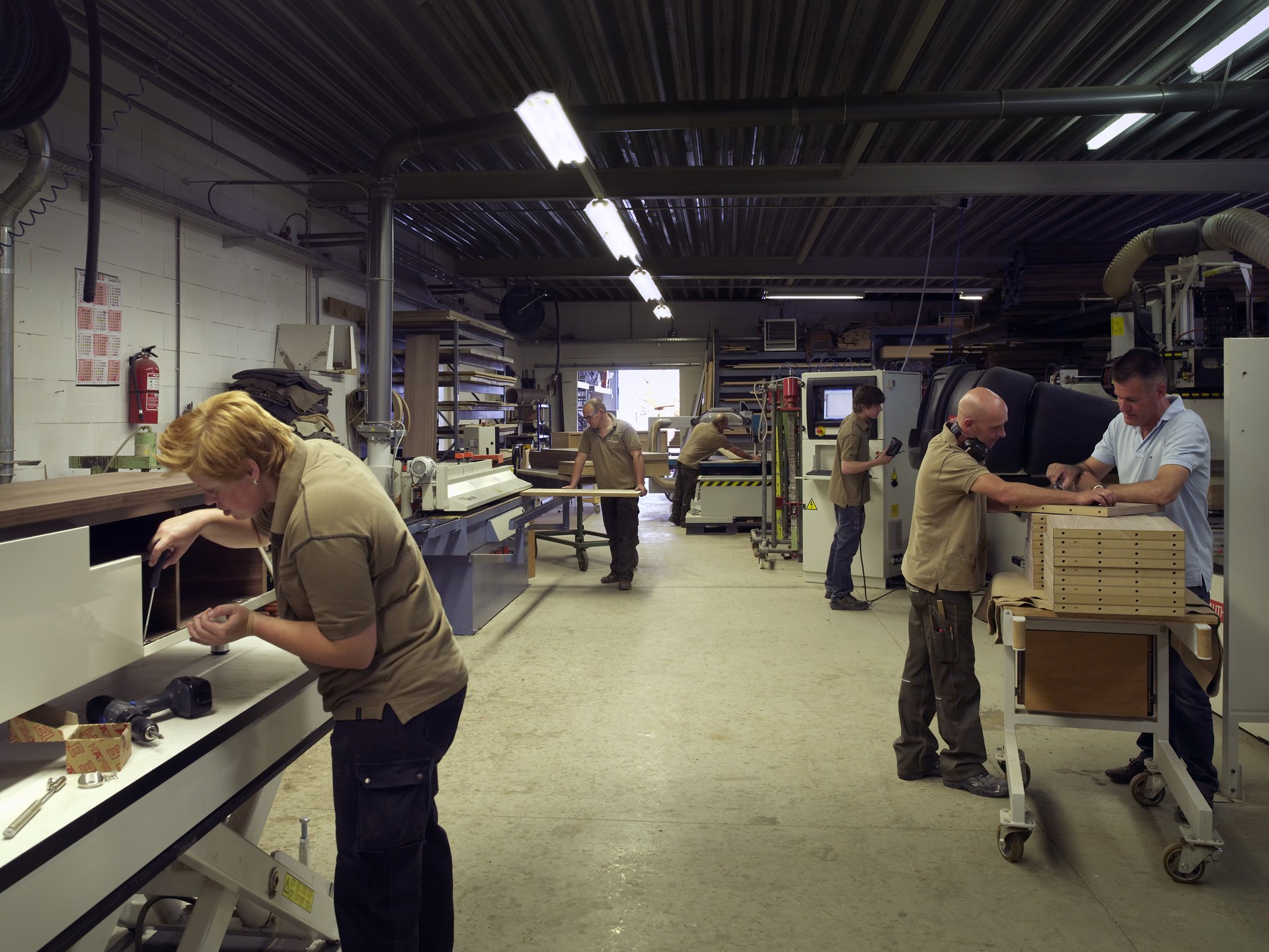
Featured photograph: Shixart1985 / Wikimedia Commons, CC BY 2.0; WordPress resized the original. It is an illustrative workshop scene, not a Source Foshan job.