Hospitality guide
Restaurant Furniture Sourcing in China: Chairs, Tables, Booths and Bar Seating for F&B Projects
China's restaurant furniture comes mainly from two clusters: Foshan's Longjiang and Lecong towns in Guangdong for upholstered chairs, booths and stone or timber tables, and Anji county in Zhejiang for high-volume metal and plastic-shell chairs. A commercial-grade dining chair typically costs USD 35–120 ex-works, MOQs run 20–50 pieces per model and production takes 30–45 days. Specify contract strength tests (EN 16139 or ANSI/BIFMA X5.4), wipeable finishes and the right floor glides, and the savings hold up in daily service.
- 300+vetted suppliers
- 60+projects delivered
- 18destination countries
- 100%inspected before loading
Updated by the Source Foshan sourcing team in Foshan.
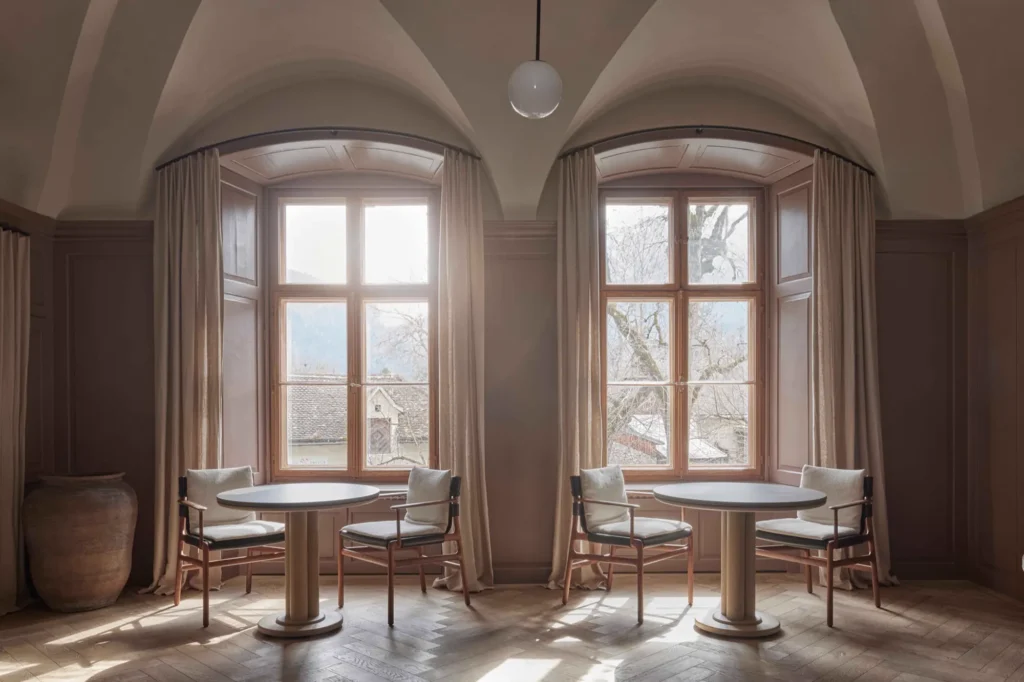
At a glance
- 01
Commercial dining chairs from Foshan and Anji typically cost USD 35–120 ex-works; solid-timber and fully upholstered models sit at the upper end.
- 02
Specify EN 16139 level L1 for cafés and restaurants, or ANSI/BIFMA X5.4, so seating is tested for daily commercial use.
- 03
MOQs are usually 20–50 pieces per chair model and colour; Lecong showroom stock allows smaller mixed orders.
- 04
Allow 30–45 days production plus 3–6 weeks sea freight; knock-down packing cuts chair volume by 40–60%.
- 05
A 60-seat restaurant furniture package ex-works Foshan typically costs USD 7,000–18,000 depending on materials, before freight and duties.
What furniture does an F&B project need, and what specifications are typical?
Ask the team about thisAn F&B project needs six furniture families – dining chairs, armchairs, bar and counter stools, booths or banquettes, tables in two or three sizes, and a host or service counter – and each has a commercial specification that differs from its residential look-alike. The differences are structural rather than visual: thicker frames with stretcher rails or metal reinforcement, higher-density foam, wipeable fabrics and lacquers, and glides matched to the floor.
| Item | Typical commercial specification | Indicative ex-works price (USD) |
|---|---|---|
| Side dining chair | Solid ash or beech, or steel frame; seat height 450–470 mm; upholstered or timber seat; EN 16139 L1 or ANSI/BIFMA X5.4 | 35–120 |
| Dining armchair | Same frame rules; arm height 640–680 mm so it slides under the table apron | 70–180 |
| Bar or counter stool | Seat 750 mm (bar) or 650 mm (counter); footrest with metal wear plate; swivel optional | 60–160 |
| Booth or banquette | Plywood frame in 1.2–1.5 m modules; seat foam 35–45 kg/m³; fire barrier where required; kick plate | 250–600 per linear metre |
| Table, 2-top and 4-top | Tops 600–800 mm square or Ø 700–800 mm in HPL, solid wood, sintered stone or marble; cast-iron or steel base with levellers | 60–250 complete; 25–90 base only |
| Communal or high table | 2.4–3.0 m long, 1,050 mm high; solid wood or veneer top on steel understructure | 300–900 |
| Terrace chair | Powder-coated aluminium or PE rattan, stackable, quick-dry cushion | 40–140 |
Hotel restaurants usually fall inside a wider FF&E package with its own model-room process, described in our guide to hotel furniture sourcing in China. Terraces and courtyards need outdoor-grade frames, weaves and foams, which have their own material logic; see outdoor furniture sourcing in China. This page covers the indoor F&B seating and tables that make up most of a restaurant order.
Restaurant seating should be tested to a non-domestic strength and durability standard – EN 16139 in Europe or ANSI/BIFMA X5.4 in North America – and tables to EN 15372, because these tests simulate years of commercial use that a residential product never faces. Writing the standard into the purchase order, and asking for the test report from an accredited laboratory, is the single most effective quality control you can apply before production starts.
- EN 16139 (non-domestic seating): two test levels. L1 covers general use in cafés, restaurants, canteens, bars, banks and function rooms; L2 covers extreme use such as night-clubs and transport terminals. Requirements are based on users up to 110 kg, with seat static loads of 1,600 N at L1 and 2,000 N at L2. Specify L1 for most restaurants, L2 for bars with late trading.
- ANSI/BIFMA X5.4-2020 (lounge and public seating, reaffirmed 2025): safety, durability and structural tests for single and multiple seating, based on a 275 lb (125 kg) user and an estimated ten-year life in single-shift use.
- EN 15372 (non-domestic tables): strength, durability and safety with five test levels; level 2 general use suits most restaurants, higher levels for bars and heavy-use canteens.
- Fabric abrasion: the ACT heavy-duty guideline of 30,000 Wyzenbeek double rubs or 40,000 Martindale cycles is the practical minimum for dining seating; booths often go higher.
- Stain and wipe resistance: stain-treated fabrics, coated fabrics (PU or vinyl) for booths and high-turnover seating, and two-component polyurethane lacquer on timber so the finish survives daily wiping with detergent.
- Glides: felt or PTFE glides for timber floors, nylon for tile and stone, metal-capped glides for chairs that are stacked and dragged. Specify by floor type per area; the wrong glide is the most common complaint after delivery.
- Board emissions: E1 or CARB Phase 2 / TSCA Title VI certified plywood and MDF for booth frames, table tops and counters, with the mill certificate in the shipment file.
Fire performance depends on the destination and on whether the restaurant sits inside a hotel or other regulated building. The main regimes – CAL TB 117-2013 in the US, BS 5852 Crib 5 in the UK and EN 1021 in the EU – and how commercial projects specify them are set out in our contract furniture sourcing guide. For a standalone restaurant, confirm the requirement with your local fire authority before you send the specification to China, and write the standard into every seating line.
Solid wood, metal, plywood shell or plastic: which chair material should you choose?
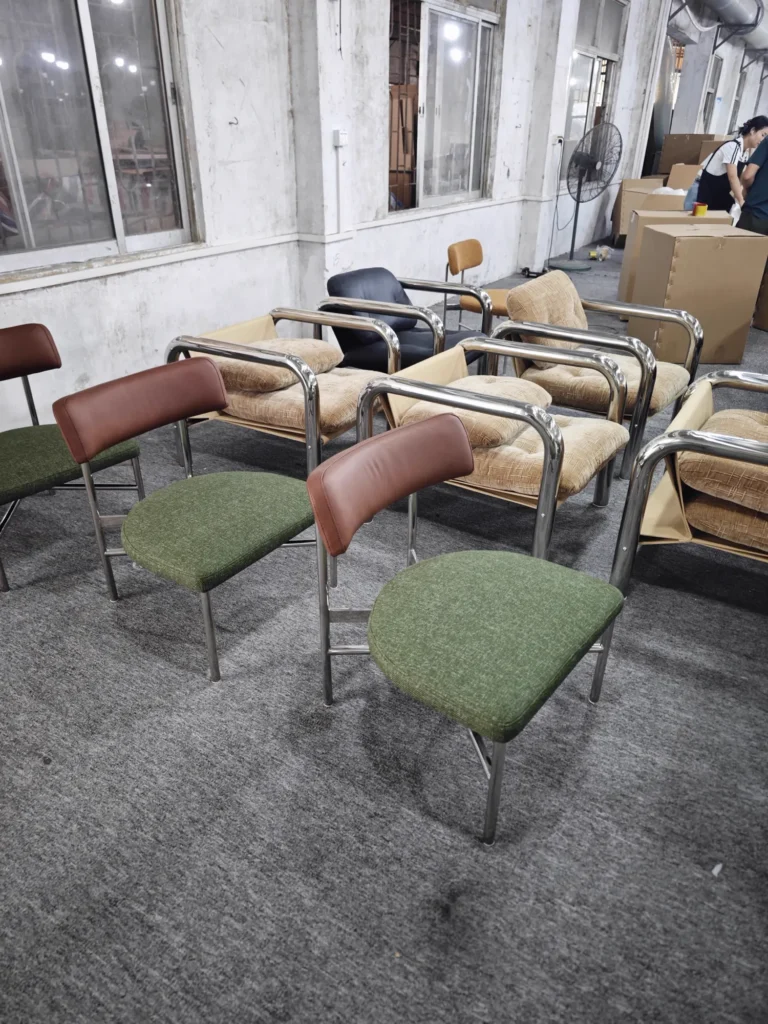
Ask the team about thisChoose the frame material by the service pattern and the floor, not by the catalogue photograph: solid ash or beech for warmth and repairability in full-service dining, powder-coated steel or aluminium where chairs are stacked or moved daily, moulded plywood shells for consistent volume with a designed look, and polypropylene for fast-casual and outdoor overflow. Every material is made within Foshan or a day’s drive of it, so the choice is about performance and budget rather than availability.
| Frame material | Advantages | Limitations | Indicative chair price ex-works (USD) |
|---|---|---|---|
| Solid ash or beech (Longjiang workshops) | Repairable, takes stain and lacquer well, strong with mortise-and-tenon or dowelled joints, premium feel | Heavier; moves with humidity; 4–6 week production; needs seasoned timber | 55–120 |
| Powder-coated steel tube | Low cost, stackable, slim profile, high-volume supply from Anji and Foshan | Coating chips at stacking contact points; cut edges rust if unsealed; cold to the touch | 35–80 |
| Aluminium | Light, stackable, corrosion-resistant, works indoors and on terraces | Higher material cost; weld quality must be checked; fewer decorative profiles | 45–110 |
| Moulded plywood shell | Consistent, light, mid-century look, quick production on existing moulds | Veneer face is fragile at edges; new shapes need tooling (USD 3,000–8,000) | 40–95 |
| Polypropylene or other plastic | Lowest cost, stackable, washable, wide colour range, outdoor-capable if UV-stabilised | Reads as budget; colour fade outdoors without UV stabiliser; hard to repair | 18–45 |
| Fully upholstered on timber or steel frame | Comfort and acoustic softening; fabric-led design; hides the frame | Fabric wear and staining; needs heavy-duty fabric and fire treatment; slower cleaning | 60–160 |
Table tops follow a similar logic. High-pressure laminate on plywood or MDF (indicatively USD 30–70 for a 700 mm top) is the workhorse: heat and stain resistant, light and cheap to replace. Solid oak or ash (USD 80–200) suits full-service dining and can be sanded and re-oiled. Sintered stone at 12 mm (USD 90–220), produced in Foshan’s Nanzhuang ceramics district, resists heat, scratches and staining better than natural stone and is now the default for premium casual dining. Natural marble (USD 100–250) looks best and etches worst; it needs sealing and careful staff. Prices are indicative ex-works for tops alone and vary with edge profile and size.
Send your list. Get compared options from Foshan within one business day.
Real suppliers, real prices and lead times side by side, from a local team that walks the showrooms and factories every week. No commitment.
Booths and banquettes are made to your floor plan and priced per linear metre, typically USD 250–600 ex-works Foshan depending on back height, upholstery and fire specification; a 1.2–1.5 m module is the practical unit for production and shipping. Because they are site-specific, they are the one restaurant item that always needs shop drawings and a signed-off sample section before production.
The construction that lasts is a plywood frame (18 mm sides, 12 mm back panel), a webbed or plywood seat deck, seat foam of 35–45 kg/m³ and back foam of 25–30 kg/m³, a fire barrier between fabric and foam where the destination requires it, and a recessed or metal kick plate at floor level so mops and shoes do not damage the base. Fabric should be coated (PU or vinyl) or a stain-treated contract textile above 40,000 Martindale; leather works in premium settings but needs a stated thickness (1.0–1.2 mm) and a pigmented finish.
Customisation covers back height (usually 900–1,200 mm), seat depth (480–520 mm), channelled or buttoned upholstery, corner and curved modules, integrated power, plinth lighting and a matching wall-fixed back rail. Send a measured site drawing with wall lengths, column positions and floor level variations; the factory will split the run into modules and mark which are wall-fixed. Our custom furniture development process – reference, dimensioned shop drawing, samples, first-article approval, batch, inspection – applies exactly to banquettes.
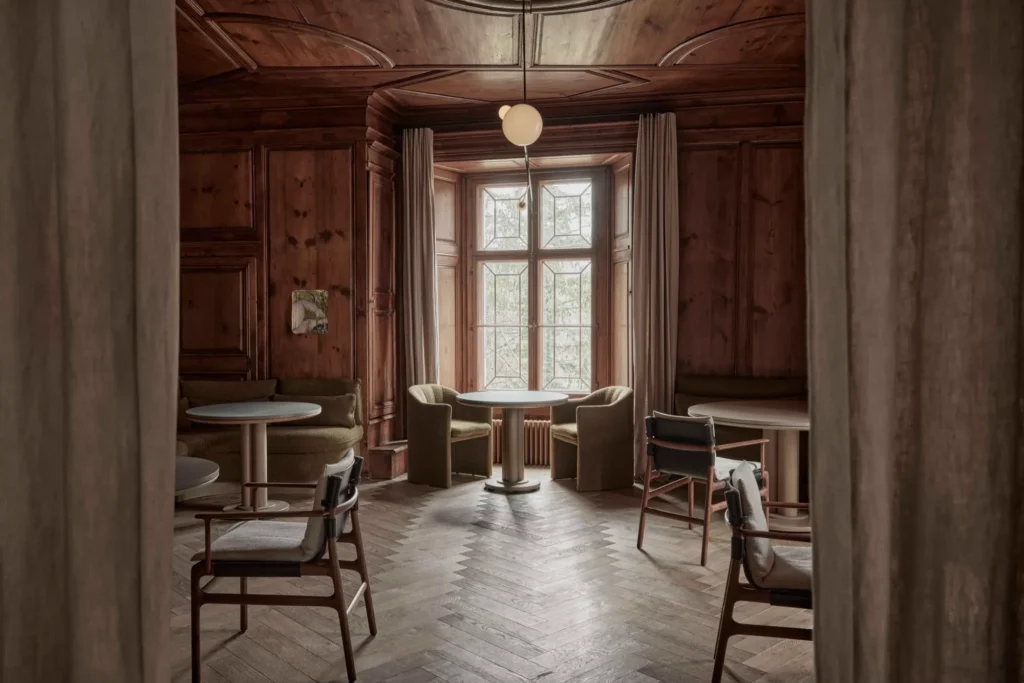
Ask for a sample section A 600 mm sample of the booth – frame, foam, fabric, kick plate and stitching – costs USD 150–400 and two weeks. It fixes comfort, seam quality and fabric tension before 30 metres are produced, and becomes the control sample for inspection.
Expect a minimum of 20–50 pieces per chair model and colour from a factory, 30–45 days of production from confirmed drawings and fabric, and a lower threshold if you buy from showroom stock. MOQ exists because frames are cut in batches and fabric is bought by the roll; asking for one frame in three fabrics costs less than three frames in one fabric each.
| Source | Typical MOQ per model | Production lead time | Price position | Best for |
|---|---|---|---|---|
| Longjiang chair factory (made to order) | 30–50 pieces per model and colour | 30–45 days | Base | Full projects with custom finish or fabric |
| Anji chair factory (volume metal, plastic, swivel) | 50–200 pieces; often a mixed 20 ft container | 30–40 days | Lowest per unit | Chains and multi-site rollouts with standard models |
| Lecong hospitality showroom (stock collections) | 1–10 pieces; mixed models accepted | 7–20 days from stock; 30 days if remade | 10–25% above factory | Small cafés, fast openings, sampling before a larger order |
| Trading company | Flexible; aggregates several factories | 35–50 days | 8–15% above factory | Buyers without a local team who need one invoice |
Lead times stretch before Chinese New Year (late January or February) and the October holiday week, when factories close for one to two weeks and the weeks either side fill up; a chair order confirmed in early January usually ships in March. Upholstered chairs depend on fabric availability, so confirm the fabric is in stock before you pay the deposit or accept a 2–3 week extension. Volume pricing steps typically fall at 50, 100 and 300 pieces; the terms retailers and chains negotiate at those levels are covered in our guide to buying furniture wholesale from China.
For a first project, visiting the dining tables and chairs showrooms in Lecong and Longjiang lets you sit on the chairs, check joints and glides, and order a sample set the same day; a follow-up factory order then reproduces the approved sample at MOQ pricing.
A furniture package for a 60-seat restaurant – 44 chairs, 8 linear metres of booth seating for 16 covers, twenty tables, six bar stools and service stations – costs roughly USD 6,700 ex-works Foshan in an economy specification, USD 11,900 in a mid-range specification and USD 18,300 in a premium one. These are indicative totals built from the unit prices above; your quotes will move with fabric grade, top material and finish complexity.
| Item | Quantity | Economy: steel or PP chairs, HPL tops | Mid-range: solid beech upholstered chairs, oak or HPL tops | Premium: ash armchairs, sintered stone, leather booths |
|---|---|---|---|---|
| Dining chairs | 44 | 1,760 (40 each) | 3,300 (75 each) | 5,280 (120 each) |
| Booth seating | 8 linear metres (16 covers) | 2,000 (250 per m) | 3,200 (400 per m) | 4,800 (600 per m) |
| Tables, 2-top | 10 | 800 (80 each) | 1,500 (150 each) | 2,200 (220 each) |
| Tables, 4-top | 10 | 1,100 (110 each) | 2,000 (200 each) | 3,000 (300 each) |
| Bar stools | 6 | 360 (60 each) | 600 (100 each) | 960 (160 each) |
| Host stand and waiter stations | 3 | 450 (150 each) | 900 (300 each) | 1,500 (500 each) |
| Spare parts, glides and touch-up (about 3%) | – | 190 | 350 | 530 |
| Total ex-works, indicative | – | about 6,700 | about 11,900 | about 18,300 |
Landed cost is higher. Export packing, inland trucking, ocean freight, insurance, destination port charges, duties and last-mile delivery typically add 25–45% to the ex-works total, so the same three packages land at roughly USD 9,000, 16,000 and 25,000 in most Western markets. A 60-seat package usually fits in 20–28 m³, which is a 20 ft container (33 m³) with room to spare or a less-than-container-load shipment. Chairs and tables sit under different headings of Chapter 94 of the Harmonized System and may carry different duty rates, so have your customs broker classify each line. The step-by-step cost structure and documents are covered in how to buy furniture from China.
Buy chairs assembled unless the freight saving is decisive: an assembled timber dining chair packs to about 0.25–0.35 m³ and a knock-down one to 0.12–0.18 m³, so knock-down halves the volume but adds assembly labour, torque errors and loose joints if the site crew is untrained. Metal and plastic stacking chairs ship assembled and nested, five or six to a carton, at 0.08–0.12 m³ per chair, which is why they dominate volume orders.
- Knock-down tables are standard: tops and bases ship separately, bases nested; ask for pre-drilled tops, bagged fixings per table and a one-page assembly sheet.
- Booth modules ship assembled with the kick plate fitted, wrapped in foam and stretch film, cornered and, for premium fabrics, crated; label each module with its position from the site drawing.
- Carton specification: five-ply export carton, foam or air-cushion around legs and arms, chair-to-chair separators, and a moisture barrier for upholstery; a written standard prevents ‘factory standard’ meaning a single-ply box.
- Spare parts: order 3–5% extra glides, 2–3% extra fixings and a touch-up kit per finish; ask for two spare chairs per fifty for a busy room.
- Replacement policy: agree in the contract how damaged pieces are replaced (photo evidence, credit or parts on the next shipment) and who pays freight.
- Inspection: an item-by-item pre-shipment inspection with photographs of joints, glides, fabric alignment and carton drop tests, released before the balance is paid.
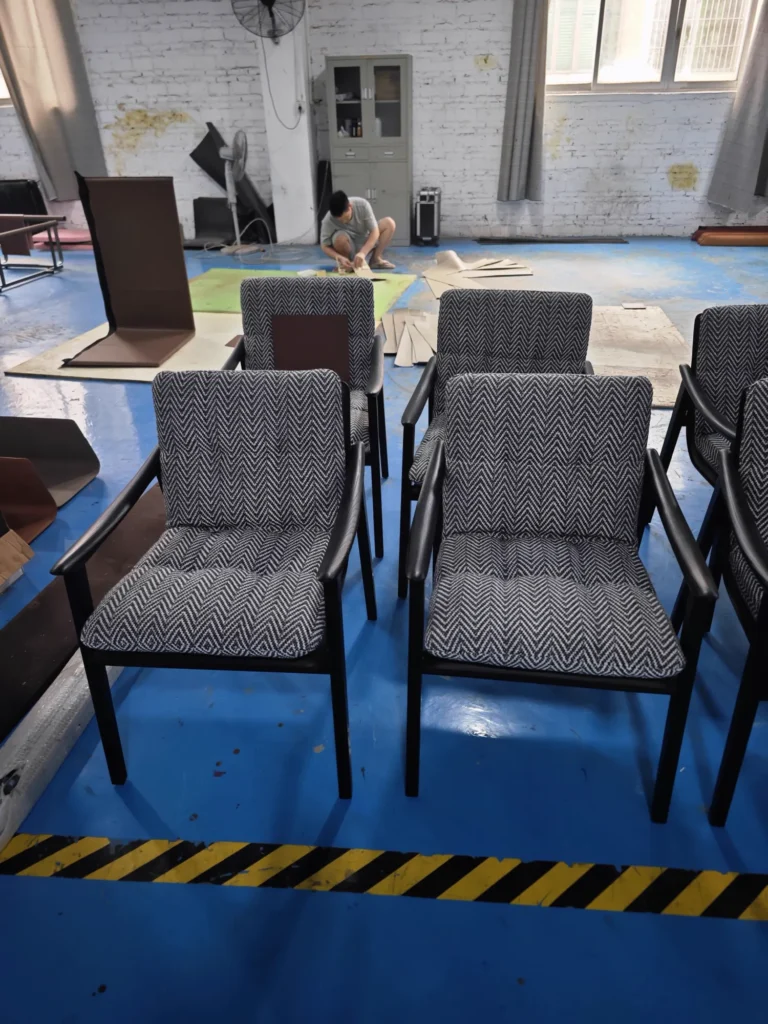
The packing standard your supplier should be held to, and what a pre-shipment report ought to contain, are set out on our quality control and shipping page.
Source upholstered chairs, booths and stone or timber tables in Foshan, and high-volume metal, plastic or swivel chairs in Anji, Zhejiang; most restaurant projects end up combining the two. Foshan’s Longjiang town in Shunde district is China’s upholstery centre and holds hundreds of chair and sofa workshops, while Lecong, fifteen minutes away, has the hospitality showrooms – Gelaimei Furniture covers hotel, restaurant and apartment furniture, and the Lecong malls carry dedicated F&B floors. Stone tops come from Foshan’s Nanzhuang and Shatou material districts, metal frames from Nanhai’s Dali town, so one Foshan trip covers a complete restaurant.
Anji county in Zhejiang, about two hours from Shanghai, produces one in every three chairs made in China and half of those exported; it is the country’s largest swivel-chair base and describes itself as the world’s largest office-chair base, with more than 1,700 furnishing enterprises and chair output worth RMB 31.19 billion in 2024. For restaurants that means low-cost metal and polypropylene stacking chairs, swivel dining chairs and bar stools at MOQs of 50–200 pieces, with every component – mechanism, steel frame, upholstery – made within a short radius. Anji suits chains and volume rollouts; Foshan suits design-led and upholstered projects.
Dongguan Houjie, an hour east of Foshan, adds export-grade contract factories that already supply international hotel and restaurant brands, at higher prices and higher MOQs. Whichever cluster you use, verify that the supplier owns the workshop it shows you – business licence, address, export record – using the steps in our guide to finding and verifying China furniture manufacturers, and buy samples before you buy a container.
Source Foshan is a local sourcing team based in Foshan and working in Dongguan – not a manufacturer, not a marketplace. For F&B projects the team searches and shortlists chair, booth and table suppliers across 300+ vetted showrooms, factories and specialist workshops, then returns compared quotes line by line with a stated service fee and no hidden markups: transparent, compared pricing, never ‘guaranteed cheapest’. Booths and custom tables follow the custom development route of dimensioned shop drawing, material samples and first-article approval before the batch is made.
Orders are placed and confirmed with every supplier, production is tracked with weekly photo updates, and goods pass seven quality checkpoints from material selection to shipment approval with a full item-by-item photo and video report before you pay the balance. Export packing follows a written standard, and chairs, tables and stone tops from different workshops are consolidated in one warehouse into one shipment. Interior studios can source under their own brand with an options sheet per line item through the designer FF&E service. Guided Foshan buying visits run from USD 99 per day. Contact hello@sourcefoshan.com or WhatsApp +86 151 9256 9580; replies within one business day.
Frequently asked questions
Can I mix chair models and colours in one order to reach the MOQ?
Usually yes, if the frame is the same. Factories batch the frame cutting, so 50 identical frames split across three fabrics or two stain colours normally count as one MOQ, sometimes with a small surcharge per extra colour. Mixing different frame models does not combine, and each will carry its own minimum. Showroom stock in Lecong is the exception, where mixed small quantities are sold as they stand.
How do I check chair quality without visiting the factory?
Order one or two samples first and test them hard: rock the chair on a flat floor, twist the back, check the joints for glue lines and dowels, weigh it, and compare the seat height and glides against your specification. Ask for the EN 16139 or BIFMA test report and the fabric abrasion result. Then have an item-by-item pre-shipment inspection with photographs of joints, glides and cartons before paying the balance.
What seat height and table height should I specify?
For dining, a seat height of 450–470 mm with a table top at 740–760 mm gives the usual 280–300 mm gap. Counter seating pairs a 650 mm stool with a 900–950 mm counter; bar seating pairs a 750 mm stool with a 1,050–1,100 mm bar. Specify these in millimetres on every line; Chinese factories build to the drawing, and a 20 mm error across 60 seats is a costly one.
Are Chinese restaurant chairs suitable for outdoor terraces?
Only if built for it. Indoor steel frames rust at cut edges and indoor foam holds water. For terraces specify powder-coated aluminium or UV-stabilised polypropylene, PE rattan rather than PVC, stainless or nylon glides and quick-dry foam with solution-dyed acrylic covers. Many Foshan suppliers make indoor and outdoor versions of the same design, which keeps a dining room and its terrace visually consistent.
How long does a restaurant furniture order take from deposit to opening?
Plan four to five months. Allow two to three weeks for quotes and samples, 30–45 days of production, one to two weeks for inspection and packing, three to six weeks of sea freight and one to two weeks for customs clearance and delivery. Add three to four weeks if production spans Chinese New Year or the October holiday, and two to three weeks for a custom booth sample stage.
What warranty is realistic for restaurant chairs and tables from China?
Two to three years on frames and structural joints is common from established factories, with one year on fabric, finish and moving parts such as swivels and gas lifts. The warranty is only enforceable if the contract names the supplier entity, the remedy and who pays freight. In practice, holding 3–5% spare glides, fixings and two spare chairs per fifty resolves most issues faster than a claim.
Do I need fire-retardant treatment on restaurant chairs?
It depends on the destination and building. Standalone restaurants in many US states follow CAL TB 117-2013 for upholstered seating, UK venues fall under BS 7176 hazard categories, and EU public buildings commonly require EN 1021-1 and -2. Restaurants inside hotels inherit the hotel’s stricter regime. Confirm with your local fire authority and write the exact standard on each upholstered line before quoting.
Sources and further reading
- FIRA International — EN 16139:2013 strength, durability and safety requirements for non-domestic seating — Test levels L1 (general use: cafés, restaurants, bars) and L2 (extreme use); 110 kg user basis
- BIFMA — ANSI/BIFMA X5.4-2020 (R2025) Public and Lounge Seating standard reaffirmed — Scope and current status of the lounge and public seating standard
- BSI Knowledge — BS EN 15372 Furniture: strength, durability and safety, requirements for non-domestic tables — Non-domestic table standard with five test levels
- Association for Contract Textiles — Abrasion performance guideline — Heavy duty 30,000 Wyzenbeek double rubs / 40,000 Martindale cycles
- China Daily — Furniture companies see a green revolution in Anji (September 2025) — Anji produces one in three chairs made in China and half of exports; chair output RMB 31.19 billion in 2024; 1,700+ enterprises
- US EPA — Formaldehyde emission standards for composite wood products (TSCA Title VI) — Certification requirement for plywood, particleboard and MDF used in US-bound furniture
Field notes · from the blog
What buying in Foshan is actually like, from people who paid for the lesson.
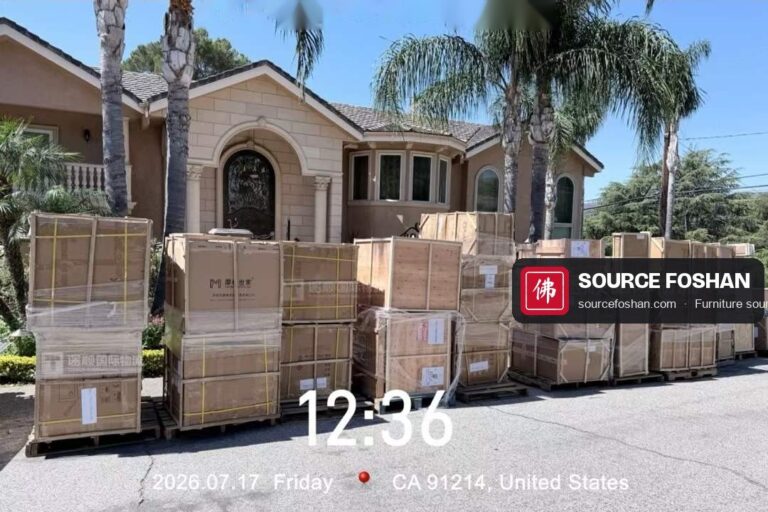 Shipping Furniture From Foshan to France: LCL vs FCL, Ports, EU Duty, French VAT and the Delivery Leg (September 2026)
In short Sea freight from Shenzhen or Nansha to Le Havre or Fos-sur-Mer takes about 25–35 days in September 2026, with most services routed…
Shipping Furniture From Foshan to France: LCL vs FCL, Ports, EU Duty, French VAT and the Delivery Leg (September 2026)
In short Sea freight from Shenzhen or Nansha to Le Havre or Fos-sur-Mer takes about 25–35 days in September 2026, with most services routed…
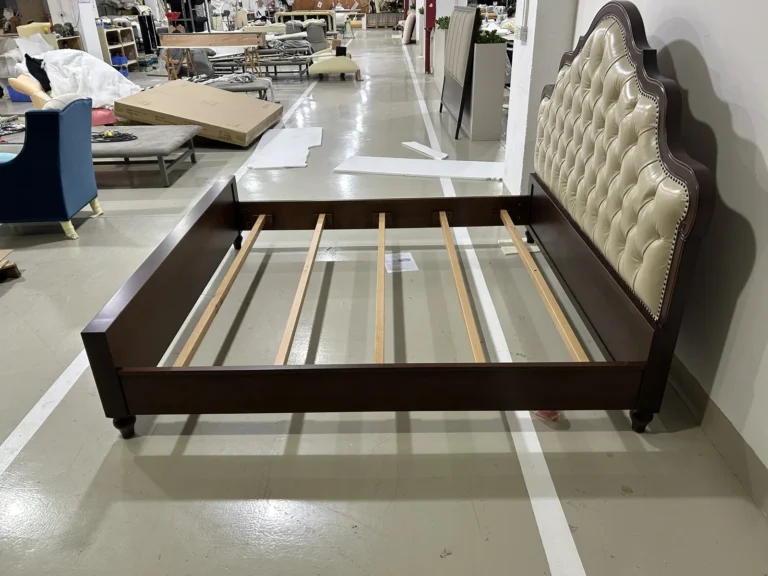 Factory-Direct Furniture From Foshan: A Six-Step SOP, the Traps at Each Step and How to Close Them
Value ÷ price, the six-layer channel mark-up that turns a ¥5,000 sofa into ¥20,000, why Foshan, five hard quality indicators, and the four traps…
Factory-Direct Furniture From Foshan: A Six-Step SOP, the Traps at Each Step and How to Close Them
Value ÷ price, the six-layer channel mark-up that turns a ¥5,000 sofa into ¥20,000, why Foshan, five hard quality indicators, and the four traps…
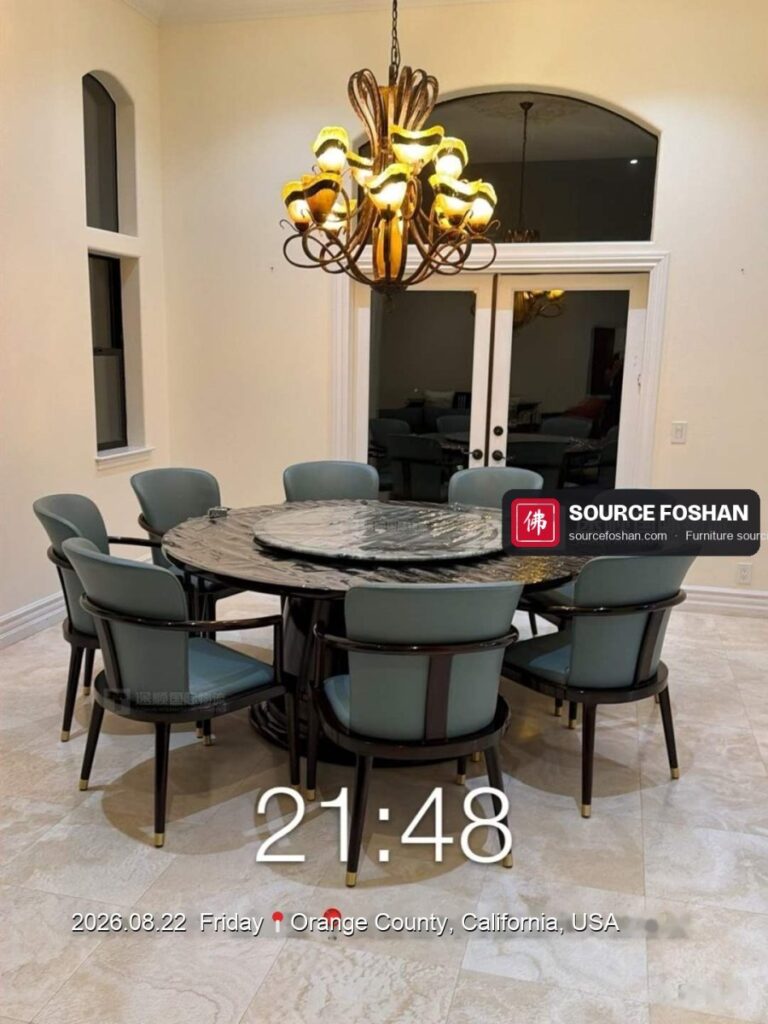 Foshan to Orange County: A Full Container Unloaded at 09:41, Every Room Furnished by 21:48 — Same Day
In short A full container of Foshan furniture for a house in Orange County, California: a marble-top desk and leather chair, a round marble…
Foshan to Orange County: A Full Container Unloaded at 09:41, Every Room Furnished by 21:48 — Same Day
In short A full container of Foshan furniture for a house in Orange County, California: a marble-top desk and leather chair, a round marble…
Send your list. We will tell you honestly how it would run.
A floor plan, an FF&E schedule, a product link or a rough brief is enough. Our local team in Foshan replies within one business day with real options, prices and lead times — no commitment.
Start Your ProjectWhatsApp +86 151 9256 9580 · hello@sourcefoshan.com · WeChat 15192569580