- Your packed volume is under about 15 m³ — roughly a living room, a bedroom and a dining set.
- You can accept 21–31 days port to port plus 5–10 days of consolidation and deconsolidation at each end.
- Nothing in the order is stone, glass or a single heavy slab: LCL cargo is handled loose alongside other shippers' freight.
- You are comfortable that fixed destination charges — terminal handling, deconsolidation, customs entry — apply whether the consignment is 3 m³ or 12 m³.
Destination guide · Australia
Shipping Furniture From China to Australia
Furniture shipped from Foshan reaches Melbourne, Sydney or Brisbane in 20–27 days port to port in a full container, or 21–31 days as an LCL consignment. Most furniture enters at 0% duty under ChAFTA with a valid Certificate of Origin, plus 10% GST on the landed value. Below about 15 m³ you ship LCL; above it a 20 ft container is usually cheaper and always safer for stone and solid timber. Source Foshan, a sourcing agent based in Foshan, China, consolidates the order, crates it to ISPM 15, books the sailing and arranges carry-in at the other end.
Page reviewed by the Source Foshan sourcing team in Foshan · freight and duty figures are dated and sourced at the foot of the page.
At a glance
Five numbers to carry into the first conversation.
20–27 daysShenzhen or Guangzhou to Melbourne, port to port, full container
USD 4,275–5,22540 ft high-cube ocean freight, September 2026
0% + 10%ChAFTA duty with a Certificate of Origin, then GST on the landed value
15 m³Where a 20 ft container starts to beat an LCL consignment
ISPM 15Timber packaging treated and IPPC-marked, or the container is held
Before it sails
What leaves Foshan, whatever the destination.
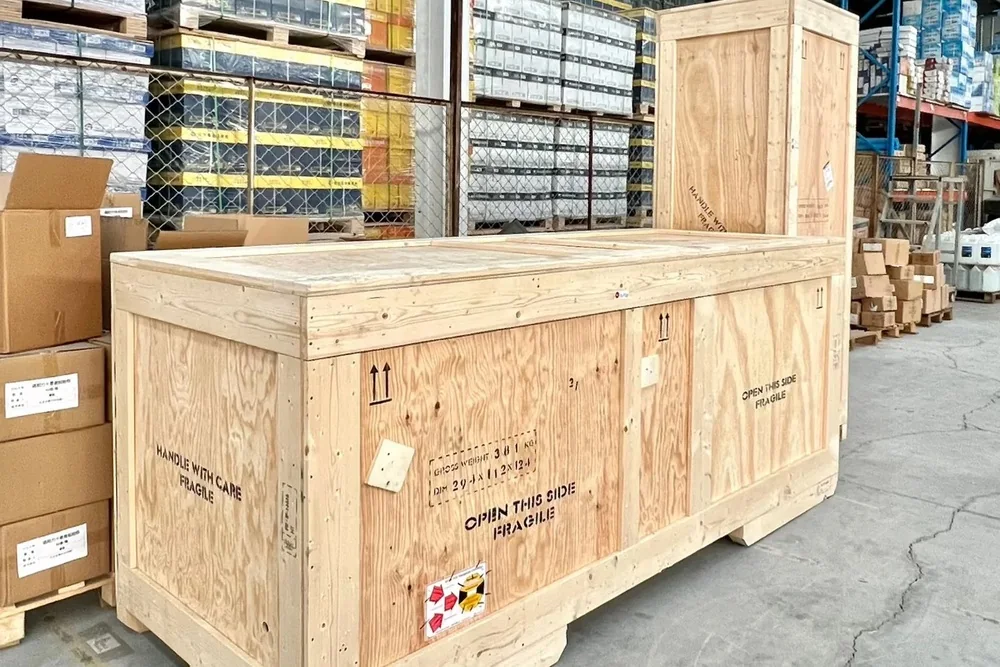
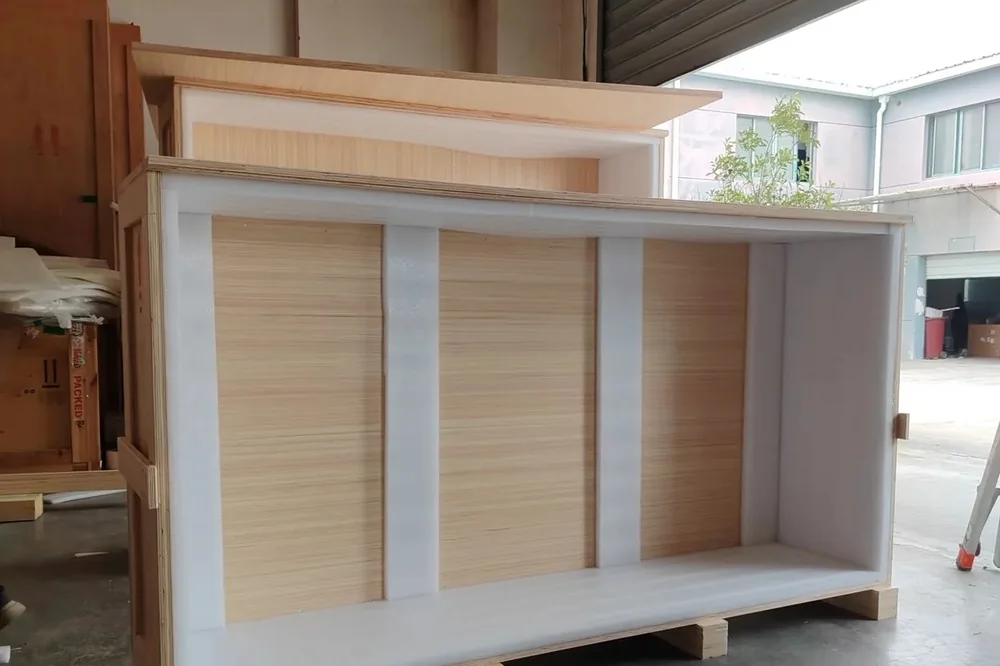
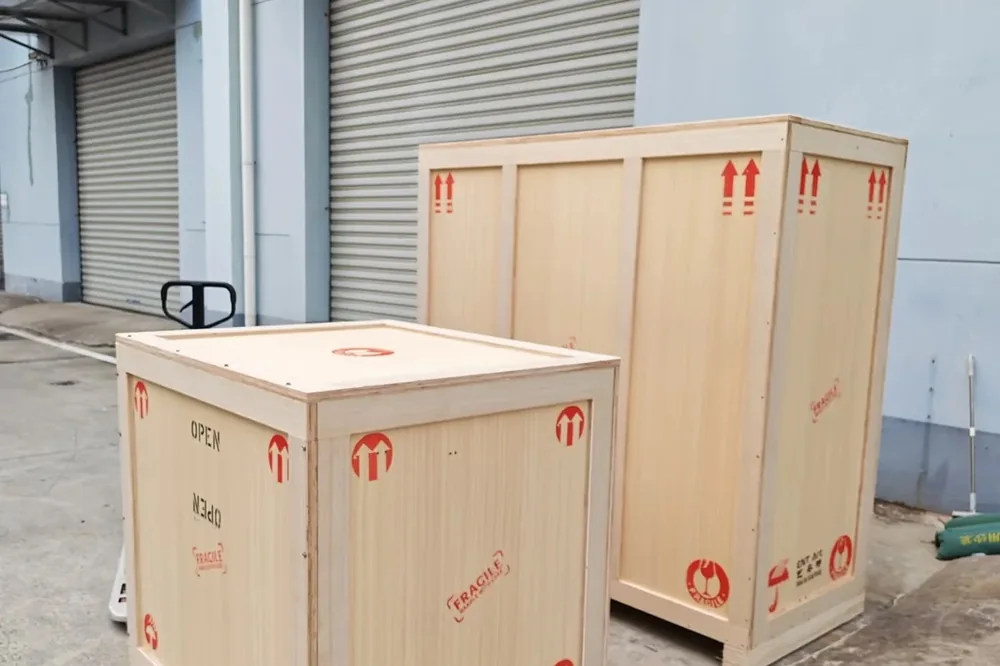
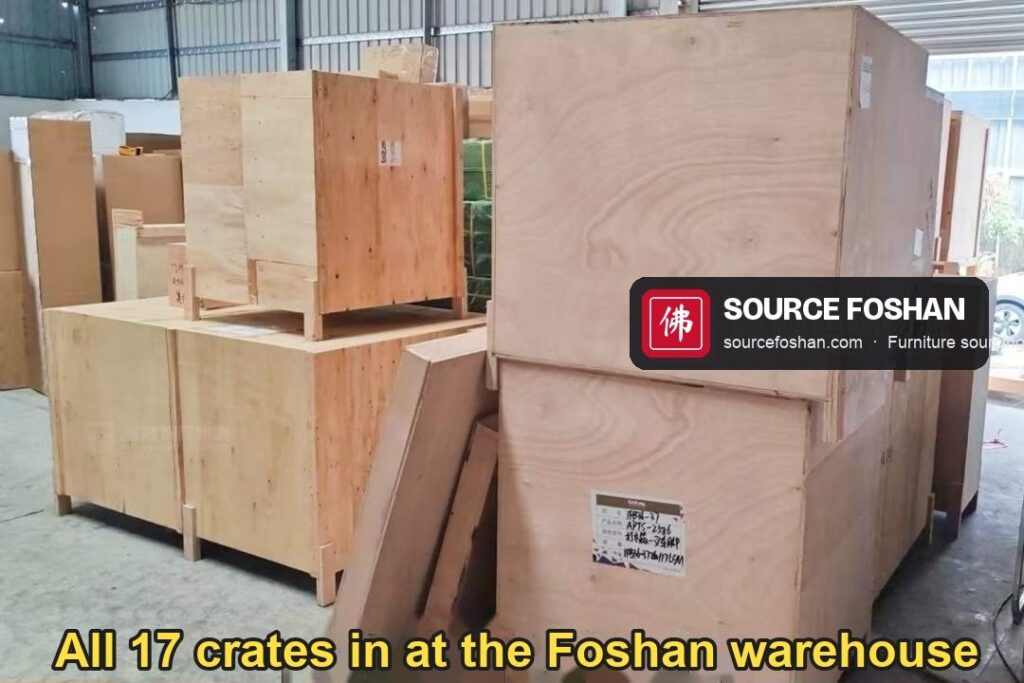
The same three steps stand behind every container we send to Australia. These are our own warehouse photographs, not stock images.
01 · The one decision
A full container or an LCL consignment?
The single decision that moves the cost of an Australian order is whether your volume justifies a box of its own. It is a volume question before it is a price question.
- Your packed volume passes about 15 m³: a 20 ft holds roughly 28–33 m³ of crated furniture in practice.
- The order includes stone tops, marble, glass or solid-timber slabs that should not be handled twice.
- You are furnishing a whole house: 45–70 m³ once sofas, mattresses and wardrobes are counted, which is a 40 ft high-cube.
- You want the container sealed in Foshan and opened at your address, with nobody else's cargo in it.
LCL territory
under 15 m³
One 20 ft container
30 m³ loaded
One 40 ft high-cube
68 m³ loaded
A three-seat sofa carton is 1.6–2.2 m³; four stacked dining chairs 0.6–0.9 m³; a knock-down wardrobe 0.5–0.8 m³. Send the list and we return the packed volume per line.
A 40 ft high-cube offers about 76 m³ and loads to 65–70 m³ once bracing and gaps are counted. Between 15 and 28 m³ the arithmetic is close; we quote both and show you the landed number for each.
02
What does it cost to ship furniture to Australia?
Every line that appears between the ex-works price and the furniture standing in the room. Ranges, not promises.
| Line | Indicative | Notes |
|---|---|---|
| Ocean freight, 20 ft | USD 2,160–2,640 | Shenzhen or Guangzhou to Melbourne or Port Botany |
| Ocean freight, 40 ft HC | USD 4,275–5,225 | The same sailing; about twice the volume for well under twice the price |
| LCL ocean freight | USD 30–45 per m³ | Before destination charges, which is where LCL quotes mislead |
| LCL destination charges | AUD 400–900 per consignment | Terminal handling, deconsolidation, customs entry — fixed, not per m³ |
| Export packing and consolidation | About USD 30 per m³ | Re-crating, bracing, labelling, packing list |
| Marine insurance | About 0.5% of insured value | On goods plus freight |
| Customs duty | 0% with ChAFTA Certificate of Origin | 5% without one, whatever the goods actually are |
| GST | 10% | On customs value plus duty plus freight and insurance |
| Biosecurity and fumigation | AUD 0–1,000 | Nil if the timber is correctly treated and marked; fumigation if it is not |
| Delivery, unload and assembly | Quoted per address | Stairs, lifts and kerb access change this more than distance does |
Indicative landed cost, Foshan to a Melbourne address, September 2026. Ocean freight moves monthly — confirm at booking.
03
How long does it take, week by week?
From the deposit to the last crate leaving your drive. The sea leg is the part nobody can compress.
- Week 0Orders placed and consolidated
Pieces from each factory are collected at one Foshan warehouse, checked against the specification and re-crated for sea.
- Week 6–10Inspection and loading
Every item photographed against the spec; the balance falls due after you approve the report. Timber is treated and IPPC-marked before the container is sealed.
- Week 10–14At sea
20–27 days Shenzhen or Guangzhou to Melbourne, Port Botany or Brisbane. Tracking shared weekly.
- Week 14–15Customs and biosecurity
Entry lodged, ChAFTA Certificate of Origin presented, GST paid. DAFF may call the container for a biosecurity inspection.
- Week 15–16Delivery and carry-in
Delivery booked to the address, crates opened, pieces carried in and assembled, packaging taken away the same day.
04
Duty, tax and clearance into Australia
Australia is straightforward on duty and strict on timber. The two things that hold Australian furniture shipments are a missing Certificate of Origin and untreated wood packaging.
Chinese-origin furniture enters free of duty under the China–Australia Free Trade Agreement, but only against a valid Certificate of Origin issued in China. Without it you pay the 5% general rate regardless of where the goods were made. We obtain the certificate with the shipment, not after it.
Charged on the customs value plus duty plus freight and insurance — not on the ex-works price. A GST-registered business claims it back on its next BAS; a private importer does not.
Solid wood packaging over 6 mm must be heat-treated or fumigated to ISPM 15 and carry the IPPC mark. Solid timber furniture can also be inspected. An untreated pallet is enough to have the whole container held, fumigated at your cost (AUD 300–1,000) and delayed by one to two weeks.
Commercial invoice, packing list with packed volume per line, bill of lading, ChAFTA Certificate of Origin, ISPM 15 treatment certificate, and the inspection report. One packing list covering every supplier, so a queried line can be settled at the desk.
05
Clearance is not delivery. What happens at the door.
A container at the kerb is not furniture in the house. What happens in the last hundred metres is scoped before the ship sails, because it cannot be fixed afterwards.
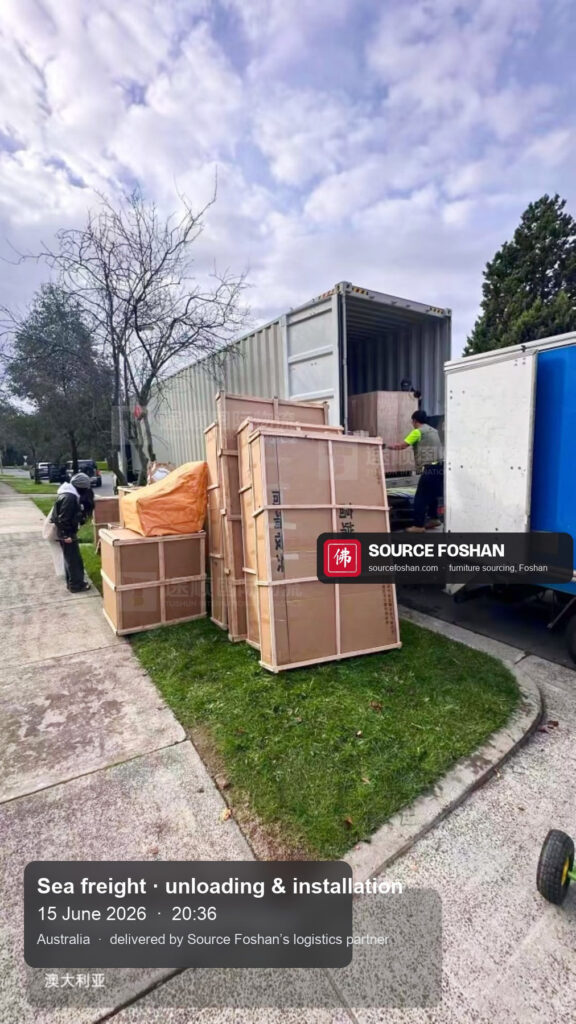
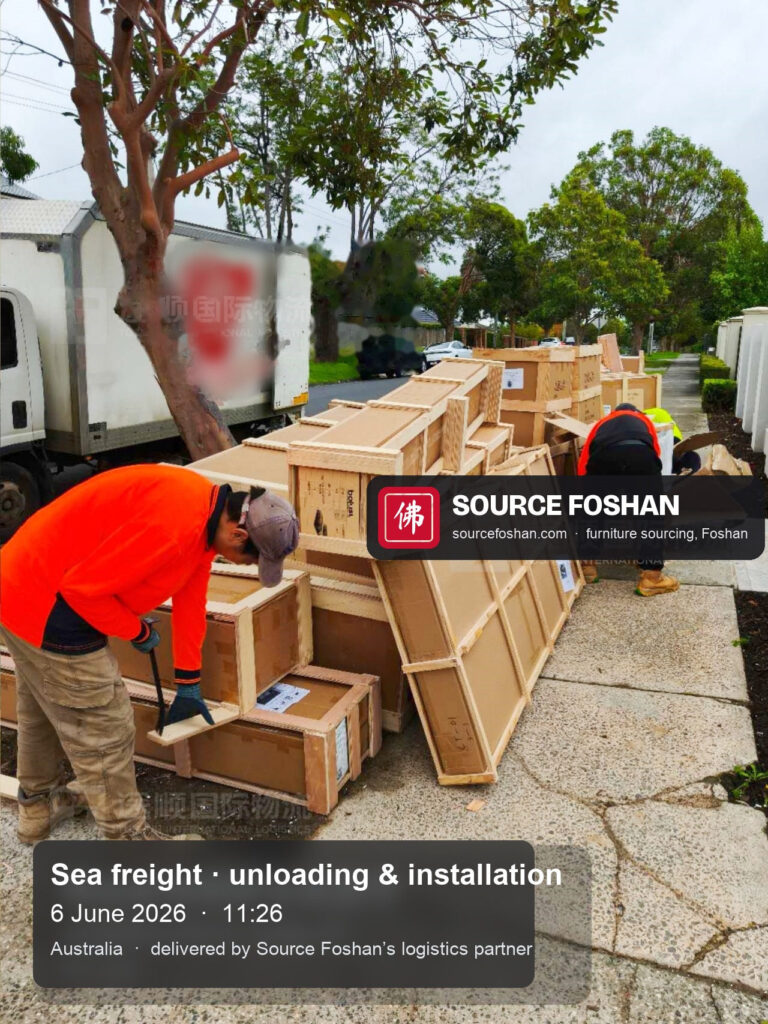
In much of Melbourne and Sydney it cannot. On our Melbourne delivery the container was worked in the street and the crates transferred to a box truck — planned in advance, not discovered on the day.
Two storeys with no lift means a larger crew and a slower day. It goes in the quotation before the order is placed.
Crates are opened outside, pieces carried in, beds and tables assembled and positioned by room against the packing list.
Timber, cardboard and wrap leave with the crew the same day. In Australia that matters: you cannot put a container's worth of crating in a kerbside bin.
FAQ
Shipping furniture to Australia, answered.
How long does furniture take from China to Australia?
Twenty to twenty-seven days port to port in a full container from Shenzhen or Guangzhou to Melbourne, Port Botany or Brisbane, and twenty-one to thirty-one days as an LCL consignment. Add two to four weeks of production and consolidation before the sailing, and one to two weeks for customs, biosecurity and a delivery booking at the other end. Door to door, a typical order runs fourteen to sixteen weeks from deposit.
Do I pay import duty on furniture from China to Australia?
Usually not. Chinese-origin furniture enters Australia at 0% duty under the China–Australia Free Trade Agreement, provided a valid Certificate of Origin travels with the shipment. Without that certificate the general rate of 5% applies. GST of 10% is charged separately on the customs value plus duty, freight and insurance, and is claimable by a GST-registered business.
What is ISPM 15 and why does it matter in Australia?
ISPM 15 is the international standard for treating solid wood packaging so it cannot carry pests. Any timber packing over 6 mm — crates, pallets, bracing — must be heat-treated or fumigated and stamped with the IPPC mark. Australian biosecurity is among the strictest in the world: one untreated pallet can have the container held, fumigated at your cost and delayed a week or two. All timber on our shipments is treated and marked before loading, and the certificate travels with the documents.
Is LCL or a full container cheaper to Australia?
Below about 15 m³, LCL. Above it, a 20 ft container is usually cheaper per cubic metre and always safer for stone and solid timber, because nothing is handled loose alongside another shipper's cargo. The trap in LCL quotes is that the per-cubic-metre ocean rate looks small while the fixed destination charges — terminal handling, deconsolidation and the customs entry — apply whether you ship 3 m³ or 12 m³.
Can you deliver into the house, not just to the kerb?
Yes, and we scope it before the ship sails. On our Melbourne delivery the container could not reach the house, so it was worked in the street and transferred to a box truck; on a two-storey job near Sydney a three-person crew carried slab pieces up the staircase. Carry-in, stairs, assembly and packaging removal are written into the quotation — a standard freight quote stops at the kerb.
Send your list and your Australia address
Quantities, rooms or a rough list are enough. You get compared factory options, the packed volume, the container call and a landed estimate within one business day.
Fields marked are required.
No spam, no obligation. Replies come from the sourcing team in Foshan, usually within one business day.
Sources & further reading
Where these figures come from.
- Sino Shipping — Freight from China to Australia — FCL and LCL rate ranges and port-to-port transit times, September 2026
- Australian Border Force — China–Australia Free Trade Agreement — ChAFTA preferential duty and Certificate of Origin requirements
- IPPC — ISPM 15, wood packaging material — The treatment and marking standard Australian biosecurity enforces on timber packaging
- Australian Taxation Office — GST — 10% GST on the value of a taxable importation
Ocean freight is a spot market and moves monthly; duty and tax rules change without notice. Treat every figure here as a starting point and confirm it at booking with your broker.