- Your packed volume is under about 15 m³ — the order we delivered into British Columbia was exactly this shape.
- You can accept the deconsolidation step at Vancouver on top of the 10–18 day sea leg.
- Nothing in the order is a stone top, a glass panel or a single heavy slab.
- You accept that terminal handling, deconsolidation and the customs entry are charged per consignment, not per cubic metre.
Destination guide · Canada
Shipping Furniture From China to Canada
Furniture shipped from Foshan reaches Vancouver or Prince Rupert in 10–18 days port to port, one of the fastest ocean legs from China anywhere; Montreal and Toronto via Panama run 25–35 days. Most furniture enters duty-free under Canada's MFN rates — wooden, metal, bamboo and rattan furniture under 9403 — but upholstered wooden seating under 9401.61 and 9401.69 can carry up to 9.5%. GST is 5% on the duty-paid value, with provincial tax on top in most provinces. Source Foshan, a sourcing agent based in Foshan, China, consolidates the order, inspects it and arranges carry-in — we have delivered into British Columbia.
Page reviewed by the Source Foshan sourcing team in Foshan · freight and duty figures are dated and sourced at the foot of the page.
At a glance
Five numbers to carry into the first conversation.
10–18 daysShenzhen to Vancouver or Prince Rupert — among the fastest lanes we run
USD 3,800–8,30040 ft into Vancouver, 2026 — the widest band of any of our routes
0–9.5%MFN duty: nil on most 9403 furniture, up to 9.5% on upholstered seating
5% GSTOn the duty-paid value; provincial sales tax applies separately
15 m³Where a 20 ft container starts to beat an LCL consignment
Before it sails
What leaves Foshan, whatever the destination.
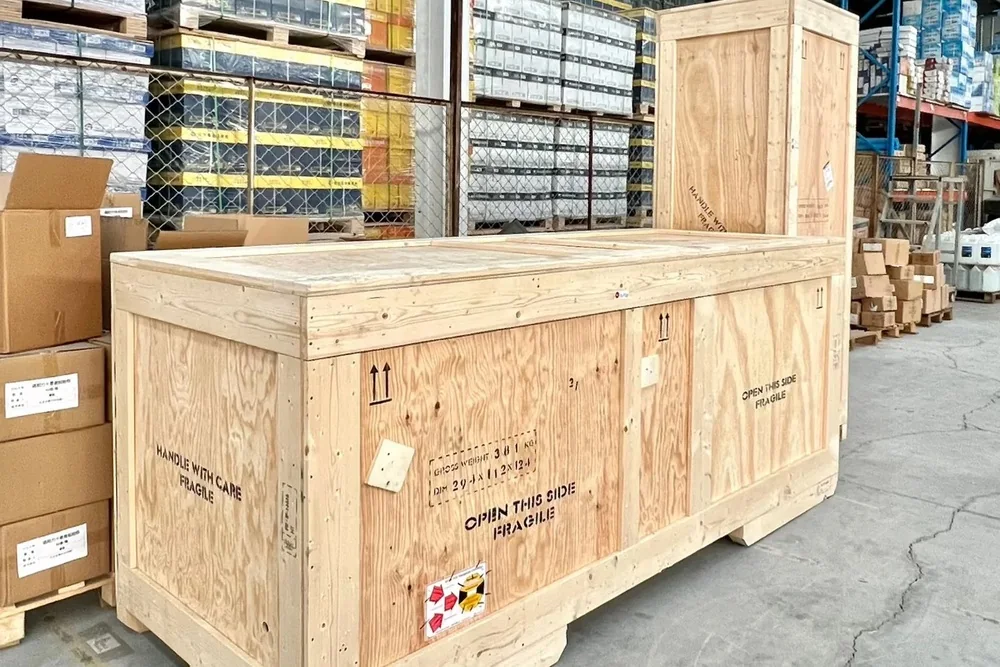
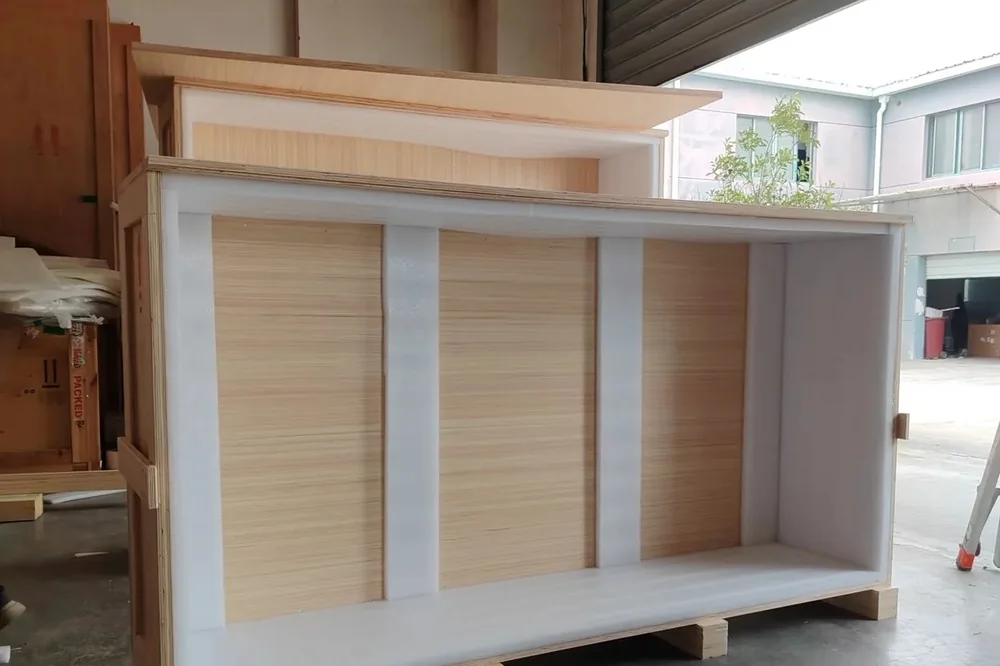
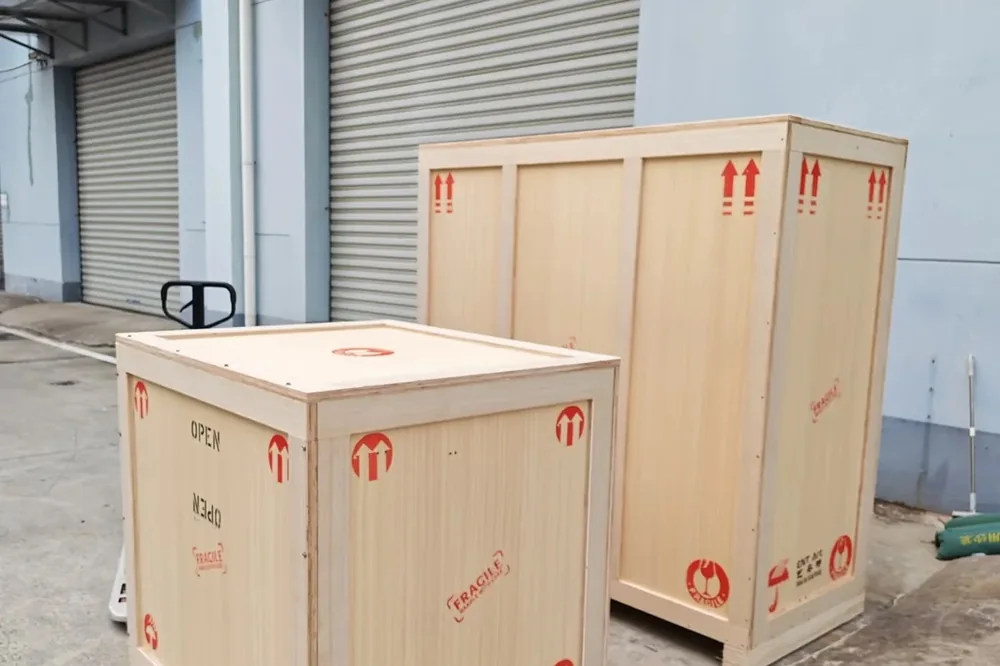
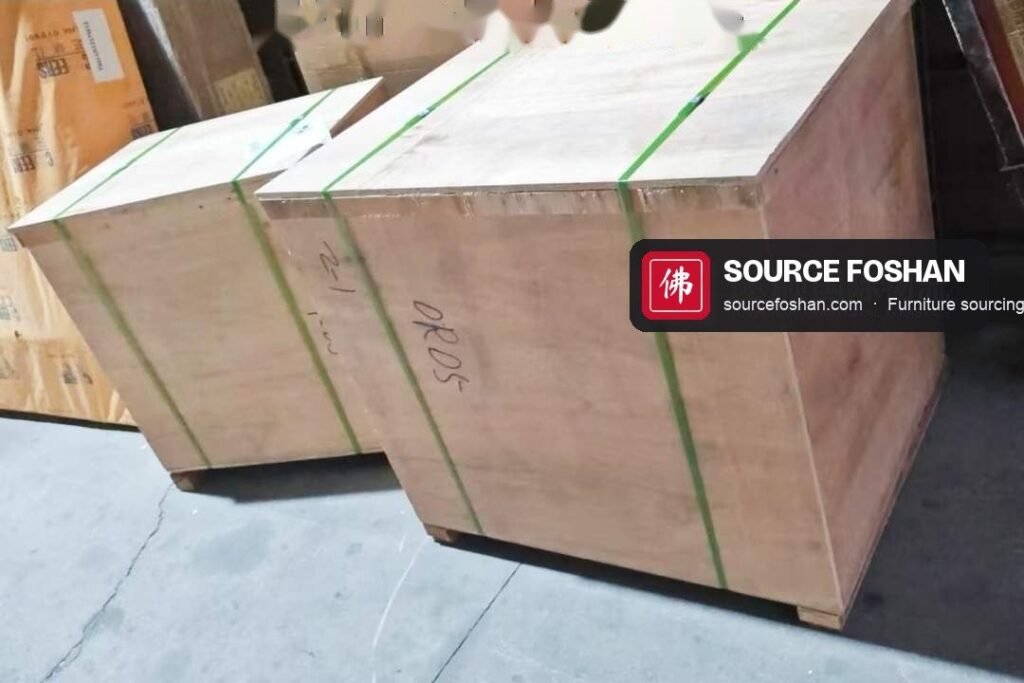
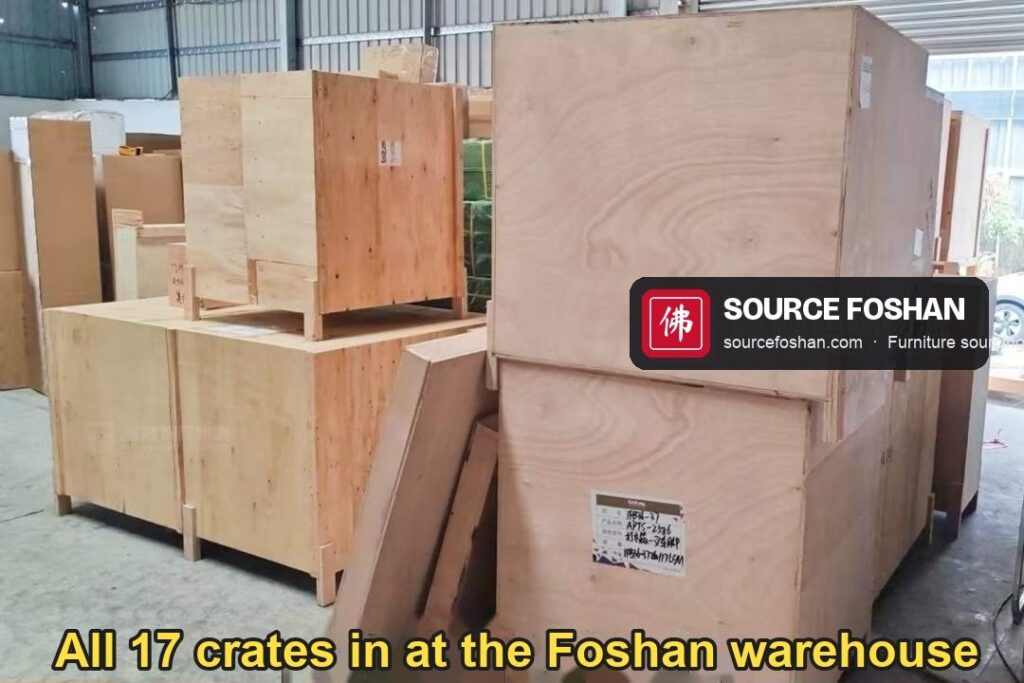
The same three steps stand behind every container we send to Canada. These are our own warehouse photographs, not stock images.
01 · The one decision
A full container or an LCL consignment?
Canada splits in two. West-coast addresses get one of the shortest sea legs from China; eastern addresses either add a Panama transit or a rail leg from the Pacific. That choice matters more than LCL against FCL.
- Your packed volume passes about 15 m³; a 20 ft loads 28–33 m³ of crated furniture.
- You are furnishing a whole house: 45–70 m³, which is a 40 ft high-cube.
- The address is in central or eastern Canada and you want the box railed intact from Prince Rupert rather than handled twice.
- The order includes marble, sintered stone or solid-timber slabs that should be handled once.
LCL territory
under 15 m³
One 20 ft container
30 m³ loaded
One 40 ft high-cube
68 m³ loaded
A three-seat sofa carton is 1.6–2.2 m³; four stacked dining chairs 0.6–0.9 m³; a knock-down wardrobe 0.5–0.8 m³. Send the list and we return the packed volume per line.
Prince Rupert's Fairview terminal has direct rail to Chicago and eastern Canada and is often the faster gateway for Toronto or Montreal than a Panama routing. Vancouver's Deltaport and Vanterm carry the most volume for the west.
02
What does it cost to ship furniture to Canada?
Every line that appears between the ex-works price and the furniture standing in the room. Ranges, not promises.
- Goods, ex-works Foshan USD 32,000
- Export packing and consolidationAbout USD 30 per m³ USD 1,950
- Ocean freight, 40 ft HCMid-point of the September 2026 band USD 6,050
- Marine insuranceAbout 0.5% of goods plus freight USD 190
- Customs dutyModelled at a 5% blend: nil on casegoods, up to 9.5% on upholstered seating USD 1,600
- GST (5%)On the value for duty plus duty; provincial tax handled on your return USD 1,983
- Delivery, unload and assemblyIndicative; access decides it USD 1,500
One basket, priced into all eleven destinations, so the bars are comparable. The duty and tax block is what actually changes — as a share of the goods value, Canada at 11.2%, against 9.2% into Singapore and 50.0% into the United States.
| Line | Indicative | Notes |
|---|---|---|
| Ocean freight, 20 ft | USD 2,500–4,500 | Shenzhen to Vancouver or Prince Rupert |
| Ocean freight, 40 ft HC | USD 3,800–8,300 | The widest spread of any of our lanes; the spot market moves hard here |
| LCL ocean freight | USD 45–90 per m³ | Before destination charges, which is where LCL quotes mislead |
| LCL destination charges | CAD 450–900 per consignment | Terminal handling, deconsolidation and the customs entry — fixed, not per m³ |
| Export packing and consolidation | About USD 30 per m³ | Re-crating, bracing, labelling, packing list |
| Marine insurance | About 0.5% of insured value | On goods plus freight |
| Customs duty | 0% on most 9403 furniture | Up to 9.5% on upholstered wooden seating under 9401.61 and 9401.69. No FTA with China |
| GST | 5% | On the value for duty plus duty; recoverable by a GST-registered business |
| Provincial sales tax | 0–10% by province | PST or the provincial portion of HST; handled on your return, not usually at the border |
| Inland rail, eastern Canada | CAD 1,500–3,500 per container | Prince Rupert or Vancouver to Toronto or Montreal |
| Delivery, unload and assembly | Quoted per address | Winter access and rural approaches change this more than distance |
Indicative landed cost, Foshan to a Canadian address, 2026. The 40 ft band is unusually wide on this lane — confirm at booking.
03 · Use this on us too
The fourteen lines a door-to-door quotation has to show.
Nearly every bad shipping story on this route starts with a quotation that was shorter than this list. Paste it into your next enquiry and ask for a price against each line. A forwarder who will not break the price out is quoting you a number, not a service.
- Inland move, factory to warehousePer supplier, or stated as waived. Buyers are caught by this line more than any other.
- Warehouse receipt and check-inCounted against the packing list, photographed, with the free storage days and the daily rate afterwards.
- Re-packing and cratingWhich items get closed crates, which get open frames, which stay in cartons — and the price for each.
- Timber treatment and the IPPC markTreatment, marking and the certificate, priced separately from the crate.
- Measured packed volume, line by lineThe m³ you are billed for, with the measurements it came from.
- Export declaration and certificate of originIncluding who files it and what it costs if the certificate is issued late.
- Ocean freight, with the surcharges namedBase rate plus each surcharge spelled out, and how long the rate is held.
- Marine insuranceThe premium, the deductible, and what the fragile-goods exclusion actually excludes.
- Destination terminal and deconsolidationTerminal handling, deconsolidation, and the free days before storage starts.
- Customs entryWho is importer of record, what value is declared, and whether duty and tax are inside the price or outside it.
- DeliveryVehicle size, kerbside or room of choice, stairs and lifts, waiting time, and the radius the price covers.
- Assembly and packaging removalBoth, or neither, but in writing. A container leaves roughly a tonne of crate and carton behind.
- GST and provincial taxWhich apply at the delivery province, and who remits them.
- Residential surcharge and liftgateConfirmed together with the delivery date.
Send us the same list. We answer it line by line, in writing, before you pay anything.
04
How long does it take, week by week?
From the deposit to the last crate leaving your drive. The sea leg is the part nobody can compress.
- Foshan Consolidation warehouse, all suppliers
- Yantian / Nansha Load port, Shenzhen or Guangzhou day 0
- Pacific crossing Direct, no transhipment on most strings day 4
- Vancouver / Prince Rupert Arrival, CBSA entry day 14
- Toronto / Montreal By rail from the Pacific, or via Panama day 24
Prince Rupert is the closest North American port to Asia and has direct rail east, which for a Toronto or Montreal address often beats a Panama routing on landed time even though the ocean leg ends further from the door.
- Week 0Collected and coded
Pieces from each factory collected at one Foshan warehouse and re-crated. Headings are separated on the packing list, because seating and casegoods attract very different duty in Canada.
- Week 6–10Inspection and loading
Every item photographed against the spec; the balance falls due after you approve the report. Timber treated to ISPM 15 before the container is sealed.
- Week 10–12At sea
10–18 days to Vancouver or Prince Rupert; 25–35 days to Montreal via Panama. Tracking shared weekly.
- Week 12–13CBSA clearance
Entry lodged by your broker, duty by heading and 5% GST settled. Chinese-origin wood goods can draw a CFIA look at the packaging.
- Week 13–16Rail and delivery
Intact rail to an eastern address if that is the routing, then delivery, uncrating, assembly and packaging removal.
05
Duty, tax and clearance into Canada
Canada has no trade agreement with China, so the tariff heading does real work here — and the line that catches buyers is upholstered seating.
Wooden furniture under 9403.30–.60, metal under 9403.20 and bamboo or rattan under 9403.83 generally enter free under Canada's MFN rates. Upholstered wooden seating under 9401.61 and 9401.69 can carry up to 9.5%. A sofa and a sideboard on the same packing list can therefore attract very different duty.
GST is 5% of the value for duty plus any duty. Provincial sales tax or the provincial portion of HST is generally accounted for on your own return rather than collected at the border. A GST-registered business recovers the 5%.
CUSMA covers North American origin, not Chinese. There is no preferential rate to claim and no certificate of origin that will produce one — which is the opposite of the Australian and New Zealand position and worth knowing before you budget.
You need an import-export Business Number with CBSA and a customs broker to lodge the entry. We supply the codes, packed volume per line and documents early enough to be checked, and the ISPM 15 certificate travels with the shipment.
06
Clearance is not delivery. What happens at the door.
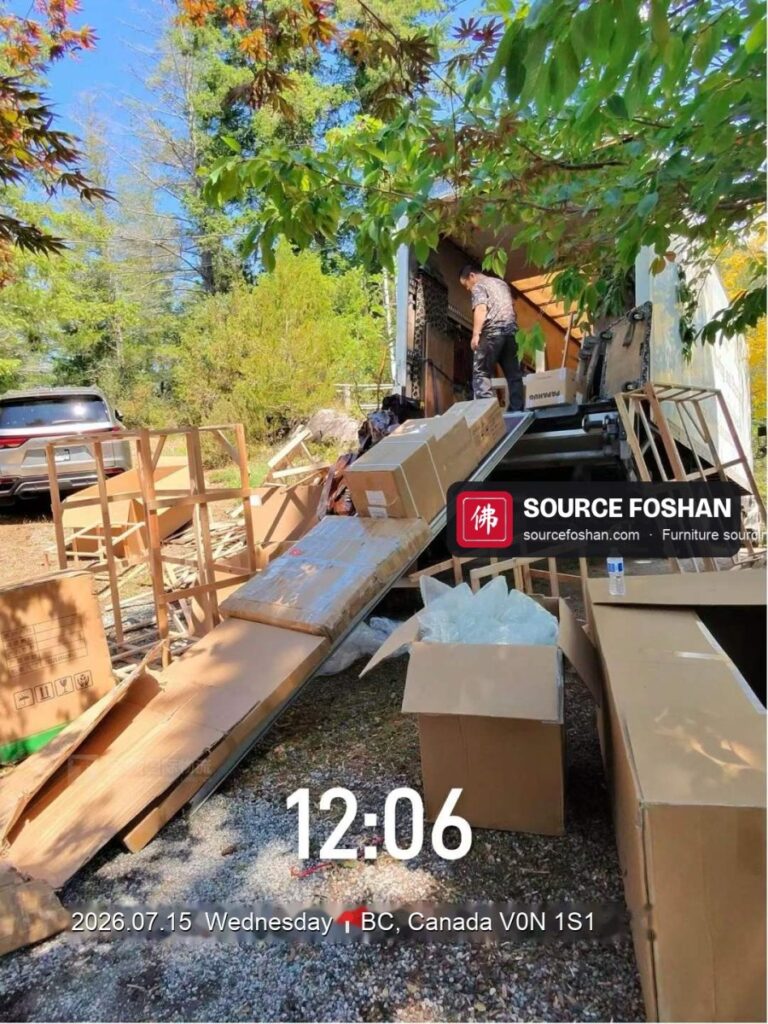
We have run this delivery. On our British Columbia job the truck unloaded at the house, the crates were opened outside and everything was assembled and cleared in one visit.
A Vancouver or Victoria address is a short run from the port. Toronto, Montreal and the prairies add a rail leg that is quoted with the rest of the job rather than discovered after arrival.
Snow, ice and frozen ground affect vehicle choice and crew size between November and March. It goes in the quotation.
Crates are opened outside, pieces carried in, beds and tables assembled and positioned by room against the packing list.
Timber, cardboard and wrap leave with the crew the same day rather than filling the driveway.
07 · What arrival looks like
Photographs from the research file.
Other people’s shipments, not ours. In September 2026 we read 20 first-hand Chinese-language shipping notes and their comment threads from buyers who moved furniture from China to Canada, and cleared their photographs for publication. They show what the process actually looks like at the kerb and in the room. Our own delivery photographs are further down, under case notes.
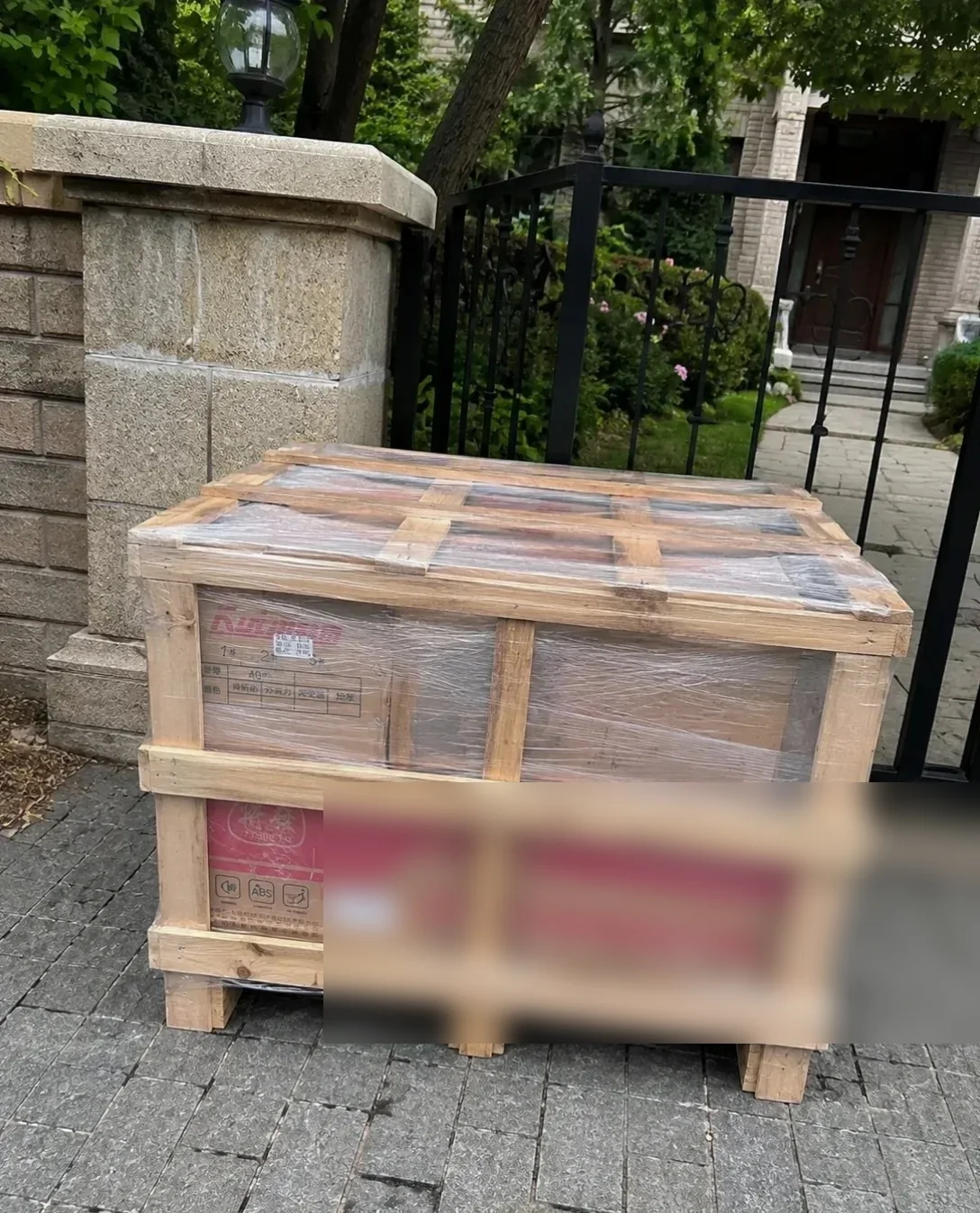
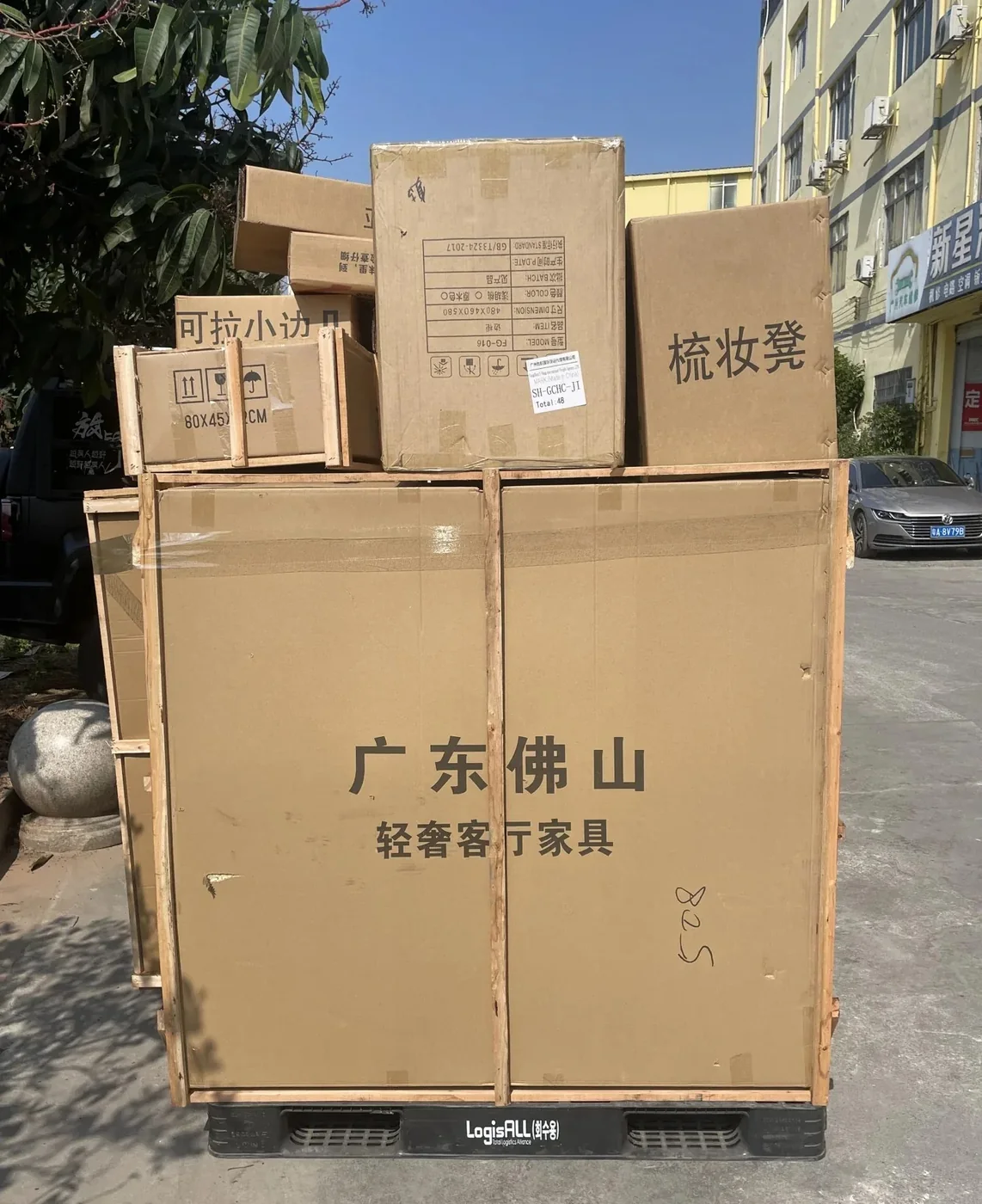
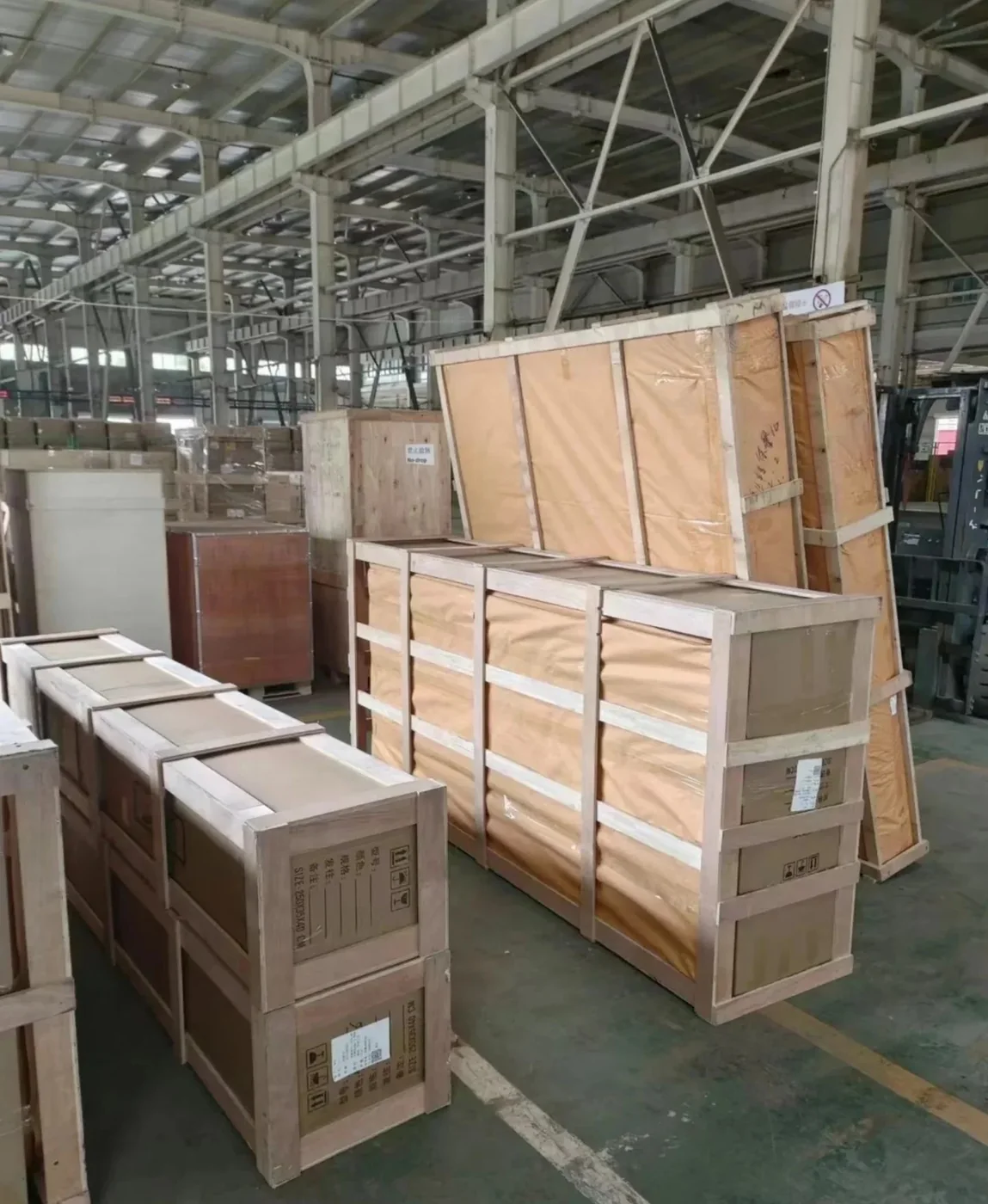
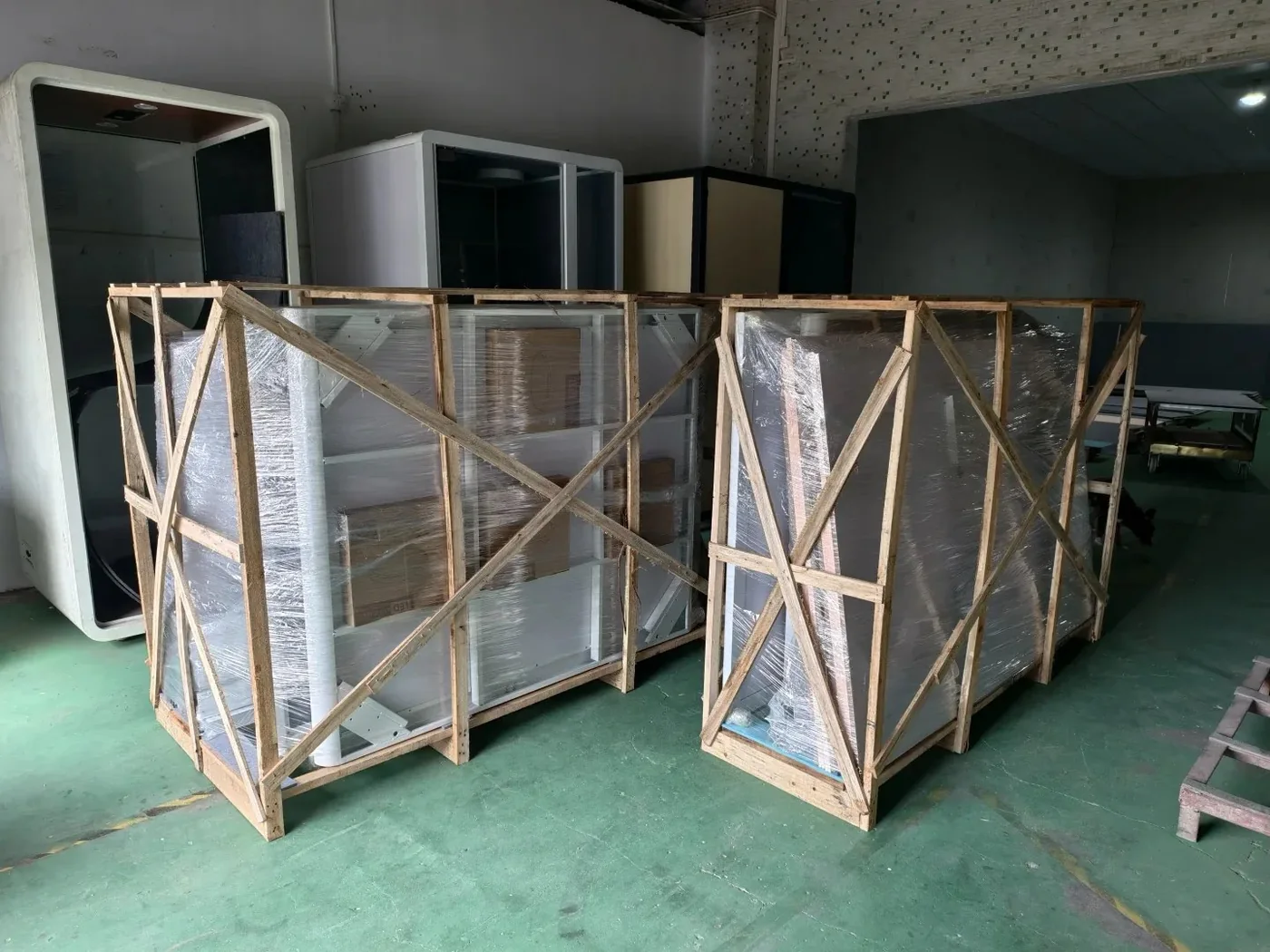
Published with the rights holder’s permission. Faces, house numbers, vehicle plates and third-party company marks have been cropped or redacted; nothing else in these frames has been altered.
08 · Field notes
What goes wrong, in the words of people who have already done it
Compiled in September 2026 from 20 first-hand Chinese-language shipping notes on the China–Canada route and their comment threads, cross-read against our own files. Poster experience, forwarder marketing and our practice are kept apart: the left column is what buyers reported happening, the right column is what we do about it. Every rate, duty and border rule stays with the authorities listed at the foot of this page.
-
The trap
“A few hundred per m³” that doubles by the time it is a real quotation.
What we doItemised, including delivery, unpacking and debris. The cheap headline rate is almost always port-to-port dressed as door-to-door.
-
The trap
Over-crating that inflates the volume you pay for.
What we doCrate stone, glass and fragile pieces; frame or carton the rest. On a 40 ft box the difference is a whole cost band.
-
The trap
Chinese trucking booked into the New Year peak.
What we doMove the inland leg before the holiday. Domestic trucking rates can double in the weeks before Chinese New Year.
-
The trap
Residential delivery without a liftgate.
What we doConfirm the residential surcharge and the liftgate at booking. A crate on a 53 ft trailer and no tail lift is a wasted delivery day.
-
The trap
An inspection with no contingency behind it.
What we doBudget for exam, storage and container rent. A CBSA examination is a normal outcome, not a disaster, unless nothing was set aside for it.
-
The trap
A bed and its mattress arriving on different days.
What we doAsk for one consignment and one delivery date, in writing.
09 · The honest version
When a Canadian import is not worth it
Canada has no trade agreement with China, so the heading does real work — and one line catches most buyers.
- An order that is mostly upholstered seating. Up to 9.5% duty on 9401.61 and 9401.69 against nil on most casegoods changes the arithmetic. A sofa-heavy list is the one to check line by line before committing.
- Small orders to eastern Canada. An LCL consignment to Toronto or Montreal is deconsolidated at the coast and re-handled, then railed. Below about 15 m³ the inland leg can cost more than the sea leg.
- A fixed date between November and March. Winter access, frozen ground and weather delays on the prairie rail corridors are real. We build slack in rather than promise a day.
- Commodity flat-pack. Canadian retailers land this at volumes you will not reach; the duty-free position does not change that.
Where Canada works is whole-home and custom orders at container volume, especially to British Columbia — we have run that delivery.
FAQ
Shipping furniture to Canada, answered.
How much is import duty on furniture from China to Canada?
It depends on the heading, because Canada has no free trade agreement with China. Most furniture under heading 9403 — wooden, metal, bamboo and rattan — enters free under the MFN rate. Upholstered wooden seating under 9401.61 and 9401.69 can carry up to 9.5%. GST of 5% is charged separately on the value for duty plus duty, and provincial sales tax is generally handled on your own return rather than at the border.
How long does furniture take from China to Canada?
Ten to eighteen days port to port from Shenzhen to Vancouver or Prince Rupert, which is among the fastest ocean legs from China to anywhere. Montreal and Toronto via the Panama Canal run twenty-five to thirty-five days, or you can rail an intact container east from the Pacific. Add two to four weeks of production and consolidation before the sailing and one to two weeks for clearance and delivery.
Vancouver or Prince Rupert?
Vancouver's Deltaport and Vanterm handle the largest share of trans-Pacific volume and suit British Columbia addresses. Prince Rupert's Fairview terminal has direct rail to Chicago and eastern Canada and is often the faster gateway for a Toronto or Montreal address than routing through Panama. We compare the two on landed time, not just ocean rate.
Have you delivered to Canada before?
Yes. In July 2026 we shipped a mixed order to British Columbia as a part-container consignment: re-crated in Foshan, loaded 5 June, sailed 9 June, and on 15 July the truck unloaded at the house, the crates were opened outside and everything was assembled and the packaging cleared in a single visit. The full case note with photographs and time stamps is linked on this page.
Should I ship LCL or a full container to Canada?
Below about 15 m³, LCL — which is what our British Columbia order was. Above it a 20 ft container is usually cheaper per cubic metre and safer for stone and solid timber. If the address is in central or eastern Canada there is a second argument for the container: an intact box can be railed from the Pacific, while an LCL consignment is deconsolidated at the coast and re-handled.
Is delivery to the door with duty included the right choice?
Not always — it is the most expensive of three options, and for some volumes the cheapest is collecting from a local warehouse yourself. Door delivery with duty inside the price buys convenience and hides the tax position; a formal entry with delivery quoted separately shows you both. We price both and let you choose, and we confirm the residential surcharge and the liftgate either way.
What happens if CBSA examines the container?
It is examined, and you pay the exam fee, the storage and the container rent while it happens. This is a normal outcome rather than a disaster, but it is only survivable if a contingency was set aside for it. We budget for it explicitly on Canadian quotations. CBSA sets the fees and the timelines.
Should I ship before or after Chinese New Year?
Before, if the dates allow. Domestic Chinese trucking to the port can double in the weeks before the holiday, factories close, and the backlog afterwards pushes sailings out. Canadian buyers report the inland leg alone moving by four figures on holiday timing. If the order is close to the holiday we will say so and quote both scenarios.
Send your list and your Canada address
Quantities, rooms or a rough list are enough. You get compared factory options, the packed volume, the container call and a landed estimate within one business day.
Fields marked are required.
No spam, no obligation. Replies come from the sourcing team in Foshan, usually within one business day.
Sources & further reading
Where these figures come from.
- Canada Border Services Agency — Customs Tariff — MFN duty rates by tariff heading
- Canada Revenue Agency — GST/HST on imports — 5% GST on the value for duty plus duty
- UpFreights — shipping China to Canada, 2026 — Container rate ranges and Pacific and Panama transit times
Ocean freight is a spot market and moves monthly; duty and tax rules change without notice. Treat every figure here as a starting point and confirm it at booking with your broker.