Data · Shipping & consolidation
How much furniture can fit in a 20 foot or 40 foot container?
A 20ft container holds about 33 m³ inside but only 22–26 m³ of household furniture; a 40ft high-cube holds 76 m³ and 58–62 m³. How to estimate your load.
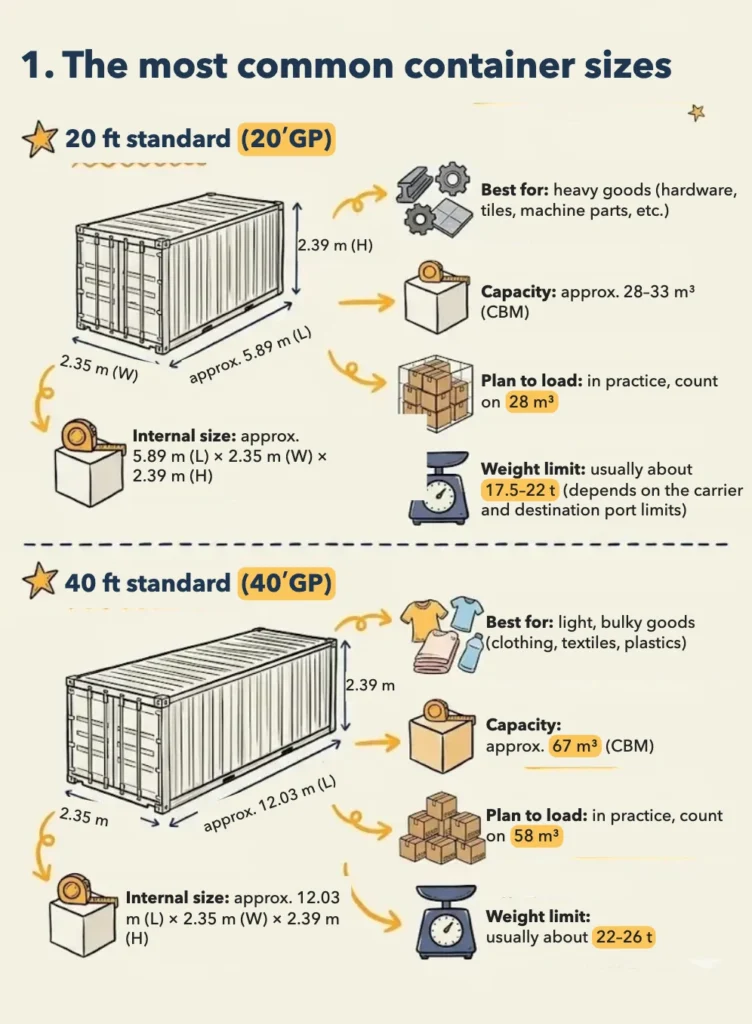
- Standard internal volumes are about 33 m³ (20ft), 67 m³ (40ft) and 76 m³ (40ft high-cube). Nobody loads furniture to those figures.
- Freight agents on Xiaohongshu plan on about 28, 56–58 and 68 m³ of ordinary cartons for the same three boxes.
- A moving company that ships household furniture works on 22–26 m³ for a 20ft, 52–55 m³ for a 40ft and 58–62 m³ for a high-cube.
- One freight agent notes that a 40ft high-cube usually costs the same as a standard 40ft for light cargo, which makes it the default choice for furniture.
A 20ft container has about 33 m³ of internal space, but freight agents plan on about 28 m³ of regular cartons and moving companies on 22–26 m³ of household furniture — roughly a three-bedroom home. A 40ft container (about 67 m³) takes around 52–58 m³ of furniture, and a 40ft high-cube (about 76 m³) around 58–68 m³. Measure your packed cartons, not the furniture, and leave a margin for crates and awkward shapes.
How much furniture can fit in a 20 foot container?
Plan on 22–26 m³ of packed household furniture in a 20ft container, even though its internal volume is about 33 m³. The inside of a standard 20ft box measures about 5.9 m long, 2.35 m wide and 2.39 m high. Freight agents who post teaching notes on Xiaohongshu say to plan on about 28 m³ of regular cartons. A moving company that ships furniture for households abroad goes lower still: 22–26 m³, which it describes as enough for the furniture of a three-bedroom, one-living-room flat.
The gap is not waste: nothing heavy can sit on a sofa, stone and glass travel on edge in crates, and chairs and lamps leave voids no packer can fill. One freight agent puts the usable share at 90–95% for regular packages; mixed furniture does worse.
How much furniture can fit in a 40 foot container — and is a high-cube worth it?
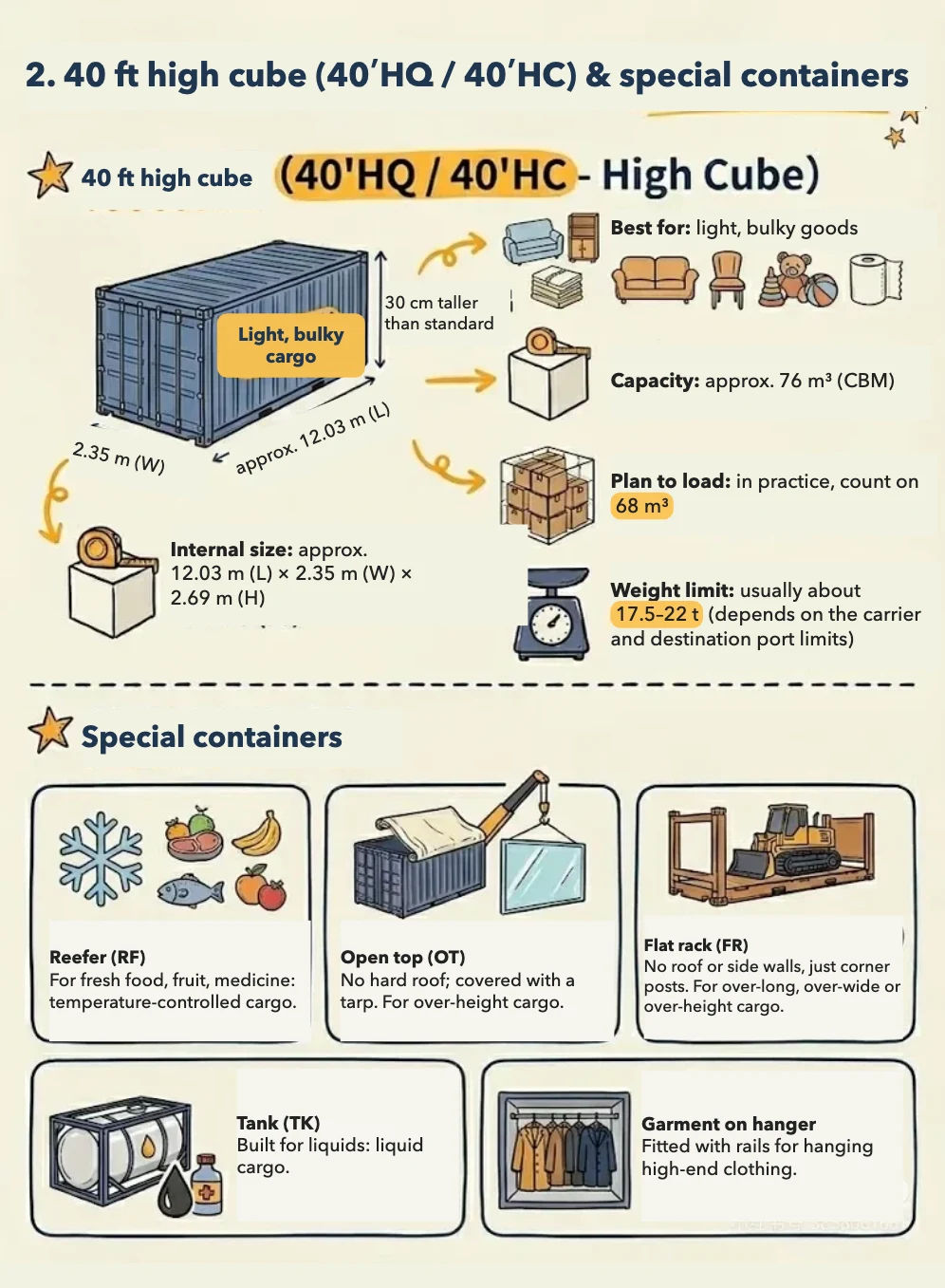
A standard 40ft takes roughly 52–58 m³ of furniture and a 40ft high-cube roughly 58–68 m³; for furniture the high-cube is almost always the better buy. The difference is height: about 2.39 m in a standard 40ft and 2.69 m in a high-cube, which adds roughly 9 m³. That extra 30 cm is exactly what a tall wardrobe carcass, a headboard on end or a second tier of dining chairs needs.
A Guangdong freight agent’s note, saved more than 500 times, makes the commercial point: for light, bulky goods a 40ft high-cube and a standard 40ft are usually priced the same, so the choice should follow volume. Its short verdict is that the high-cube is “the king of value” for light cargo.
Buyers ask how much fits in a container; the more useful question is what should sit where. A container is loaded by a plan — heavy crates low, upholstery on top of nothing, fragile pieces braced — and a plan needs every carton measured before the first one arrives at the warehouse. If your suppliers cannot give you packed dimensions, you cannot yet price your freight.
What are the 20ft, 40ft and high-cube container sizes for furniture?
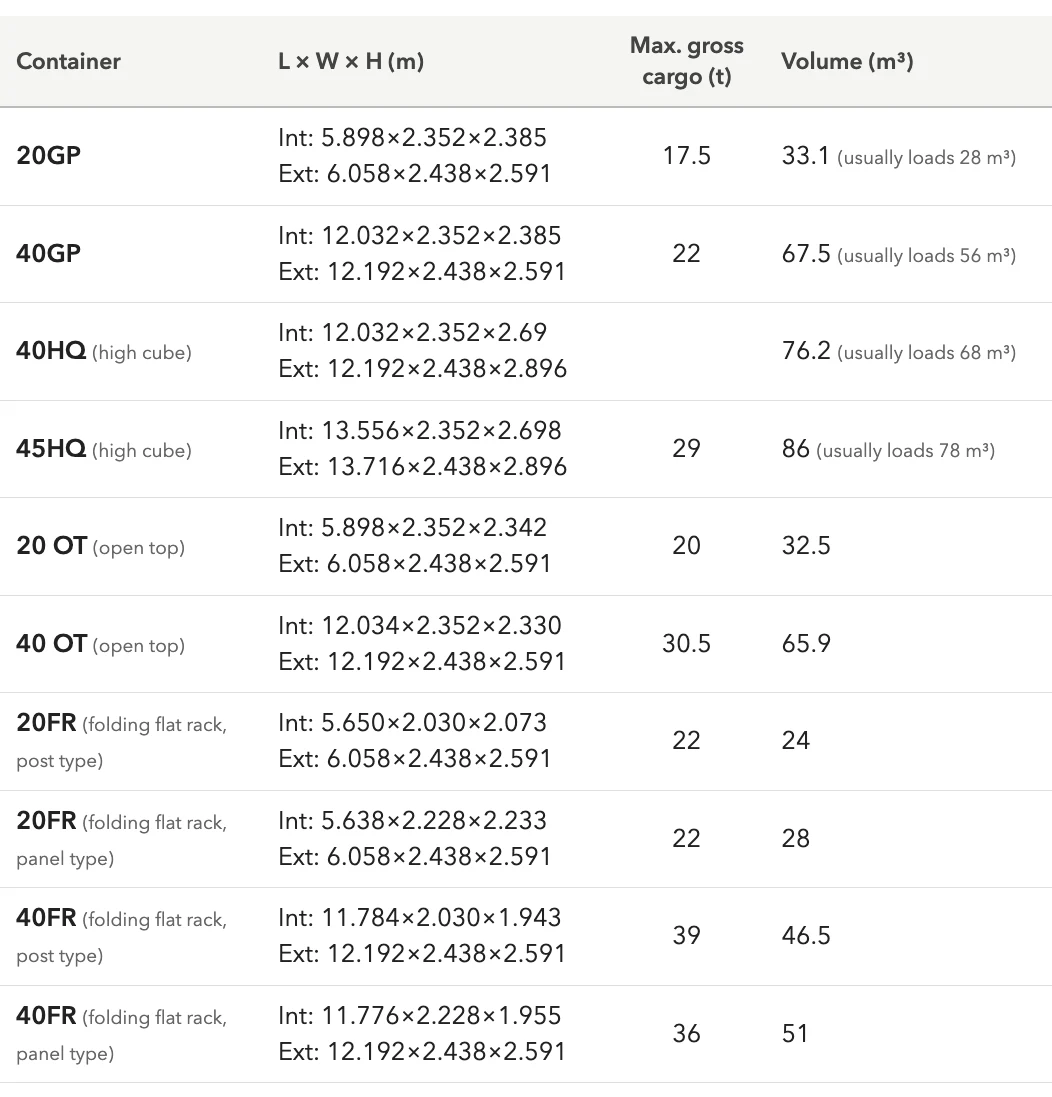
Use the right-hand column for planning; the internal volume is a ceiling you will not reach. Figures below are approximate and vary slightly between container owners.
| Container | Internal size (L × W × H) | Internal volume | Freight agents’ planning load | Movers’ household-furniture load |
|---|---|---|---|---|
| 20ft standard (20GP) | 5.9 × 2.35 × 2.39 m | about 33 m³ | about 28 m³ | 22–26 m³ |
| 40ft standard (40GP) | 12.0 × 2.35 × 2.39 m | about 67 m³ | about 56–58 m³ | 52–55 m³ |
| 40ft high-cube (40HQ) | 12.0 × 2.35 × 2.69 m | about 76 m³ | about 68 m³ | 58–62 m³ |
The movers’ figures suit a mixed home; flat-packed cabinetry, which stacks, can come closer to the freight agents’ numbers.
What does the comment section add?
The comments under the most-saved container note are short, but they flag the numbers that trip people up.
- Heavy-container surcharges. A reader asked about loading 20.8 tonnes gross in a 20ft; the author replied that it depends on the carrier, but around 20 tonnes usually triggers a surcharge.
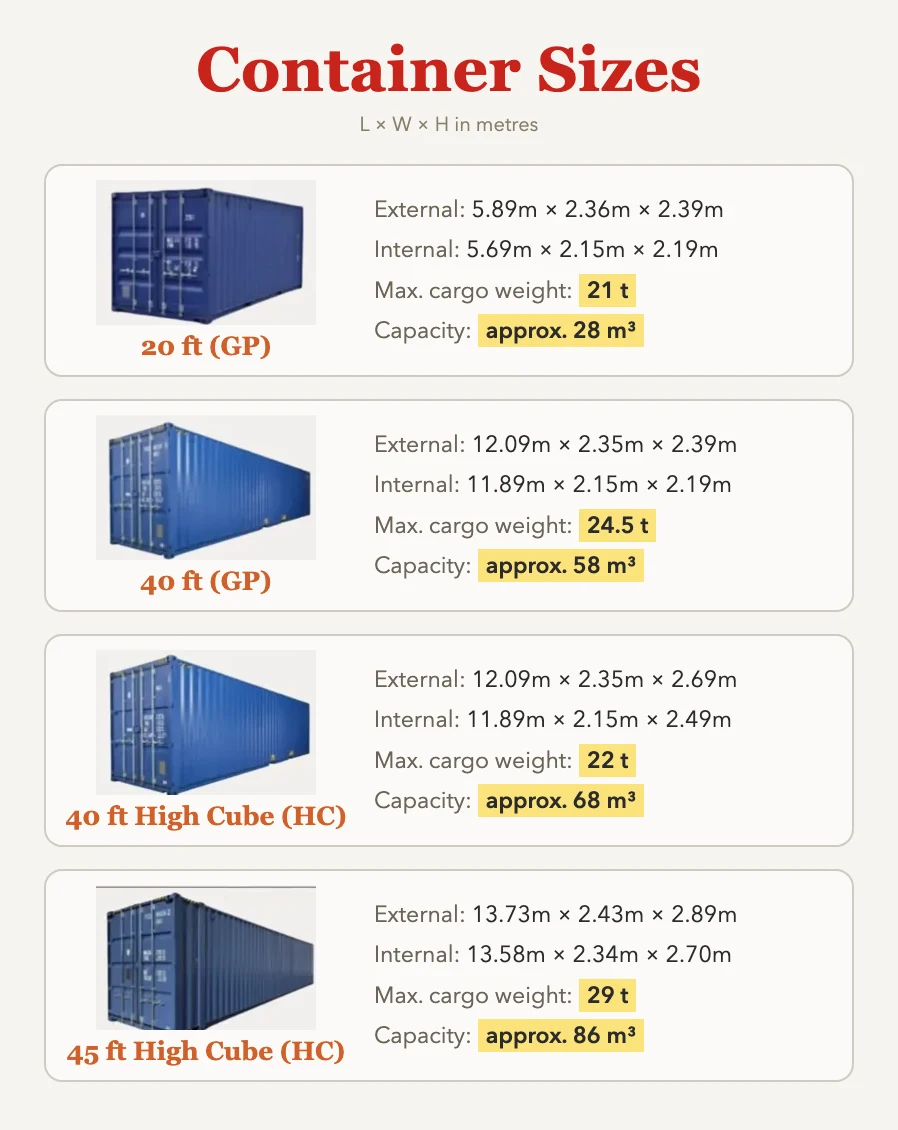
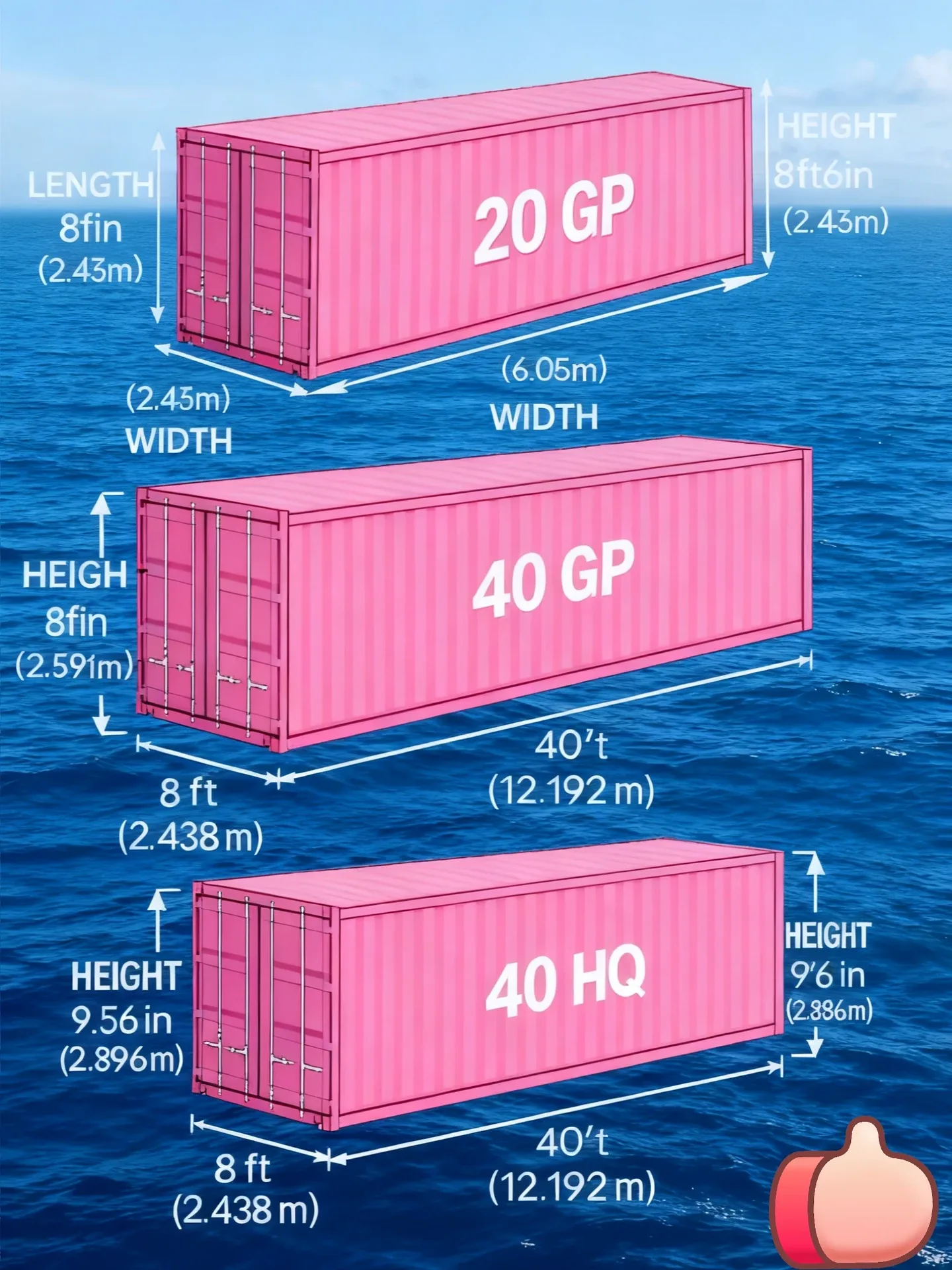
- The figures disagree. Another reader pointed out that the note’s first and second images give different capacities for the same containers — a useful reminder that all such figures are rules of thumb.
- LCL or a small full container? A reader asked which is cheaper for a part-load; the thread left it unanswered, because it depends on the route.
How do you estimate the volume of your furniture?
Add up the packed carton sizes from each supplier, then compare the total with the movers’ figures above. The product dimensions on a quote are not the shipping dimensions. A three-seat sofa in export packing can gain several centimetres on every side, and a crate for a stone dining table adds more. Ask every factory for the packed length, width, height and gross weight of each carton, and multiply length × width × height in metres for each.
- Under about 12 m³: ship in a shared container — see LCL vs FCL for furniture — after combining suppliers in a Foshan consolidation warehouse.
- About 12–26 m³: get quotes for both LCL and a 20ft; the answer depends on the route.
- Above about 26 m³: price a 40ft high-cube, which may cost little more than a 20ft on some lanes.
These thresholds follow from the movers’ loads, not from any rate card. The complete guide to shipping furniture from China explains how volume feeds into the total landed cost.
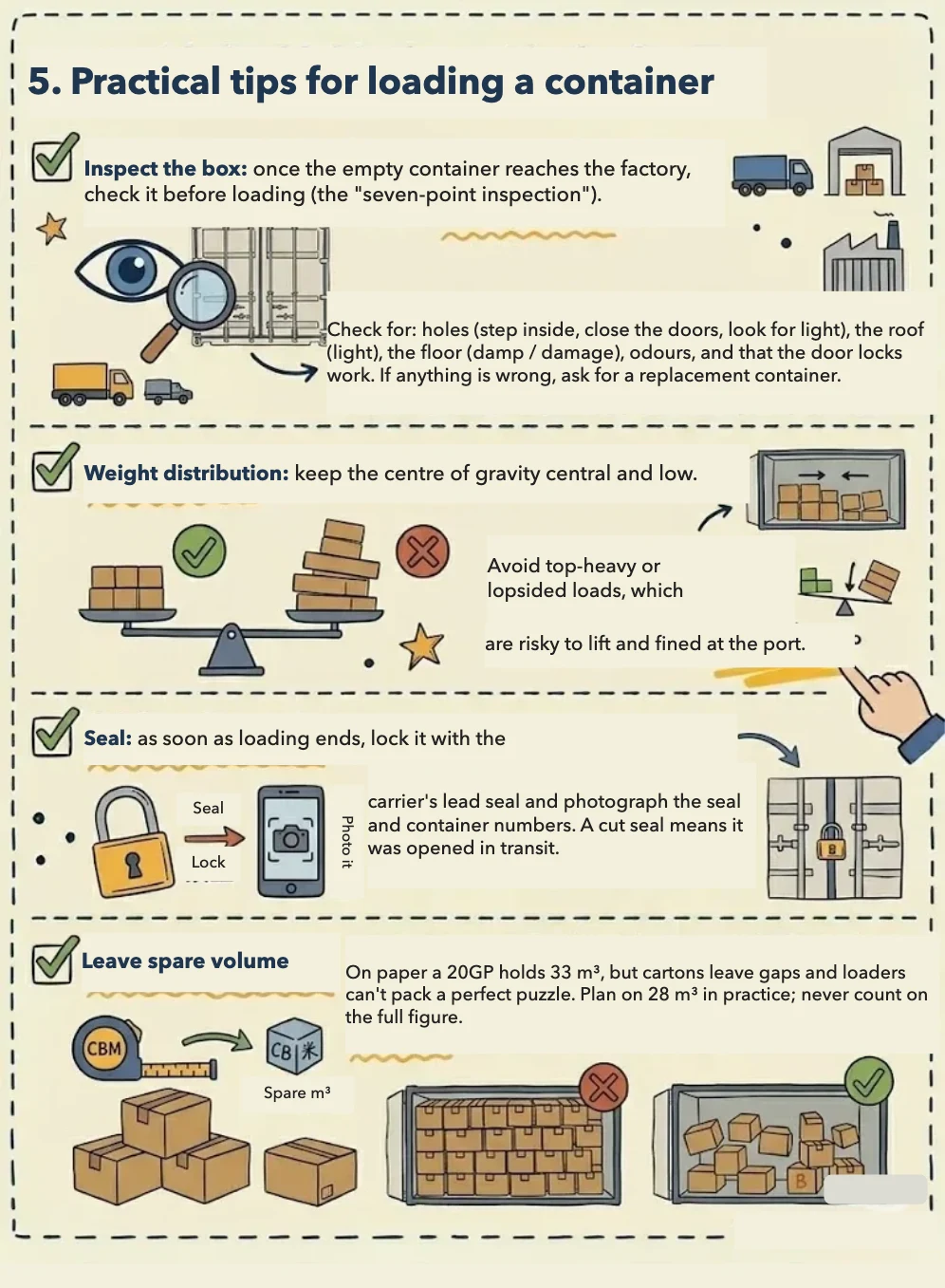
Does weight ever limit a furniture container?
Rarely for upholstery and timber, often for stone, ceramics and cabinetry with stone tops. Posted payload limits vary widely — one freight agent gives about 17.5–22 tonnes for a 20ft depending on carrier and port, another up to about 26 tonnes for a 40ft. In the comments, a reader asked whether 20.8 tonnes in a 20ft would attract an overweight charge; the answer was that most carriers begin charging a heavy-container surcharge at around 20 tonnes. A buyer shipping to Malaysia reported a kitchen island of about a tonne on its own — the kind of piece where weight matters.
Every container also needs a verified gross mass (VGM) declared before loading, so ask each supplier for carton weights. Our shipping and consolidation service collects them as part of the load plan.
How Source Foshan handles it
We plan the load before goods arrive. Each supplier’s packed dimensions and weights go into one list; goods are delivered to our Foshan consolidation warehouse, inspected against the confirmed specification, re-packed to export standard and labelled by room, and we book LCL or FCL according to the final volume. Loading is photographed. On one whole-home order for a Greater Bay Area residence, 54 items from 9 suppliers went into a single container.
If you are furnishing a whole home and want the volume planned with the design, we recommend Arcaya Living’s whole-home furnishing service, which covers design direction, furniture, decor, custom cabinetry, production follow-up, delivery and installation.
FAQ
How much furniture can fit in a 20 foot container?
About 22–26 m³ of packed household furniture, according to a moving company that ships homes abroad — roughly the furniture of a three-bedroom flat. Internal volume is about 33 m³, but furniture never packs perfectly.
How much furniture can fit in a 40 foot container?
A standard 40ft takes roughly 52–58 m³ of furniture and a 40ft high-cube roughly 58–68 m³. Internal volumes are about 67 m³ and 76 m³.
Is a 40ft high-cube better than a 40ft standard for furniture?
Usually yes. It adds about 30 cm of height and roughly 9 m³, and a Guangdong freight agent notes it is often priced the same as a standard 40ft for light cargo.
How do I calculate the cubic metres of my furniture?
Ask each supplier for packed carton dimensions and multiply length × width × height in metres for every carton, then add them up. Product dimensions understate the shipping volume.
Keep reading
Sources
- Xiaohongshu guide source note (2025-06-30, 586 likes, 7 comments). View source
- Xiaohongshu guide source note (2026-03-26, 582 likes, 0 comments). View source
- Xiaohongshu guide source note (2025-07-22, 105 likes, 0 comments). View source
- Xiaohongshu forwarder source note (2025-03-27, 339 likes, 137 comments). View source
- Xiaohongshu buyer source note (2026-03-03, 135 likes, 77 comments). View source
- Xiaohongshu guide source note (2025-09-25, 0 likes, 0 comments). View source
Not sure whether your list fills a container?
Send the list. We collect packed dimensions from each supplier, estimate the load and tell you whether LCL, a 20ft or a 40ft high-cube fits your order.