Buying guide
Accent chair specification beyond the showroom photo
Approve an accent chair by its measured seat, construction, finish and delivery configuration, not by a styled showroom photograph.

Approve an accent chair by its measured seat, construction, finish and delivery configuration, not by a styled showroom photograph. Obtain a drawing and a first-off chair in the exact fabric or leather, frame finish, cushion build and leg arrangement you plan to buy. Sit in that sample, inspect its underside and joints, check it against the room and record the observations. Then give production and receiving teams a short versioned specification they can actually compare with later chairs.
An accent chair is often purchased as a visual focal point, but a photo cannot tell you the seat height, the way the back meets the sitter, whether an arm blocks a nearby table, what supports the cushion, or how the legs will arrive. This guide makes those hidden questions explicit. The published sofa-buying guide covers larger upholstered seating orders; this article addresses the single-chair configuration and its first-off approval.
A fully read first-person Xiaohongshu account of visiting five Foshan furniture showrooms reports comparing single chairs with different materials and seat feel and noticing similar-looking designs in different displays. Those are the visitor’s subjective showroom observations, not verified material tests, supplier audits or price benchmarks. The author did not document the construction of an export chair. The practical question it raises is whether the chair you receive will match the comfort and finish you approved in the room, beyond a photograph or catalog label. Merchant endorsements and negative allegations in the note are not repeated as facts.
Identify the exact chair variant
Begin with one item code and revision. Record intended location, quantity, upholstery code and color, leg or frame material and finish, seat cushion construction, arm shape, back shape and any loose cushion. Ask the supplier for a front, side and underside drawing with overall width, depth and height; seat width, depth and height; arm height; back angle or a practical profile drawing; foot positions; and packed dimensions. Use the same units throughout. If a showroom sample is larger than the proposed production version, do not treat the sit-test as proof of the revised chair’s fit.
Make the variant list explicit. A chair offered with wood, metal or upholstered legs may have different connections and floor contact. Different cushions can alter seat height and feel even when the outer silhouette remains unchanged. A swivel base, removable back, or separate footstool is another build, not a harmless color option. Record which changes the supplier may make only with written approval. “Same appearance” is not a part number.
Ask who makes or sources the frame, upholstery and visible fittings. A showroom may contain pieces from several workshops; neither its décor nor a seller’s verbal “factory direct” statement identifies the maker of the chair quoted to you. Request an item-specific bill of materials and production drawing if the order size warrants it. Keep commercial claims as statements by the named seller until separately evidenced.
Test the chair in its intended room
Put the first-off chair beside the actual table, sofa, bedside cabinet or wall condition it will face. Ask a representative user to sit down, rest their arms, lean back, rise and move the chair. Record the user’s context and observations; do not turn one person’s preference into a universal ergonomic claim. Check whether feet reach the floor as expected, whether the front edge presses awkwardly, whether arms fit under or beside the adjacent furniture, and whether a loose cushion moves out of place. A styled image may hide a chair that is too deep for its intended location.
Measure the usable clearances as well as the overall chair. For a reading corner, check passage beside the chair with a person seated. For a hotel room, check that the chair can be moved for cleaning without striking a desk, curtain or door. For a pair of chairs, confirm the orientation, spacing and sightline. The buyer supplies the room plan and any site restriction; the supplier supplies the chair dimensions and the approved sample. Keep those responsibilities named in the drawing set.
A useful fit record has four rows: intended location / chair-and-room dimension / observed use issue / approve, revise or hold. The measurement and the observation should point to the same chair revision. If an arm needs to be shortened, approve a revised prototype; do not assume the seat feel or appearance will remain identical after the frame changes. Where a destination has accessibility or other project rules, have a qualified local reviewer check the exact layout and applicable requirements.
Inspect the first-off construction
Turn the approved sample over with the supplier’s consent and identify its frame, joints, legs, support system and upholstery attachments. Record what is visible and ask for a drawing or component description for concealed parts. The objective is traceability, not a promise that an unfamiliar visual detail is a defect. Compare leg attachment and floor contacts across all sides. Check that the chair stands evenly on the intended floor and that joints do not visibly open during ordinary handling. If a movement or stability claim matters to the purchase, define the exact assembled-product evidence required and use an appropriate method; a catalog phrase such as “heavy duty” is not that evidence.
Distinguish a fixed seat from a removable cushion. Identify the cushion core and cover construction in supplier terms, with an approved sample or section where possible. Ask how a replacement cushion would be ordered and whether the cover can be removed without damaging the chair. For an upholstered back, ask how its contour is supported and whether it changes if a different fabric is chosen. A first-off inspection should compare the actual selected textile and frame, because substituting either can change the chair’s profile and feel.
Create a short part map: component / supplier description or code / approved sample reference / replacement route. Include legs, glides, seat cushion, loose pillows and visible trim only if present. A chair with a distinctive sculpted arm may be difficult to repair if a chipped piece cannot be identified. Ask for the service route before placing a volume order, while the sample and component information are available.
Approve material and finish under useful light
Request a labeled upholstery swatch and a finish board for the selected frame. Record code, batch or revision, supplier, approved face and date. View them near the intended room lighting and beside the first-off chair. The show floor’s warm lighting can change how a color appears, so compare the full chair under more than one relevant lighting condition and retain a physical reference. A small swatch cannot show how a pattern falls over a curved back; approve the pattern placement or an acceptable range on a finished sample if it matters.
Ask the supplier to identify the actual upholstery composition and care method. A label such as “performance fabric,” “semi-aniline leather” or “easy clean” needs a product-specific definition and evidence for the claim being made. Do not infer stain resistance, abrasion life or cleanability from touch. If a test report is offered, match its material code, tested construction, method and date to the proposed upholstery. A report on a different fabric, coating or color is an open evidence question, not automatic approval. This article does not specify a universal test threshold; choose requirements for the destination, use and sales channel with qualified advice.
Define visible finish checks in ordinary language: tone relative to the approved board, grain or texture direction, seam placement, piping and trim alignment, exposed edges, leg finish and damage. Record tolerances or acceptance examples before production. A first-off chair that is attractive from the front may have uneven seams or inconsistent finish on the rear that remains visible in the intended room. Photograph every viewing side and the underside with the item code.
Convert the sample into a production check
The first-off sample should carry an ID and approval date. Keep a measurement sheet, component list, swatch references and photographs. For production, define which features inspectors can verify on selected chairs: main dimensions, leg arrangement, floor contact, visible seams, cushion fit, upholstery code and finish match. Identify the lot and sample IDs. A pass on a styled showroom piece does not release unseen production units.
Separate observations from decisions. A slight color difference may be within an approved reference range; a missing glide is a countable missing component; a wobble may require checking floor flatness and leg attachment before assigning cause. Use observation / evidence / responsible person / disposition / recheck for exceptions. If the supplier changes the foam, fabric backing, leg supplier or frame thickness after first-off approval, require a documented change review and repeat the relevant sit, dimension and construction checks.
Do not let one appealing angle determine the QC photographs. Ask for front, rear, both sides, seat close-up, leg or base close-up and packed state. Use consistent lighting and label each image by chair and revision. Production photographs are evidence of particular sampled chairs only; they should not be described as proof that every unit was inspected.
Plan delivery and replacement before shipment
Ask whether the chair ships fully assembled or with legs or back detached. If assembly is required, obtain a specific instruction with tool and fixing list and a final check for uneven floor contact. Keep each loose cushion or pillow tied to its chair or finish batch. Check carton dimensions against access to the intended room, and ask how corners, arms, legs and upholstered faces are protected. A repairable chair can still arrive unusable if its matching leg set is missing.
At receiving, reconcile chairs ordered / cartons received / chairs assembled and checked / units held for issue. Link each exception to a carton and chair identifier. Photograph damage before discarding packing. Distinguish transit damage, missing parts, wrong variant, assembly error and production defects; their remedies may differ under the actual contract. Provide the project team with the approved sample photos, specification and care instructions so a local receiver is not comparing deliveries with a mood-board image.
For service, ask whether replacement glides, legs, cushion inserts or covers can be supplied in the correct revision and finish. Record answers as commitments or estimates, not a guaranteed lifetime supply. Where a textured or patterned fabric is involved, identify the risk that a later replacement may not match an earlier dye lot and decide whether to hold spare material. The handoff packet should tell a future buyer exactly which chair, material and finish was delivered.
Work a fictional twenty-chair approval
Imagine a fictional boutique hotel ordering twenty occasional chairs for two room types. The designer approves a photograph of a curved upholstered chair. A showroom sample feels comfortable, but it has a different fabric and a wider base than the quoted version. In room type B, the proposed arms would interfere with a desk drawer. The buyer cannot yet approve twenty chairs on the photograph and sit-test alone.
The next gate is two complete first-off chairs in the intended variants, with drawings for both room layouts, exact fabric and leg codes, an underside part map, finish references and sit/clearance observations. If room type B needs a narrower arm, record it as a new revision and inspect it again. For production, a defined sample of each revision is checked against the appropriate baseline. At receiving, the arithmetic is 20 ordered = accepted chairs + held chairs + not yet received or checked, with each number traceable to an item ID. It is not a defect-rate forecast or statistical sample-size rule.
If one variant passes and the other still conflicts with the desk, the buyer may release only the approved variant while holding the second. If the supplier proposes a last-minute substitute fabric, the buyer asks for the swatch and a finished sample before accepting the change. A comfortable, attractive chair remains a valid design choice; the approval must simply describe the chair that will actually be built and installed.
Request the final chair packet
Send the supplier a one-page request for: item and revision; drawing and dimensions; room fit; frame and support description; approved upholstery and finish references; first-off sit, construction and visual record; production check plan; packing and assembly method; and service-part route. Mark each point approved, evidence pending or configuration change required, with an owner and date. Refer to the exact sales market if any formal product or material requirement will be applied.
The decision is an item-specific baseline. The buyer should be able to compare a received chair with a drawing, swatch, finished sample and part list, not rely on a beautiful showroom photograph that may show a different build. Keep the approved packet with the purchase order and the receiving team, so the visual design and the physical chair stay connected throughout the order.
More in Buying Guides.
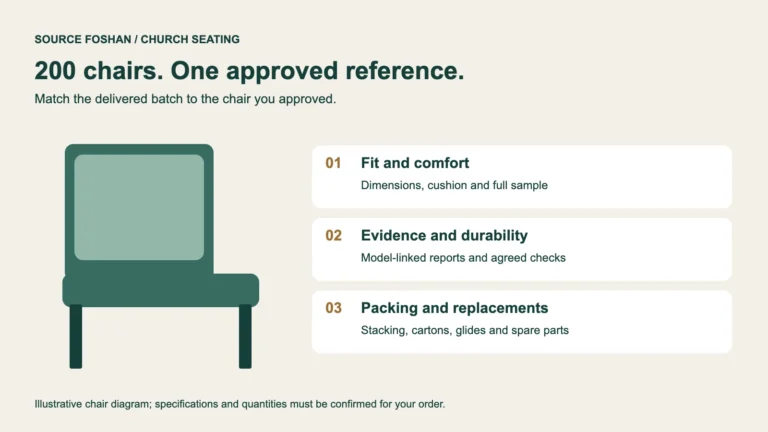
Buying 200 Church Chairs from China: Specifications, Samples and Landed Cost
Use a 200-chair planning example to organise specifications, sample approval, inspection, packing and the cost of delivery to your US site.
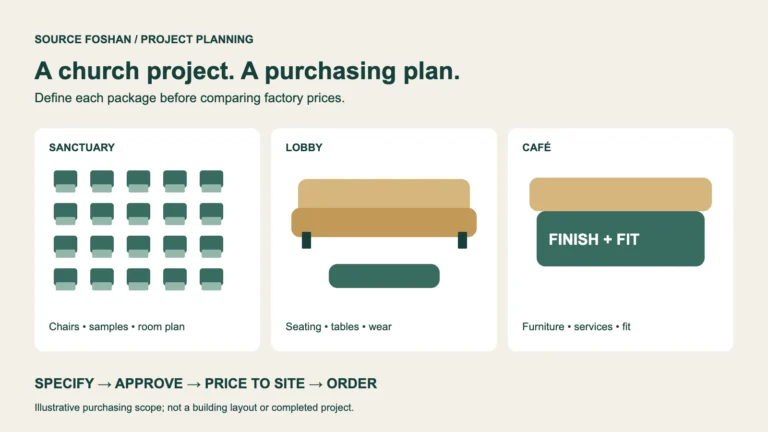
Church Renovation Sourcing from China: Is It Worth It for a US Project?
A practical guide to choosing import candidates, comparing complete installed costs and planning delivery for a US church renovation.
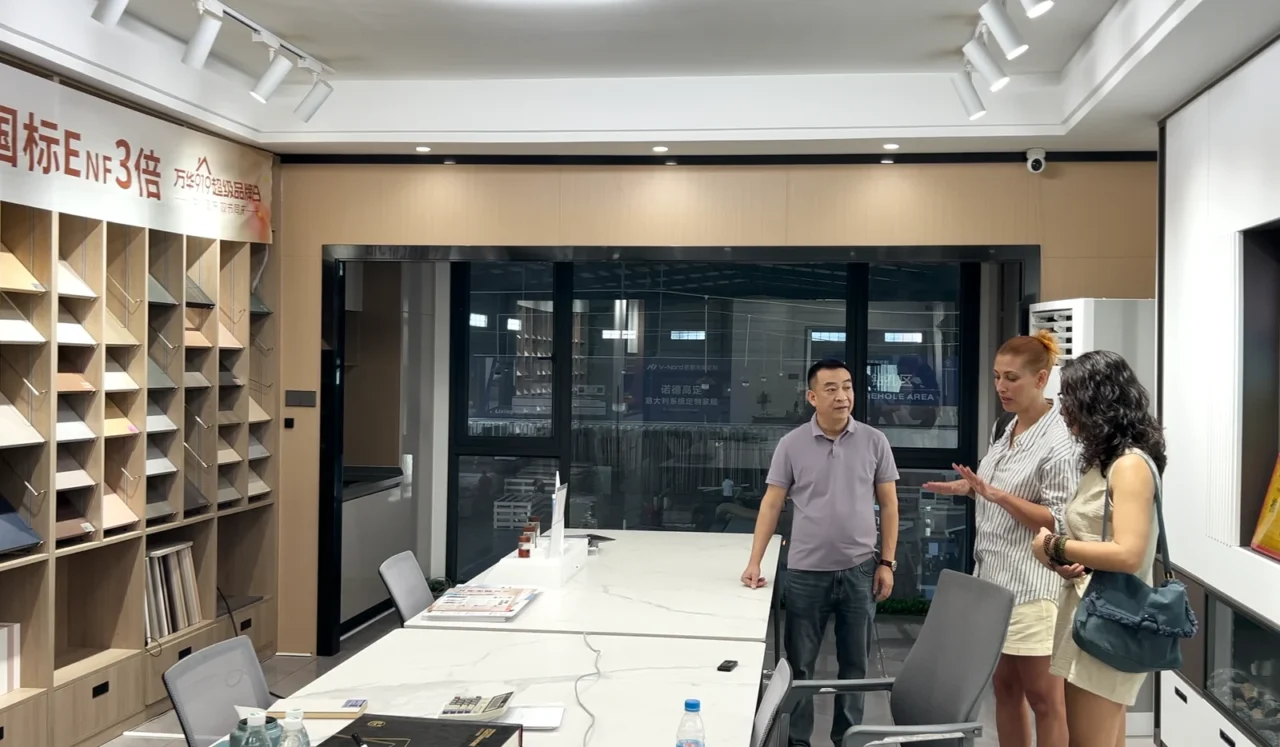
Is Source Foshan Reliable? Company Facts, Fees and Buyer Checks
Review the disclosed Chinese company, written scope, separate fee, payees and order evidence. Includes a working document checklist without a self-assigned reliability rating.