Buying guides / Indoor environment and materials
Buying Furniture and Closets from China for a Humid Coastal Apartment
A room-by-room specification guide for buying furniture and built-in closets from China for a hot, humid coastal apartment, with material questions, delivery checks and a copyable brief.

For a hot, humid coastal apartment, specify furniture and built-in closets around the actual indoor conditions, the construction of each component, and how the installation will be kept dry. A material name such as “solid wood,” “plywood” or “moisture-resistant MDF” is only a starting point. Ask for the exact product, finish, edge treatment, hardware and intended exposure before approving an order from China.
Separate an air-conditioned bedroom from a room regularly open to outdoor air, and separate both from a balcony exposed to rain. No board label establishes that a complete wardrobe will remain free of swelling, corrosion or mold in every coastal home.
- 1Describe room exposure
- 2Identify each component
- 3Approve drawings & samples
- 4Check arrival & installation
Planning workflow, not a promise of product performance or completion time.
What should I tell a supplier about a hot, humid coastal apartment?
Send the furniture layout together with a short room-by-room description. “Near the beach” does not explain whether furniture stays indoors, receives wind-driven rain, or sits beside a wall with recurring condensation.
- Use: permanent home, intermittently occupied apartment, or another arrangement; whether air conditioning or dehumidification operates while it is empty.
- Exposure: enclosed room, frequently open balcony doors, direct sunlight, splashes, or actual outdoor use.
- Building condition: any leaks, damp patches or condensation, and whether new plaster, paint and other wet work will be complete before installation.
- Scope: bedroom and living-room furniture, kitchen counter stools and fitted closets, with quantities and dimensions for each.
Resolve active building moisture problems before enclosing them behind cabinetry. The US EPA’s moisture guidance emphasizes correcting water sources and controlling indoor humidity; a furniture purchase cannot perform those building functions.
- Describe each room’s actual exposure and operating conditions.
- Agree on component specifications and a representative sample.
- Confirm site readiness, delivery access and the installation handover.
Is solid wood, plywood or moisture-resistant MDF best for coastal furniture?
There is no reliable whole-apartment winner based on material name alone. Solid wood exchanges moisture with the surrounding air, so drying, storage and allowance for movement matter. The USDA Wood Handbook, Chapter 13 explains why moisture content tends toward equilibrium with surrounding humidity and why handling and storage influence later dimensional change.
For plywood, request the actual panel identification and bond classification. APA explains that bond classification concerns adhesive moisture resistance and does not establish decay resistance. Its Exterior and Exposure 1 descriptions apply to the panels within that system; a supplier’s unverified “marine” label does not demonstrate an equivalent grade.
For MDF, distinguish standard board from a named moisture-resistant product intended for the proposed conditions. The European Panel Federation’s technical guidance describes lower thickness swelling for moisture-resistant boards than standard grades, while also documenting moisture-related dimensional changes. That comparison is not proof that an assembled closet tolerates persistent dampness.
Use our guide to solid wood, veneer and MDF specifications for the basic terminology. For this project, take the next step: specify every component separately.
| Component | Specify in writing | Check before approval |
|---|---|---|
| Closet carcass and shelves | Panel maker, product grade, thickness, shelf spans and intended indoor conditions | Matching product sheet and component schedule |
| Doors and drawer fronts | Core material, face finish, reverse face and edge treatment | A representative finished sample, including its edges |
| Backs, bases and cut-outs | Back-panel material, base detail and treatment of site-cut edges | Section drawings and installation instructions |
| Hinges, slides and fixings | Manufacturer, model, finish, exposure suitability and replacement parts | Exact hardware schedule and care requirements |
| Loose furniture and upholstery | Frame and top construction, fabric identification, cleaning and drying instructions | Material samples and the manufacturer’s care information |
| Packing and delivery | Moisture-protection proposal, storage conditions, package sizes and receiving checks | Packing specification and responsibility for wet or damaged packages |
How should built-in closets be detailed for a humid bedroom?
Review a section through the wardrobe, not only its front elevation. Ask the supplier and local installer to identify the back panel, wall interface, base, floor junction, fillers and service access. They should agree how the design deals with the actual wall condition, cleaning water and inspection access.
Request a complete edge-treatment schedule: visible edges, concealed edges, drilled openings and any trimming performed after delivery. Confirm who finishes a cut-out made by the local installer. A polished door sample does not establish what happens behind the cabinet.
Air movement and access need a project-specific discussion. A generic gap or a few ventilation holes cannot be assumed to resolve a damp wall or to control room humidity. Have the installer coordinate clearances with the cabinet maker and the building’s ventilation or air-conditioning arrangements.
Use the cabinet-board selection guide when comparing grades, then retain the chosen product identifiers in the order. Approve substitutions in writing rather than accepting “equivalent moisture-resistant board.”
What changes for sofas, beds and kitchen counter stools?
Carry the same exposure description into the loose-furniture list. Ask whether the proposed sofa, bed or table is intended for enclosed indoor use, and obtain care instructions for its fabric, finish and metal parts. If a piece will actually receive rain or spray, request a separately specified product for that exposure.
For counter stools, send the finished counter height, underside clearance and available floor space. Confirm seat height, overall width, footrest position and whether arms can pass under the counter. Compare a drawing and sample against the real counter rather than approving a stool from its photograph.
If exposure to salt-laden outdoor air is anticipated, tell the hardware supplier explicitly. Request its material, finish and maintenance recommendations for that setting. A generic “stainless” description leaves the exact product and its use conditions unresolved.
What should be measured and checked before delivery and installation?
Appoint a local person to verify final room measurements and site readiness. Record finished floor and ceiling levels, wall variations, skirting, sockets, switches, pipes and door swings. Use our cabinet measurement checklist to prepare the drawing review.
Measure the delivery route too: building entrance, lift doors and cabin, stair turns, corridor corners and apartment doorway. Check these against the largest packed item and the largest assembled component. Ask whether tall closet sections are assembled upright or need space to be tilted into position.
Agree where goods will be stored if the apartment is unfinished. Obtain the manufacturer’s conditioning and installation instructions; do not assume one fixed acclimatization period suits every material and site.
At handover, record wet packaging, visible swelling, damaged edges and hardware operation. Keep product labels, approved samples, drawings and photographs. These checks document condition and conformity; they do not predict long-term performance.
What brief can I send to furniture suppliers in China?
Copy and complete this brief before requesting comparable quotations:
We are furnishing a coastal apartment. Attached are the furniture layout and room measurements. Our scope is [rooms, items and quantities], including [built-in closet locations]. Indoor conditions are [occupancy, air-conditioning and humidity-control arrangements]. Expected exposure is [enclosed indoors / regularly open to outdoor air / direct weather exposure].
Please identify each component’s material, manufacturer or product grade, thickness, finish, edge treatment and hardware model. Include relevant product information, care requirements, samples, installation details, packed dimensions and storage instructions. Flag any item unsuitable for the stated conditions. State who verifies site dimensions, makes local cut-outs, installs and handles replacements.
Questions buyers ask about humid coastal homes
Does moisture-resistant board prevent mold inside a wardrobe?
No such conclusion follows from the label. Board performance, room moisture, leaks, condensation, stored contents and installation conditions are separate issues. Investigate the moisture source rather than relying on a material description.
Should every item in a coastal apartment be outdoor furniture?
Match the product to its actual exposure. An enclosed bedroom and a rain-exposed balcony have different requirements. Ask manufacturers to confirm the proposed use and its limits.
Can I order built-in closets from a furniture floor plan?
A layout is useful for an initial discussion. Production approval also needs verified finished dimensions, elevations, relevant sections, service positions and agreement with the local installer.
Can a sample prove that furniture will last in my climate?
A sample helps approve construction, finish and workmanship. Any performance claim needs evidence applicable to the specified product and conditions; the sample alone cannot establish a service life.
Start with the layout and the indoor conditions
Send Source Foshan your apartment furniture brief with the layout, item list, destination, budget currency and delivery target. Include the operating conditions and identify who will verify measurements and install locally, so the sourcing discussion starts with a usable specification.
Send the confirmed choices and the open questions
Include the item list, quantity, destination, references and the decisions that still need a supplier response. Service availability, scope, fees and dates are confirmed in the project proposal.
More in Buying Guides.
Sourcing Power Recliner Sofas from China: Dimensions, Mechanisms and QC
Turn a recliner reference image into an agreed specification: dimensions, movement, upholstery, electrical components, sampling and pre-shipment checks.

Modular sofa specifications for overseas buyers
Specify a modular sofa as a set of identified components and an approved assembly, not as one product photograph or one overall width.
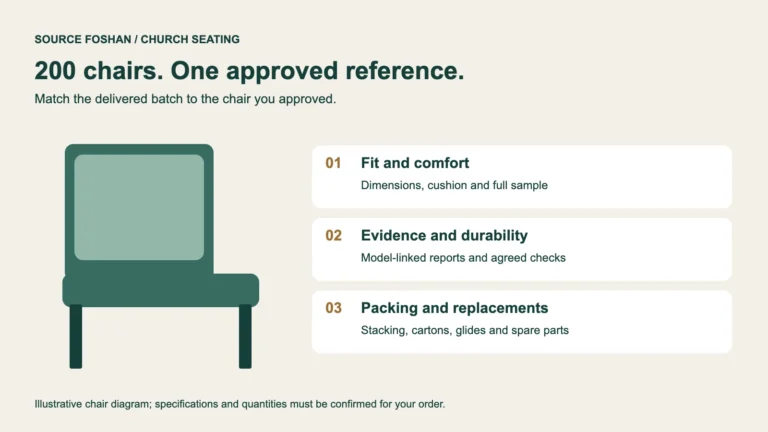
Buying 200 Church Chairs from China: Specifications, Samples and Landed Cost
Use a 200-chair planning example to organise specifications, sample approval, inspection, packing and the cost of delivery to your US site.