Canada / Furniture sourcing and import decisions
Sourcing Furniture from China to Canada: Costs, Containers, Lead Times and Suppliers
Classify the products before comparing a local offer. Includes a CAD model, first-stock list, 15-kitchen and 40-seat café illustrations, and Canadian compliance checks.
Canada / Start with classification, then compare the complete project
Canadian buyers can source furniture from Foshan for a home, rental portfolio, shop, apartment development or café. Build an item schedule, establish the importer and classify each product before comparing the delivered cost. Ordinary customs duty is only one line: some Chinese upholstered seating is subject to anti-dumping and countervailing measures. Commercial imports also need the correct CARM setup, federal GST treatment and product evidence. A blanket “40–60% cheaper” or one container price cannot resolve those questions.
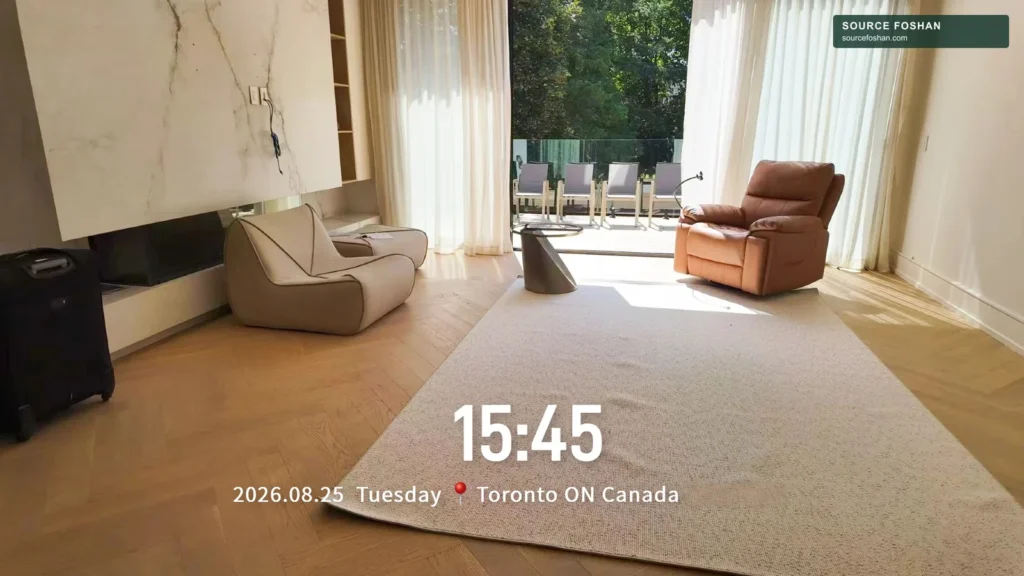
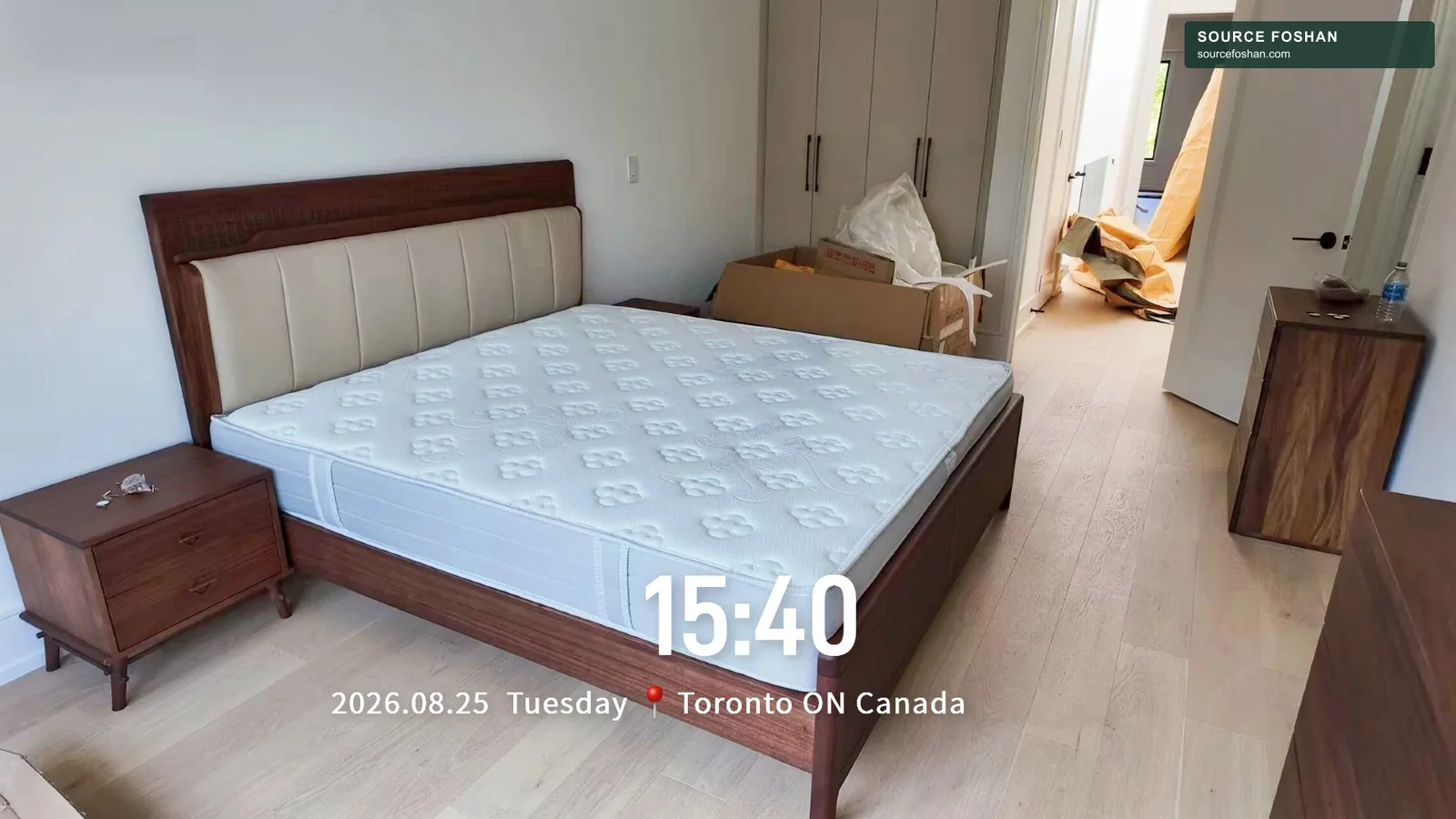
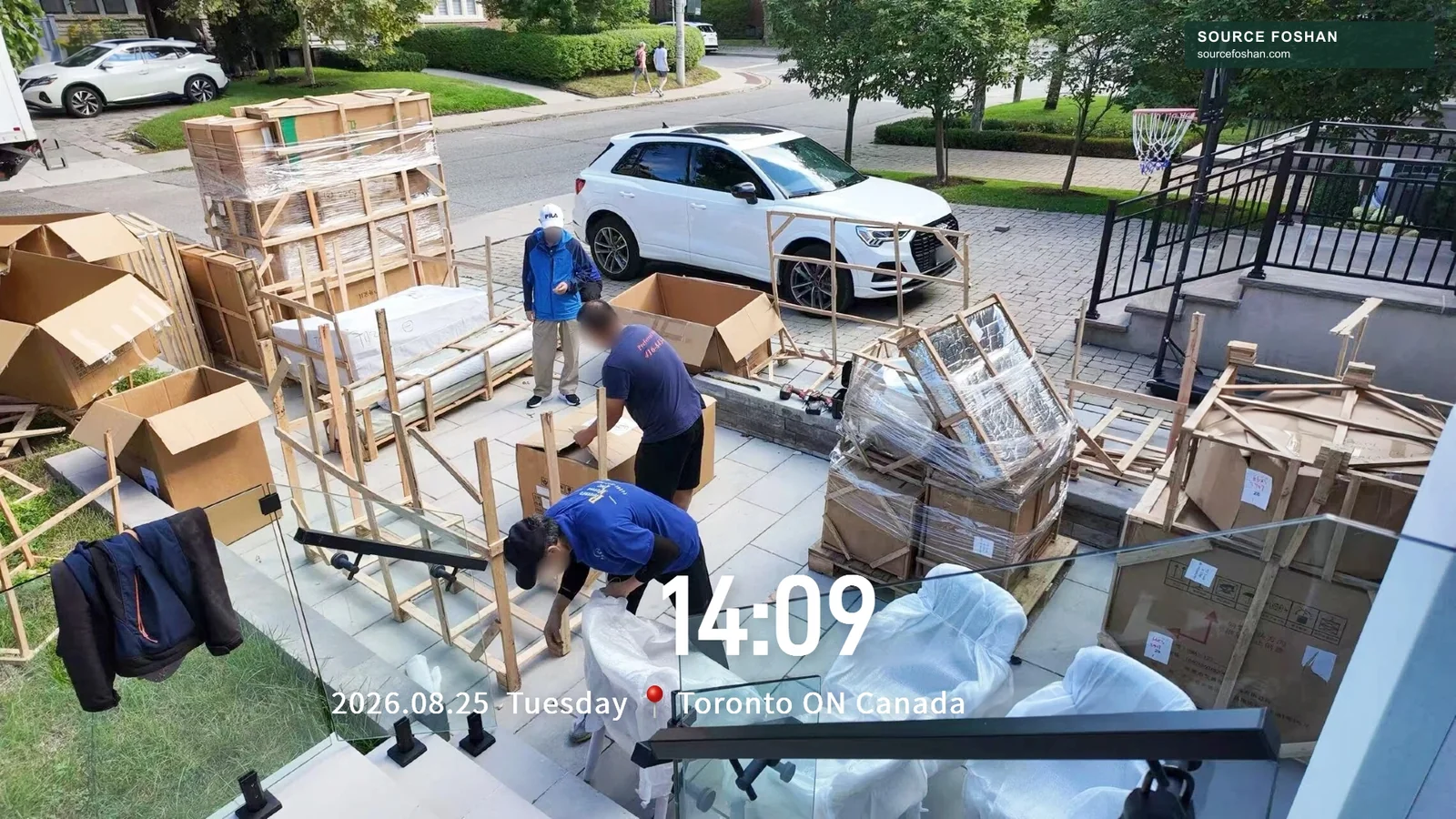
Official sources checked 24 October 2026. USD/CAD budgets, packed volumes and programme allowances are illustrations, not factory quotations, freight offers or Canadian customer invoices. Actual Toronto photographs document residential delivery stages only.
01 / Do not mistake an ordinary tariff for the whole tax bill
What does it cost to source furniture from China to Canada?
Use the goods offer plus all agreed sourcing, origin, transport, border, destination and installation work. State the currency and Incoterms rule/place. If the broker supplies a customs value, do not add charges already included in that value a second time. The importer and tax adviser must distinguish cash paid at import from any later recoverable tax.
Check upholstered seating before paying the deposit
CBSA’s upholstered domestic seating measures cover certain goods from China and Vietnam, with specific product exclusions and exporter/model normal-value arrangements. Motion features, covering, construction and intended use matter. Ask the broker to review the product definition, actual exporter and model; a heading number, fabric name or supplier assurance is insufficient. Anti-dumping and countervailing liabilities must not be entered as zero simply because the ordinary tariff is known.
ال 2026 Canadian tariff illustrates why the code matters: metal office furniture under 9403.10.00 has an MFN rate of Free, while other metal furniture under 9403.20.00 has an MFN rate of 8%. These examples do not classify your order. Seats, wooden cabinetry, mattresses and mixed goods need their own analysis, including any additional measures.
Editable CAD comparison
How do the entered import lines compare with a matched local quote?
All defaults are assumed. This model excludes unentered SIMA/countervailing duty, surtax, provincial tax and fees. Resolve those before treating either side as a complete offer.
Simplified federal GST = 5% × (customs value + entered ordinary duty). Additional transport is added to the entered sum, not automatically to the customs value. The actual valuation and GST base may include other required amounts. Compare tax, specifications, delivery and installation on the same basis. A positive gap is arithmetic, not proof of savings or a complete landed budget.
CRA’s import guidance distinguishes commercial and non-commercial imports. The federal GST/HST portion is calculated on the applicable Canadian-dollar value including duty and excise. Provincial HST treatment and possible self-assessment differ; input-tax credits have conditions. Do not automatically add both 5% GST and Ontario’s full 13% HST to the same commercial border value. For goods used in British Columbia, review the separate provincial PST rules and applicable exemptions with your adviser.
Request current origin, ocean/rail and destination quotations for Vancouver, Prince Rupert, Montreal or Halifax and the final postal code. Toronto requires an actual inland route and handover quote, not an assumed coastal delivery price. Download the Canadian import and matched-local-scope worksheet.
02 / A first container is an inventory decision
How should a new Canadian boutique furniture shop source its first stock?
Build the first order around the customer range and cash tied up, not a container’s theoretical maximum. Assign a selling unit, SKU/finish, sample requirement, reorder MOQ and packed size to every line. Keep display stock separate from sale stock and identify which components can be replenished locally.
| Group | Assumed quantity | Assumed unit allowance | Goods subtotal | Assumed packed volume |
|---|---|---|---|---|
| أرائك | 6 | 600 | 3,600 | 9.0 |
| طاولات الطعام | 8 | 250 | 2,000 | 4.0 |
| كراسي الطعام | 32 | 50 | 1,600 | 3.2 |
| هياكل الأسرة | 8 | 300 | 2,400 | 6.4 |
| Sideboards | 6 | 350 | 2,100 | 4.8 |
| Entered goods total | 60 pieces | Five product groups, not necessarily five SKUs | 11,700 | 27.4 |
The example excludes tax, freight, services and compliance work. The sofa lines still require trade-remedy screening. A model/finish mix must meet each maker’s terms; combining factories does not remove MOQ. A 27.4 m³ sum also does not prove a 20 ft load fits, because carton layout and handling space can control.
Use Lecong showrooms for physical comparisons and arrange appropriate factory checks separately. Establish the actual legal seller and maker before paying. Do not assume a fixed retail markup or margin: storage, damage, discounts, replenishment, tax, staffing and local warranty support affect the business result.
03 / Compare the same usable apartment
Is China or Canadian wholesale better for furnishing an Airbnb?
Use a matched room list and a dated local quotation. Compare delivery, assembly, tax treatment, maintenance, spare parts and the cost of managing the import. A single urgent apartment can favour local supply; repeat apartments may justify a consolidated specification. There is no universal three-apartment or 25 m³ threshold.
For example, if an apartment package is assumed to occupy 10 m³, three packages total 30 m³ before any shared spares or packing changes. That is a volume calculation, not evidence that the third apartment makes importing profitable. Obtain actual carton data and compare complete LCL/FCL offers using the shipping-mode decision tool.
Keep a bed/mattress compatibility check and a fast replacement plan for guest-critical items. Evaluate mattresses separately from sofa duties and require the actual product safety evidence. The multi-apartment package guide helps structure repeat room schedules and phased deliveries.
04 / Scope the route from the warehouse to the room
What changes for a Vancouver home renovation?
Begin with the floor plan and finished dimensions, then measure the delivery route: truck access, driveway, door opening, stair turn, landing and lift. A large sofa can fit the room and still fail the access route. Fitted joinery needs site-verified drawings and a named installation owner.
Ask whether the quoted handover is port/rail terminal, warehouse collection, kerbside, room placement or assembly. Confirm drayage, container unloading, warehouse receiving/storage, smaller-truck transfer, stairs, two-person handling and packaging removal. Do not assume a residential street can accept a container vehicle or that “door to door” includes installation.
Furniture, cabinets, tiles, hardware and electrical products can share a shipment only when their packaging, weight distribution, document and product requirements are managed together. Combining categories does not give them the same tariff, certification or warranty. For personal importing, ask the broker about the appropriate non-commercial route; do not assume new furniture qualifies as previously owned and used settler’s effects.
استخدم خدمة توريد الأثاث المنزلي بالكامل to agree coordination and the Canada shipping service for the destination scope. Neither replaces a postal-code-based provider quotation.
05 / Fifteen kitchens need fifteen checked drawing sets
How do I source cabinets for a 15-unit apartment development?
Separate repeated kitchen types from site-specific dimensions. For each unit, confirm wall measurements, finished floor levels, appliance models, plumbing, electrical positions, fillers, scribes, end panels and access. Name the designer or installer who accepts shop drawings and the tolerance strategy. A 3D render is not an installation drawing.
An illustrative kitchen and container calculation
At an assumed USD 2,800 of cabinets per unit, 15 kitchens total USD 42,000. At an assumed 4 m³ packed per kitchen, the total is 60 m³. A hypothetical 80% use of a nominal 76.4 m³ 40 HQ gives 61.12 m³: volume-only arithmetic suggests one container, with just 1.12 m³ remaining. That does not establish a safe actual load, space for appliances, stone tops or spares, or a supplier price.
Quote cabinet boxes, doors, drawers, hardware, panels, plinths, worktops, sinks, appliances and installation as identified lines. A named hinge brand is not a complete specification; record the model, finish, function and replacement route. Phase factory releases by the units that are measured and ready.
CANFER covers specified composite wood products and finished goods containing them. It requires the appropriate certified panel supply, labelling and records. Canada’s guidance on certification explains how TSCA Title VI certification may meet relevant certification requirements; that does not remove the importer’s remaining Canadian obligations. An “E0”, “ENF” or “CARB P2” sales label alone is not the finished cabinet’s complete Canadian file.
Require a unit/room/carton map, assembly and fixing details, hardware counts, accepted sample, panel traceability and a shortage/damage remedy. The actual order should state who verifies site dimensions and who pays for corrections arising from a factory or measuring error.
06 / Count operating seats once
What could a 40-seat café furniture package include?
| غرض | كمية | Assumed unit allowance | Subtotal | Assumed CBM |
|---|---|---|---|---|
| كراسي الطعام | 32 | 45 | 1,440 | 3.84 |
| مقاعد البار | 8 | 65 | 520 | 1.28 |
| Four-place tables | 8 | 140 | 1,120 | 2.40 |
| Entered goods total | 40 seats + 8 tables | Counter, joinery and other fit-out work excluded | 3,080 | 7.52 |
The 32 dining seats plus 8 counter seats give 40; the counter itself is not priced here. A banquette changes the layout and replaces relevant loose seats rather than being counted as free extra capacity. The illustrative USD 3,080 goods subtotal is below Source Foshan’s published USD 10,000 service starting point, so compare local or alternative supply for a small standalone list.
At 7.52 m³ by these assumed cartons, a full container is not automatically the economical choice. Compare matched partial-load and local offers. For commercial use, specify stability, strength, joints, seat height, cleanability, glides and the actual structural/fire evidence required by the venue and responsible adviser. A generic BIFMA or EN report must not be substituted for the tested model and scope. Outdoor pieces also need a climate, finish-care and winter-storage plan rather than a promise that every “teak” or aluminium item is weatherproof.
07 / A vessel ETA is one milestone
How long does sourcing and delivery to Canada take?
| منصة | Planning allowance | Acceptance record |
|---|---|---|
| Brief and comparable offers | 1–2 | Scope, currencies and exclusions |
| Drawings and samples | 2–4 | Approved references and test plan |
| Manufacturing | 4–8 | Accepted production slot |
| QC and consolidation | 1–2 | Corrections and carton reconciliation |
| Ocean planning allowance | 3–6 | Current route, cut-offs and ETA |
| Clearance and local handover | 1–2 | Broker and delivery appointments |
| Separate contingency | 2 | Project buffer |
| Sequential illustration | 14–26 | Not a measured average or delivery promise |
For a Toronto planning exercise, adding an assumed 1–3 weeks of inland work changes that model to 15–29 weeks. Obtain the actual rail/truck route rather than adding this allowance to every booking. Testing, trade-remedy questions, inspection, rail availability, holidays and site readiness can change the sequence. Confirm each factory’s holiday closure and restart, not a universal shutdown period.
08 / The importer owns a product-specific file
What documents and compliance do Canadian furniture imports require?
- Commercial-import setup: CBSA’s current setup guide describes CARM registration, a nine-digit business number and an import-program RM account. Arrange broker delegation and the applicable payment/security route; hiring a broker does not remove the importer’s responsibilities.
- Shipment records: commercial invoice with the required customs particulars, packing list, bill of lading/transport record, origin/material details, insurance evidence where arranged, and the correct accounting/entry records. A certificate of origin is not a universal duty-free pass.
- Classification and measures: a line-by-line tariff and origin review, including upholstered-seating SIMA exposure and any other applicable measures.
- Composite wood: the applicable CANFER/TSCA certification route, supplier compliance statements, traceability, labels and required Canadian records.
- Mattresses: Health Canada’s mattress guidance explains the relevant flammability requirements for mattresses imported, advertised or sold in Canada. A general furniture certificate is not a mattress test.
- Upholstery labels: follow the current federal guidance for the actual outer covering and other relevant requirements. The former Ontario, Manitoba and Quebec stuffed-article regimes have been repealed; do not present an obsolete provincial label or licence as a current universal condition.
- Wood packaging: confirm CFIA’s current requirements for regulated solid-wood crates, pallets and dunnage. Chinese wood packaging cannot use a phytosanitary certificate as a substitute for the required treatment/mark route. Furniture-product admissibility is a separate check.
For electrical items, upholstered or textile goods, outdoor furniture and fitted joinery, identify the additional product/use and provincial requirements before quoting. Do not infer “Canada compliant” from a website badge, a CE mark or a laboratory report for a different construction.
09 / Make the approval trail survive a multi-factory order
How should the sourcing, payment and inspection work?
- Send the intended use, item/room list, dimensions, postal code, budget currency and handover requirement.
- Confirm the legal seller, fee model, source factories and product-specific Canadian checks.
- Compare offers against one specification, including MOQ, packing, exclusions and samples.
- Approve drawings, physical references, testing and the production-release conditions.
- Agree factory deposit/balance milestones, inspection access, remedy, spares and claim responsibility.
- Inspect to the accepted scope, document findings and close material corrections before release.
- Reconcile quantities, room/SKU labels, hardware, cartons and shipping documents across factories.
- Confirm the importer/broker, actual booking and destination receiving/installation appointments.
لدى Source Foshan، published fee is 3–5% of an agreed order-value basis, with no supplier commissions and projects from USD 10,000. The proposal must identify included work and third-party extras. Goods payments go to factories against agreed milestones; do not assume the service provider guarantees every factory obligation or insurer outcome.
Inspection should identify the order, sample selection, dimensions, material/finish references, function, quantity, visible workmanship, hardware and packing findings. Sampling is not a substitute for an applicable laboratory test. Preserve original packing, labels and unpacking/condition records when receiving goods, and notify the responsible seller, carrier or insurer under the actual deadline. See the payment and release checklist و sourcing service scope.
Canadian furniture sourcing questions
What is the minimum order from Foshan to Canada?
Factory minima are model/finish-specific. Source Foshan’s published service starting point is USD 10,000, separate from customs rules. Mixed suppliers do not automatically waive MOQ; small partial loads need complete origin and destination quotations.
Is Chinese furniture always cheaper than Canadian wholesale?
No. Compare identical specification, taxes, freight, delivery, assembly, trade remedies, management and remedy. A percentage saving cannot be established without matched accepted offers. The calculator compares only entered scopes.
Can I mix products from different factories?
Yes, with agreed receiving dates, inspection, warehouse/storage charges, carton reconciliation and document ownership. Assign the response to a late supplier or a damaged carton before the shipment is consolidated.
How much duty and GST will I pay into Vancouver?
Classify each item and check origin, tariff treatment and any trade remedies. Federal GST and provincial tax treatment are separate questions. Do not apply the illustrative 8% ordinary-duty input to every item or omit a required SIMA liability.
How many CBM fit in a 20 ft or 40 HQ?
Nominal equipment figures are about 33.2 m³ and 76.4 m³ respectively. A planning reduction is an assumption; the actual carton layout, doors, weight and safe restraint decide fit. Room counts alone cannot establish the load.
Does a CARB P2 or TSCA label prove all Canadian compliance?
No. Confirm the applicable CANFER certification route, actual panels, labels, supplier statements and records. Mattress, textile and other product requirements are separate. A report for another model or material is insufficient.
Who inspects before shipment?
The order should name the appointed inspector, scope, sampling and release owner. Require photographs, findings and correction evidence. Independent checks and suitable testing can support the process but do not guarantee every hidden defect is absent.
How much does a Foshan sourcing agent charge?
Source Foshan publishes 3–5% on an agreed order-value basis, with scope and extras in writing. Other agents and resellers use different models. Check underlying offers, seller identity, payment route and written commission disclosure.
خطوتك التالية
Send the Canadian item schedule and delivery postal code.
Include product materials and construction, quantities, cabinet drawings where relevant, packed data, postal code and intended use. Flag unresolved tariff or product-compliance questions.
Sources and scope
CBSA, CRA, CFIA, Canadian product/label guidance and BC’s provincial bulletin are linked beside relevant statements. Equipment reference: Maersk. All budget, packing and programme examples are illustrative. Toronto photographs record actual room placement and unpacking, not a café, 15-kitchen project, customs ruling or price comparison.