Fournisseurs
What a furniture factory production schedule should show
Review a furniture factory production schedule for item revisions, dependencies, measurable output, approval gates and recovery before packing and dispatch.

A furniture factory production schedule should show the exact order and specification revision, dependencies that must be cleared, dated start and finish for each real operation, responsible party, inspection and buyer-approval gates, measurable completed quantities, exception recovery, and the separate handoff to packing and dispatch. A single promised delivery date or decorative Gantt bar cannot tell an overseas buyer whether the order is on track.
Use the schedule as a decision tool, not a guarantee. Ask for a baseline when the order is accepted, a dated update at an agreed cadence, and a named trigger for revising the baseline. Keep the original version. The published Foshan furniture manufacturer guide gives the wider sourcing context; this article addresses what the buyer needs to see after a candidate factory has taken a particular order.
A first-person Xiaohongshu account of buying a customized sofa for Paris reports that the author settled modules and material before the manufacturer quoted, then received completion photos and video, while the subsequent transport took much longer. This is one buyer’s reported experience, not verification of a factory’s capacity or a benchmark production or ocean-transit time. It illustrates why a schedule should distinguish specification release, manufacturing evidence and downstream transport. The note’s seller praise, prices, customs and product-design claims are not adopted here.

Anchor every date to an order-specific baseline
A useful header states purchase-order number, product and variants, accepted sample or drawing revision, ordered quantity, planned shipment-ready quantity, factory contact, buyer approver, schedule issue date and time zone. If the item has two finishes or different packaging, show their quantities separately. A plan for 300 chairs can appear complete while the required 60 black-finish chairs remain unstarted. Break out any variant whose material or route can hold the order.
Identify the event that starts the clock. “Thirty days” may mean after deposit receipt, drawing approval, sample acceptance, material arrival or some combination. Make each prerequisite explicit with a target date, actual completion date, evidence and owner. The same applies to a buyer’s tasks: late final artwork, an unapproved component or a delayed deposit can affect the plan. A buyer should be able to see which approval it owes and what happens if that gate slips.
State the delivery boundary at the end too. Production complete, factory inspection passed, packed, ready for collection, collected, exported et livré are different statuses. This article does not estimate customs or freight transit. If the commercial offer commits to a later delivery point, the responsible party should connect factory milestones to a separate logistics plan rather than making one factory end date carry every downstream risk.


Show the dependencies before the production bar
Furniture schedules often depend on incoming fabric, panels, hardware, coatings, stone, metalwork or packaging. Ask the supplier to identify the few components that could block the order: final code confirmed, purchase placed, promised receipt, actual receipt, incoming check and substitution decision if late. Do not infer from a swatch image that the correct production lot is available. Tie the material to the approved revision and the planned first operation.
A simple dependency row might read: fabric W-18, approved Rev 04, order placed 3 Nov, expected at cutting site 11 Nov, incoming shade check 12 Nov, cutting cannot start until accepted. Dates and IDs here are merely an illustrative format, not a real supplier plan. The decisive point is that a material receipt date must come avant the operation that consumes it, with time for checking. If it does not, the schedule contains a hidden assumption.
Ask which dates are estimates, supplier commitments and actual events. A material vendor’s promise is not a receipt. A completed drawing is not buyer approval. If the plan depends on an outside specialist, put its promised in-and-out dates and receiving check in the same dependency map. The buyer does not need to supervise every hour, but must see the bottlenecks that can change the shipment-ready date.
Split the route into meaningful operations
The schedule should reflect the product. An upholstered sofa might have frame production, foam and fabric receipt, cover cutting, sewing, upholstery, assembly, final appearance and function check, protection and packing. A cabinet may require panel preparation, machining, edging, hardware fit, finishing, curing where relevant, assembly, inspection and packing. Do not copy a generic list that includes irrelevant steps or omits the actual constrained stage.
For each operation, record planned start and finish, actual start and finish, quantity entered, quantity accepted, rejects or rework, operation owner and evidence. The buyer may receive a summarized update rather than a daily shop-floor log. Still, a date colored green should be backed by a count and the meaning of “done.” A cut set of components is not an assembled sofa. A finished-looking unit awaiting rework is not an accepted packed unit.
Les published factory-verification guide helps assess an organization and site. A production schedule must go further by mapping this specific order’s route and handoffs. A photograph of a workstation supports the existence of work at one time; it does not by itself show that the planned quantity passed that stage.


Make outside handoffs visible
When cutting, sewing, metal fabrication, finishing or packing is performed by another workshop, show when pieces leave the lead factory, what identity travels with them, when they are expected back, and who accepts them. Avoid treating “sent to subcontractor” as progress equivalent to accepted return. An outside stage can be entirely appropriate; the buyer’s risk is an unobserved queue or a late, defective return that leaves no recovery time.
The handoff row needs both dates and counts: sent, returned, accepted, quarantined and still outstanding. If material is supplied by the lead factory, the schedule should indicate when it is issued and how a shortage or substitution gets surfaced. The lead seller’s responsibility for the promised output should be clear in the commercial arrangement. Do not infer from the presence of a sewing machine at one location that all covers for this order will be made there.
A useful update names the earliest decision point. If returned covers miss an agreed appearance check, what is held? Who diagnoses whether the cover or frame needs correction? When does the buyer have to approve a new material? An exception path is part of the schedule because a plan without recovery logic cannot tell a buyer when to intervene.


Put buyer gates ahead of irreversible work
Mark the dates by which the buyer must approve the sample, final drawing, material reference and any first-article or first-production-unit check. Place those gates before the irreversible work they control. A first-cover check after every cover has been cut is not an early warning. A packaging approval after the goods are loaded is merely a record of a missed decision.
An approval entry should name the exact item and revision, evidence presented, decision owner, decision date and any condition. Submitted is not approved. If the buyer requests a change, issue a new revision and identify which schedule rows move. If an approval is conditional, state which operations can proceed safely and which remain on hold. This prevents a supplier from treating a polite “looks good” message as release for an entire lot.
The schedule is also useful for a buyer who wants an independent inspection. Give the inspector a realistic window tied to measurable completion, not only a calendar date. Specify how many units should be accessible, which variants and packaging state will be available, and what happens if the batch is short. An inspection booking is not proof the goods will be ready.


Report quantities, not only percentages
For every update, ask for a short reconciliation: ordered, components started, units assembled, units accepted, units needing rework, units packed and units released. Counts should not be added across stages as if they were separate finished products. Define the numerator and denominator behind a percentage. “80% complete” could mean most frames cut, most units assembled or most cartons packed; those are very different positions for a buyer facing a fixed dispatch date.
Consider a fictional order of 120 chairs, due to be factory-ready in four weeks. At the end of week two, 120 frames are cut, 72 chairs assembled, 60 pass final check, 12 need rework and 24 are packed. The update should show all five counts and the 48 chairs not yet assembled. Reporting only “120 frames completed” or “50% finished” hides the next bottleneck. If the approved output rate is 24 packed chairs per working day, the remaining 96 might appear to need four days, but only if materials, labor, inspection and rework allow that rate. This is invented arithmetic, not a claim about actual Foshan throughput.
Compare the latest forecast to the original baseline. If an operation slipped two days but the dispatch gate has not moved, ask what recovery action closes the gap: additional capacity, resequencing, earlier inspection or a partial shipment agreed by the buyer. Do not accept a new end date that silently overwrites the missed milestone. Preserve each version and the reason for change.

Use an exception log with an escalation threshold
Add a compact log beside the schedule. Each exception has an ID, affected item and quantity, first detection date, cause as currently understood, containment, decision owner, recovery proposal, revised milestone and next update date. The cause can remain unconfirmed; labeling a guess as fact can misroute the fix. Where a late material or rework issue threatens a buyer approval or shipment-ready gate, notify the buyer at the agreed threshold rather than waiting for the next routine weekly report.
Define that threshold in the purchase packet. It could be any material change, any shift of the factory-ready date, a specified number of rejected units, or a missed gate on the critical path. There is no universal two-day or five-percent rule that suits every product. The buyer and seller should choose triggers in proportion to the order and any firm downstream booking. If dates move, revise the forecast and show which assumption changed.
A strong update can be brief: baseline milestone, actual status, evidence, exception, forecast and decision required. Eight pages of colored bars with no changed dates are less useful than a one-page dated report that says a critical cover lot has not arrived and the first-article check must move.


Finish at a checkable shipment-ready gate
The final factory milestone should have a definition of done: the agreed quantity and variant mix assembled, rework closed or disposition agreed, inspection outcome recorded, packaging and labels approved, carton count reconciled, and goods placed at the agreed handoff point. A buyer may need other project-specific records; list them in the order. Then show the separate planned collection or transfer date and responsible logistics contact. A warehouse photograph cannot substitute for carton identity or an accepted final count.
Before order release, ask the supplier for a schedule with baseline version, dependencies, operation owners and quantities, buyer gates, outside handoffs, update cadence, exception thresholds and shipment-ready criteria. Return it if it contains only one “production: 30 days” bar. Your next action is to fill a schedule review sheet with the unanswered cells and ask for an issue-numbered revision before treating the dispatch date as credible.


Photo credits and limits
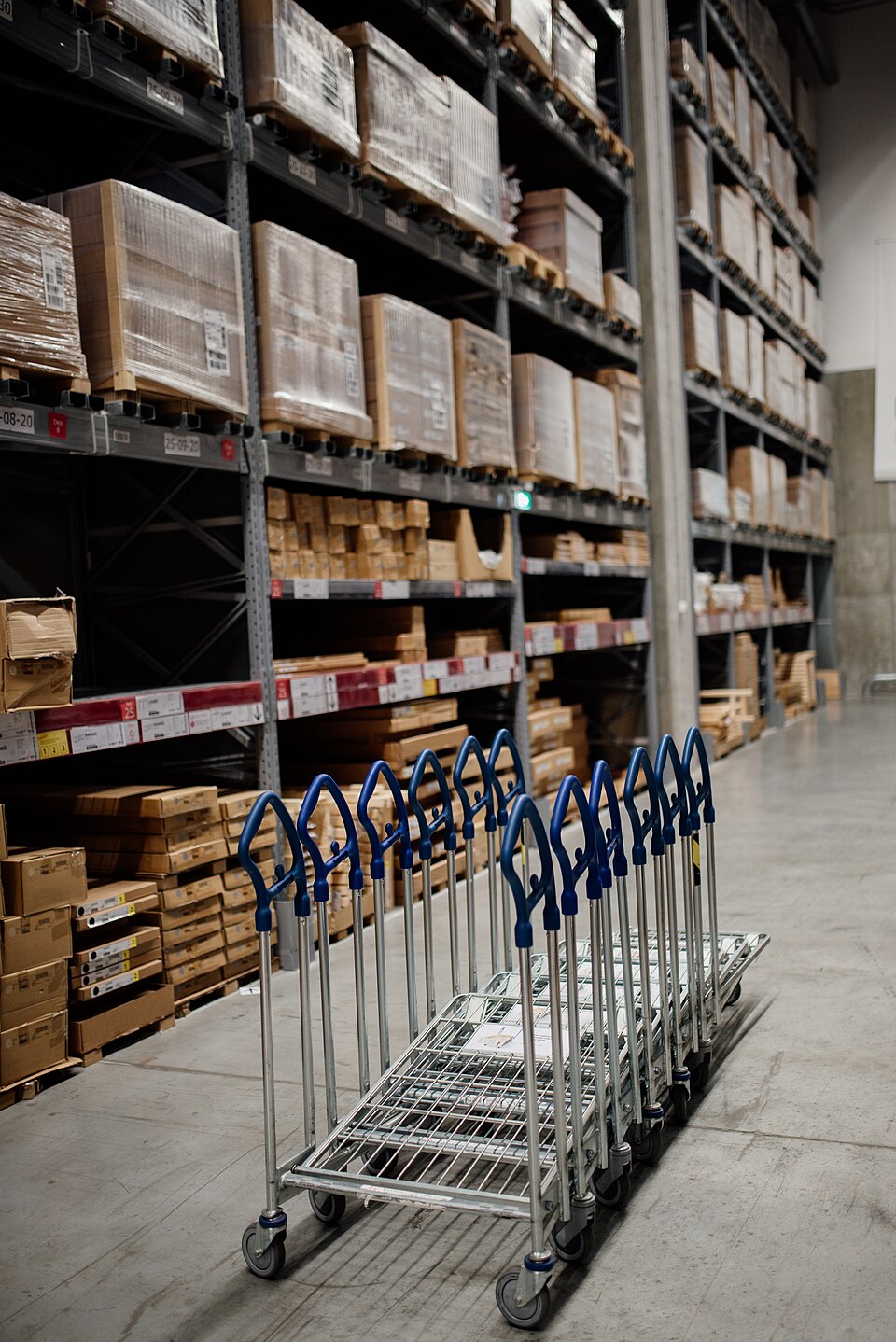
The eight genuine photographs are unrelated illustrations from eight distinct Wikimedia Commons source pages. Every draft caption links its photographer, original page and licence; the photo ledger records the visual purpose and file hash. None depicts Source Foshan work, the cited shopper’s order, a verified Foshan workshop or a production schedule for an actual project.