Guide · Shipping & consolidation
Shipping furniture from China: the complete 2026 guide to costs, containers, paperwork and delivery
Shipping furniture from China, step by step: LCL or a 33/67/76 m³ container, advertised rates, duty and VAT basics, packing, insurance and a 4-month plan.
- Furniture ships by volume: a 20ft, 40ft and 40ft high-cube container hold about 33, 67 and 76 m³ inside, but real furniture loads are noticeably lower.
- A Guangdong forwarder advertised RMB 1,230 per m³ door-to-door to the UK in June 2026; a London buyer reported paying RMB 23,000 for 9 m³ in May 2026. Adverts and invoices are not the same thing.
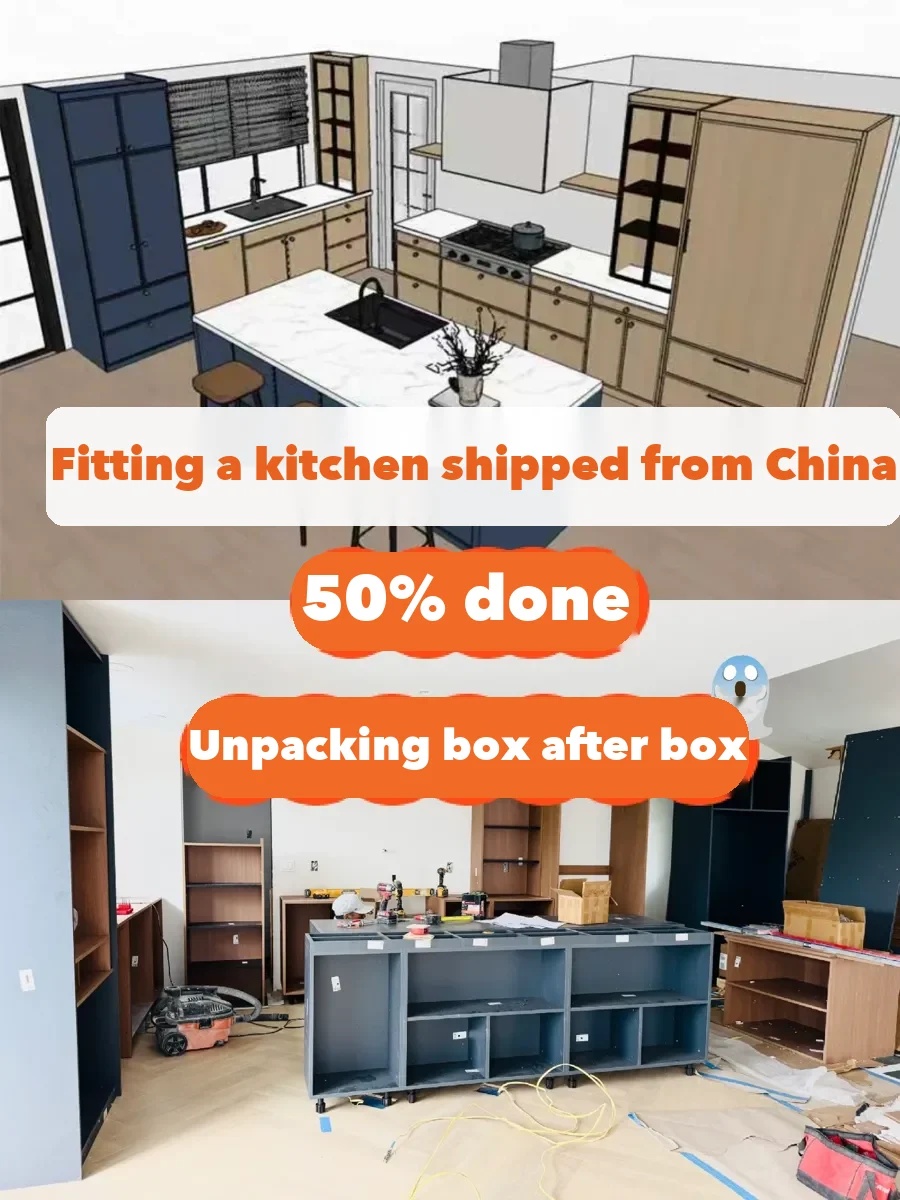
- A Seattle buyer’s custom cabinets took about five months from design to unloading, including a Chinese New Year production slowdown; her advice is to allow at least four months.
- Duty and tax depend on the destination and the HS code: at the time of writing the UK charges 20% import VAT and Australia 10% GST. Confirm with your customs broker.
- The buyers and designers we read agree on one point: once furniture is on the ship, there is almost no room for rework. Inspection has to happen in China.
Shipping furniture from China means moving goods from each factory to a consolidation warehouse, through Chinese export customs, across the sea in a shared (LCL) or full (FCL) container, and through import clearance to your door. Freight is priced by volume, so the real costs sit in packing, destination charges, duty and tax, and delivery. Allow three to four months from order to installation, and settle quality before the goods leave China, because returns after shipping are rarely practical.
How does shipping furniture from China actually work?
It is a chain of six handovers: factory, consolidation warehouse, export customs, ocean freight, import clearance and final delivery — and most problems start at the first two. Few overseas buyers order from a single factory. A sofa comes from Longjiang, a dining table from Lecong, lighting from another town, so the goods first have to meet in one place. That is the job of a consolidation warehouse: receive each delivery, count it, check it, re-pack it and hold it until the order is complete.
- Production and inspection at each supplier, against a written specification.
- Delivery to the warehouse, where cartons are opened, photographed, re-packed and labelled.
- Export declaration in China, using the commercial invoice and packing list.
- Sea freight, either as part of a shared container or in a container of your own.
- Import clearance at the destination: duty, VAT or GST, and any biosecurity checks.
- Delivery to kerbside or into the room, with unpacking, assembly and removal of packaging if you pay for it.
Our furniture shipping and consolidation service page shows how we run the chain for clients.
How much does it cost to ship furniture from China?
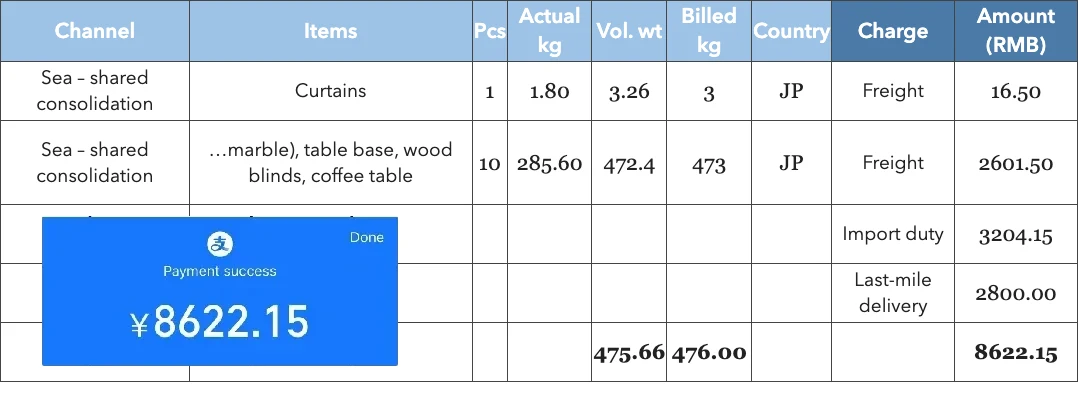
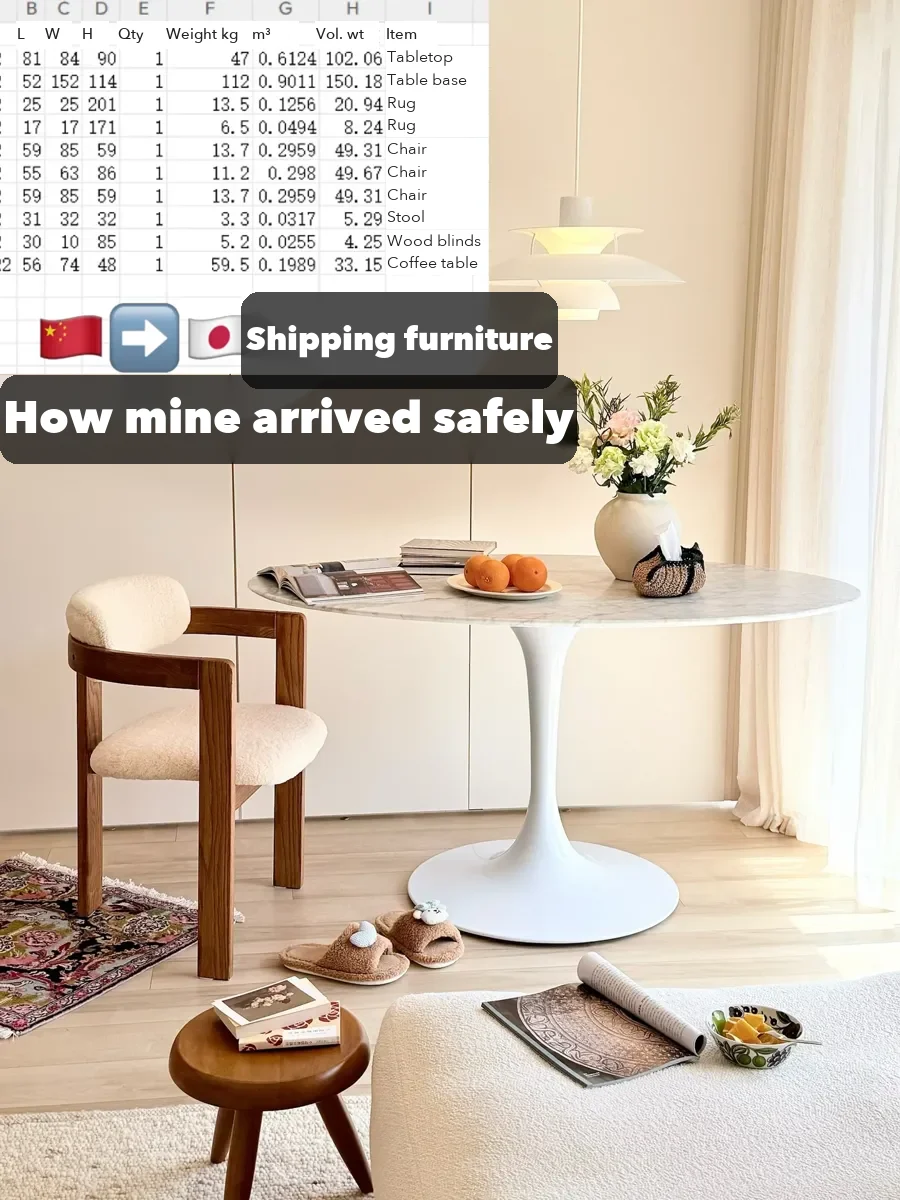
Ocean freight is usually the smaller part of the bill; packing, destination charges, duty, tax and delivery decide the total. A buyer in Japan who shipped 11 pieces in October 2025 broke her bill into five parts that apply almost everywhere: freight from China plus last-mile delivery at the destination, packing (crating is typically charged by the cubic metre), import tax, customs inspection fees, and insurance. She also reminds readers that carriers charge on whichever is higher, actual weight or volumetric weight — which is why her spreadsheet listed both for every piece.
Advertised rates give a rough starting point. Treat them as adverts, not quotes:
| Route | Advertised rate | Who posted it, when |
|---|---|---|
| China → UK, door-to-door, oversized goods | RMB 1,230 per m³, described as duties included | Guangdong logistics company, June 2026 |
| China → USA, oversized goods | RMB 6 per jin (about RMB 12 per kg) | Guangdong forwarder, April 2026 |
| China → Australia, US, Canada, Europe | About RMB 600–700 (Australia) to 1,390 (Europe) per m³ | Forwarder adverts, 2025–2026, collected in our US and Australia buyer records |
Invoices tell a different story. A London buyer reported RMB 23,000 for 9 m³ in May 2026 — roughly double the per-metre advert above, because her price included warehouse checks, crating, clearance and delivery with assembly. To estimate your own volume, start with how much furniture fits in a container, then read the destination guides for the UK and Canada.
The cheapest part of shipping furniture from China is the part everyone compares. Per-cubic-metre rates differ by a few hundred renminbi; a sofa built to the wrong spec, a crate that fails at unloading or a wrong customs declaration costs thousands. Choose the route by who checks the goods before the container is sealed, not by the freight rate. For an overseas buyer, the consolidation warehouse is the last place anyone can still fix anything cheaply.
Should you ship furniture LCL or in a full container?
Ship LCL (a shared container) for a few pieces; price a full container once your packed list approaches half of one. Standard containers hold about 33 m³ (20ft), 67 m³ (40ft) and 76 m³ (40ft high-cube) inside, but furniture never fills them perfectly: sofas cannot carry weight, crates add bulk and irregular shapes leave gaps. Moving companies on Xiaohongshu work on roughly 22–26 m³ of furniture in a 20ft box and 58–62 m³ in a high-cube.
LCL is charged per cubic metre with a minimum, and the goods are handled at a shared warehouse at each end. A full container (FCL) is a flat price per box, loaded once and opened by you. The crossover depends on the route and the destination charges; our LCL vs FCL comparison shows how to find it, and the France example works through one real lane.
What does the comment section add?
The comment threads under the cabinet and Japan posts add three practical warnings.
- “Door-to-door” did not mean duty paid. Asked whether her forwarder handled customs, the Seattle buyer replied that she had booked clearance and delivery to the door and still paid the new tariffs herself.
- What it cost. She put the whole order — kitchen, entry wardrobe, pantry and walk-in closet — at a little over RMB 70,000 including hardware, and chose veneered panels partly because she understood solid wood would complicate shipping.
- Beware planted referrals. Under the Japan post, a string of comments asks where to find a forwarder mentioned only by nickname further down the thread — a common pattern in referral marketing. Get quotes from forwarders you have checked yourself.
How long does shipping furniture from China take?
Plan for three to four months from order to installation, and longer if production crosses Chinese New Year. The clearest timeline in our research comes from a buyer in Seattle who ordered custom kitchen and wardrobe cabinets from a Chengdu company:
| Stage | Dates | Time |
|---|---|---|
| Design | mid-Nov – mid-Dec 2024 | about 1 month |
| Production (over New Year) | 15 Dec 2024 – 13 Mar 2025 | about 3 months |
| Received by forwarder → ship sails (one day late) | 17 – 28 Mar 2025 | 11 days |
| Sea freight to US port | 28 Mar – 9 Apr 2025 | 12 days |
| Customs clearance | 9 – 13 Apr 2025 | 4 days |
| Inland transport and unloading | 13 – 21 Apr 2025 | 8 days |
Only about three and a half weeks of that was at sea or in clearance; the rest was design and production. Her cargo also reached port on the day new US tariffs took effect — a reminder that duty rates can move while goods are afloat. Routes to Europe, the Gulf and New Zealand take longer at sea; see the New Zealand and Dubai and Gulf guides.
What paperwork, duties and taxes apply when you import furniture from China?
You need a commercial invoice, a packing list and a bill of lading, a correct HS code for each item, and a customs broker at the destination who knows the local rules. Most furniture falls under Chapter 94 of the Harmonized System, but the right subheading depends on material and use; our guide to furniture HS codes in Chapter 94 explains how to pick one. The code drives the duty rate, and the declared value drives the tax.
- UK: import VAT of 20% at the time of writing, plus any duty set by the commodity code.
- Australia: 10% GST, and a formal import declaration for consignments above AUD 1,000.
- New Zealand: biosecurity inspection of timber items and wood packaging, as well as GST.
- Canada, the UAE and the US: rules and rates differ and, for the US, have changed several times since 2025.
All of these are starting points, not advice — confirm with your customs broker before you order. Two warnings apply everywhere. First, adverts promising “duties included” mean someone else is making the declaration; ask whose name is on it. Second, several Xiaohongshu buyers say new furniture cleared as duty-free “personal effects”. Those exemptions generally cover used belongings of people moving house, not new furniture bought to furnish a home, and a wrong declaration can be costly.
How do you stop furniture arriving damaged?
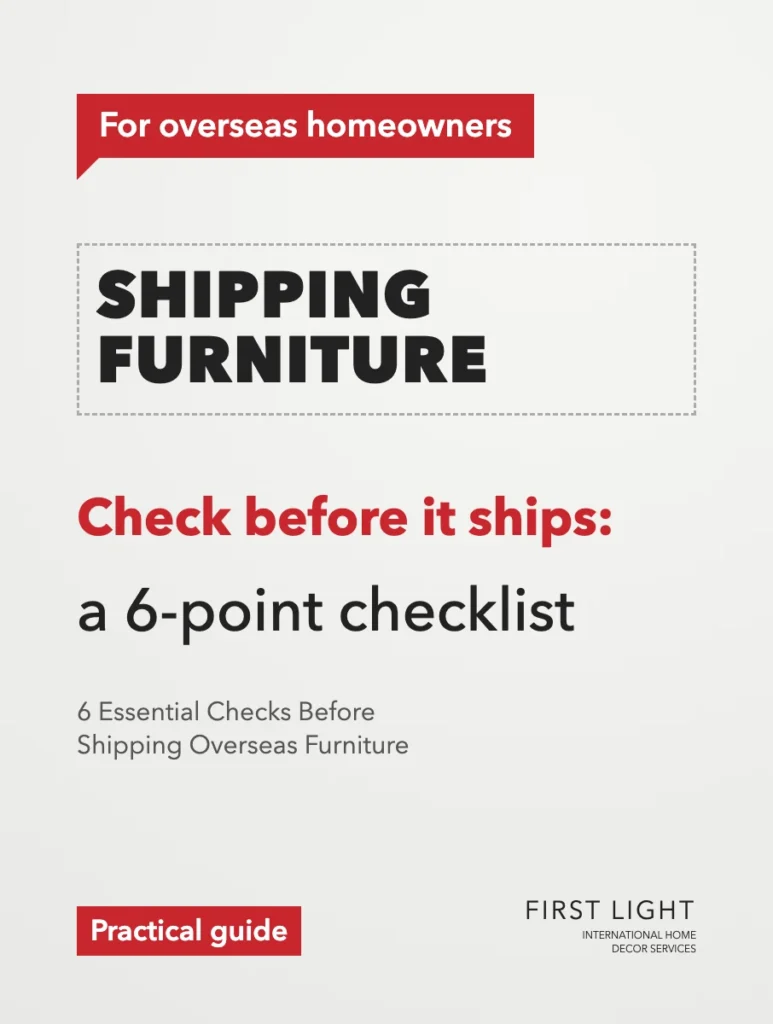
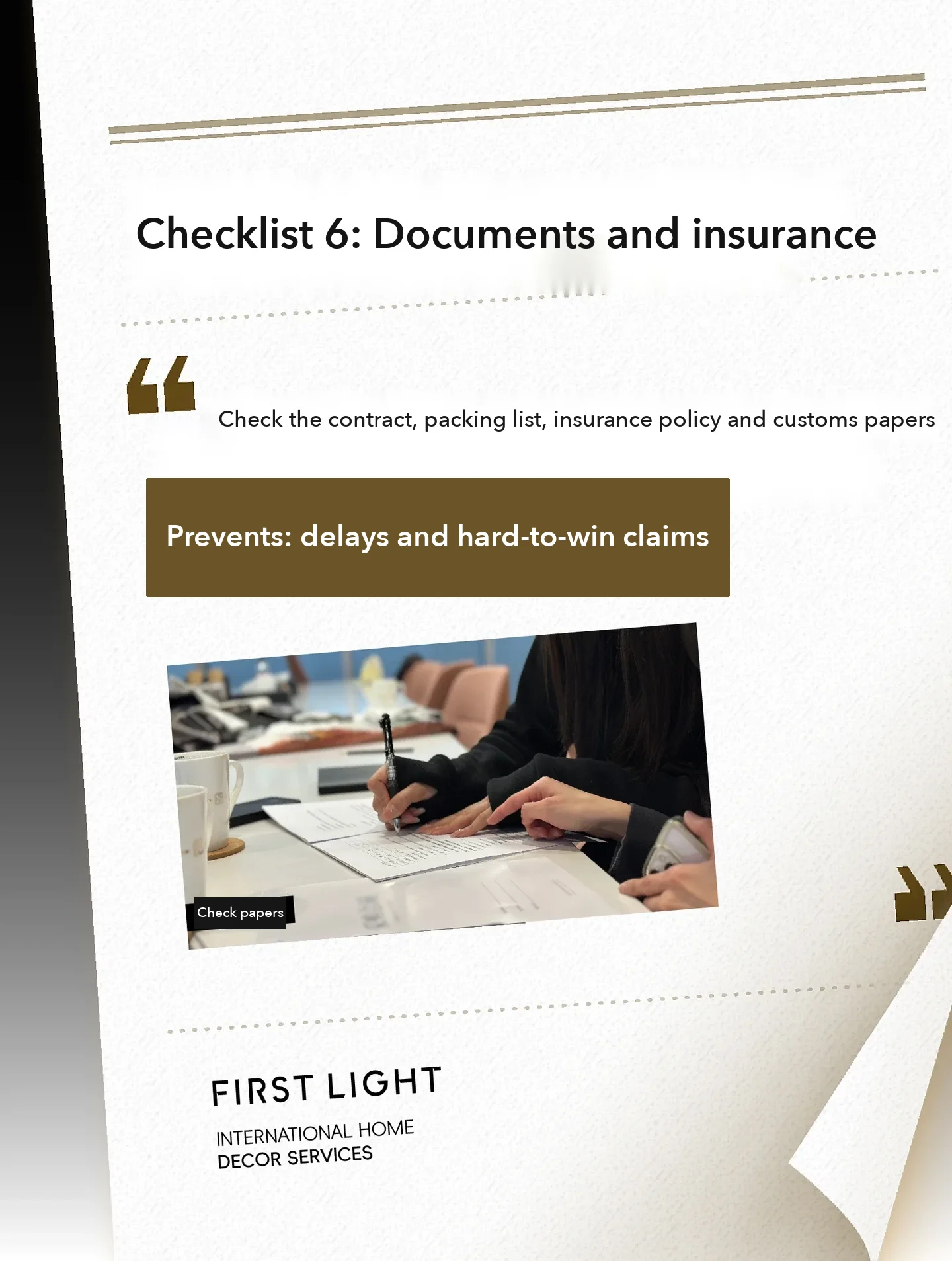
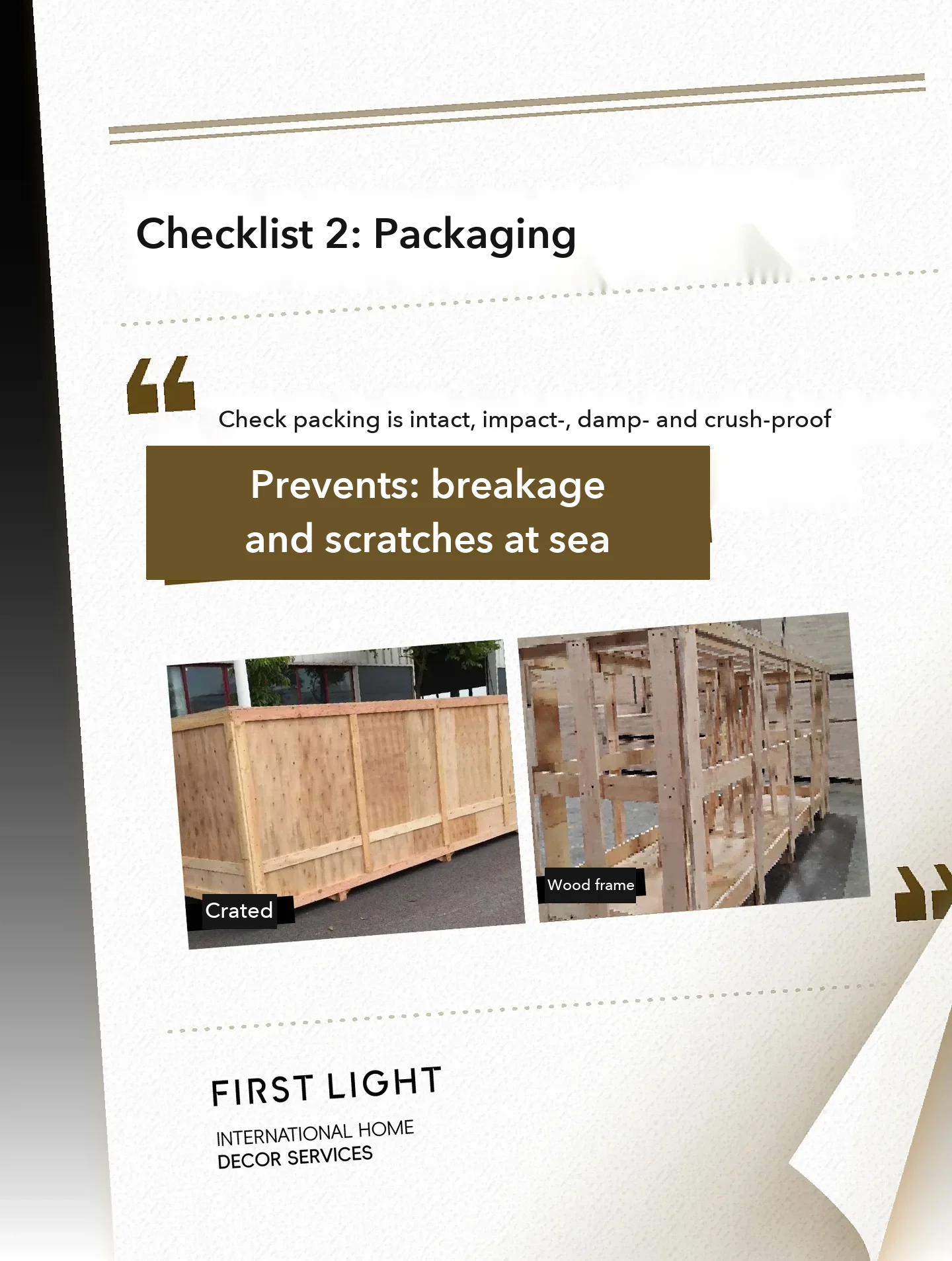
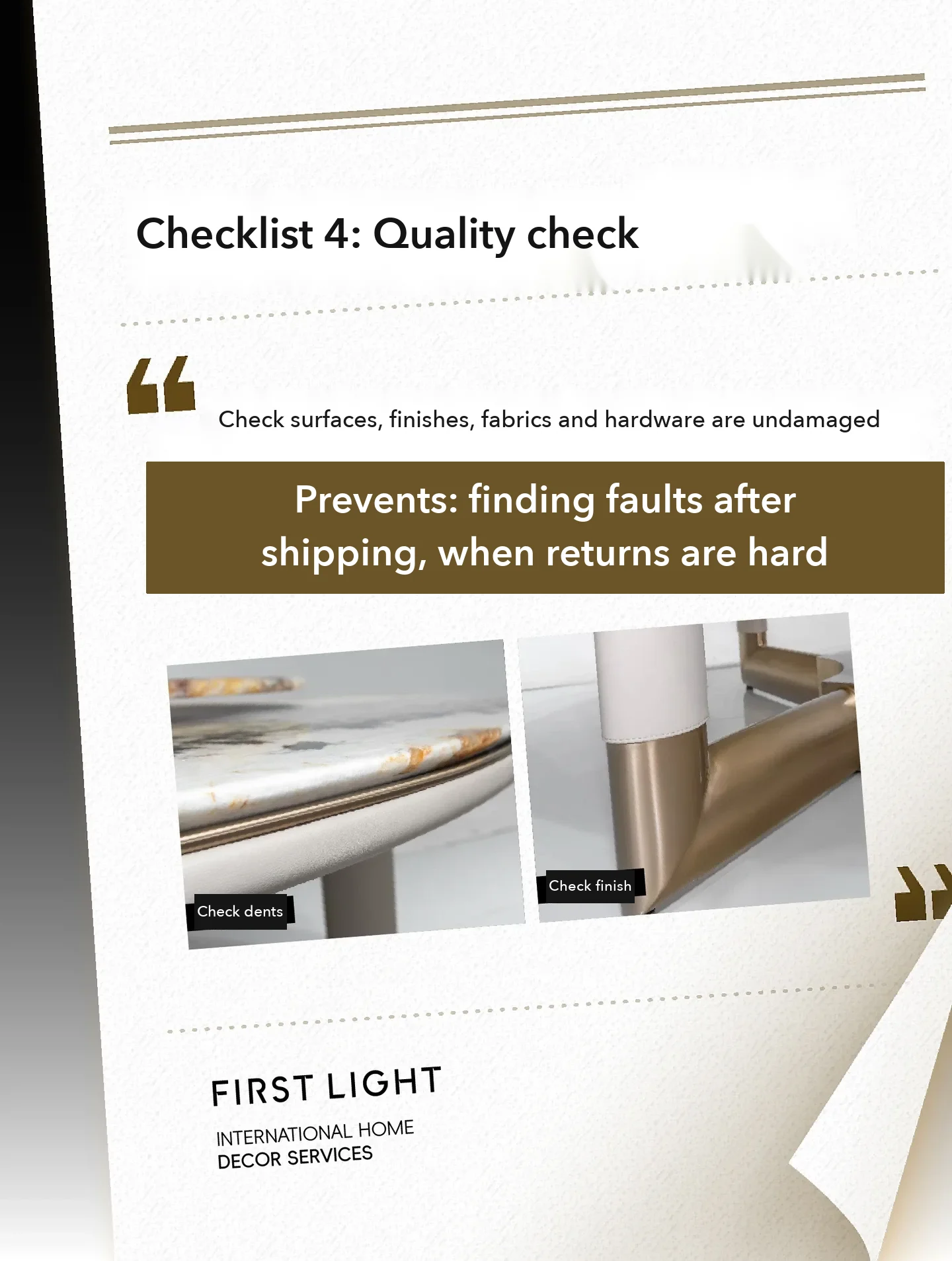
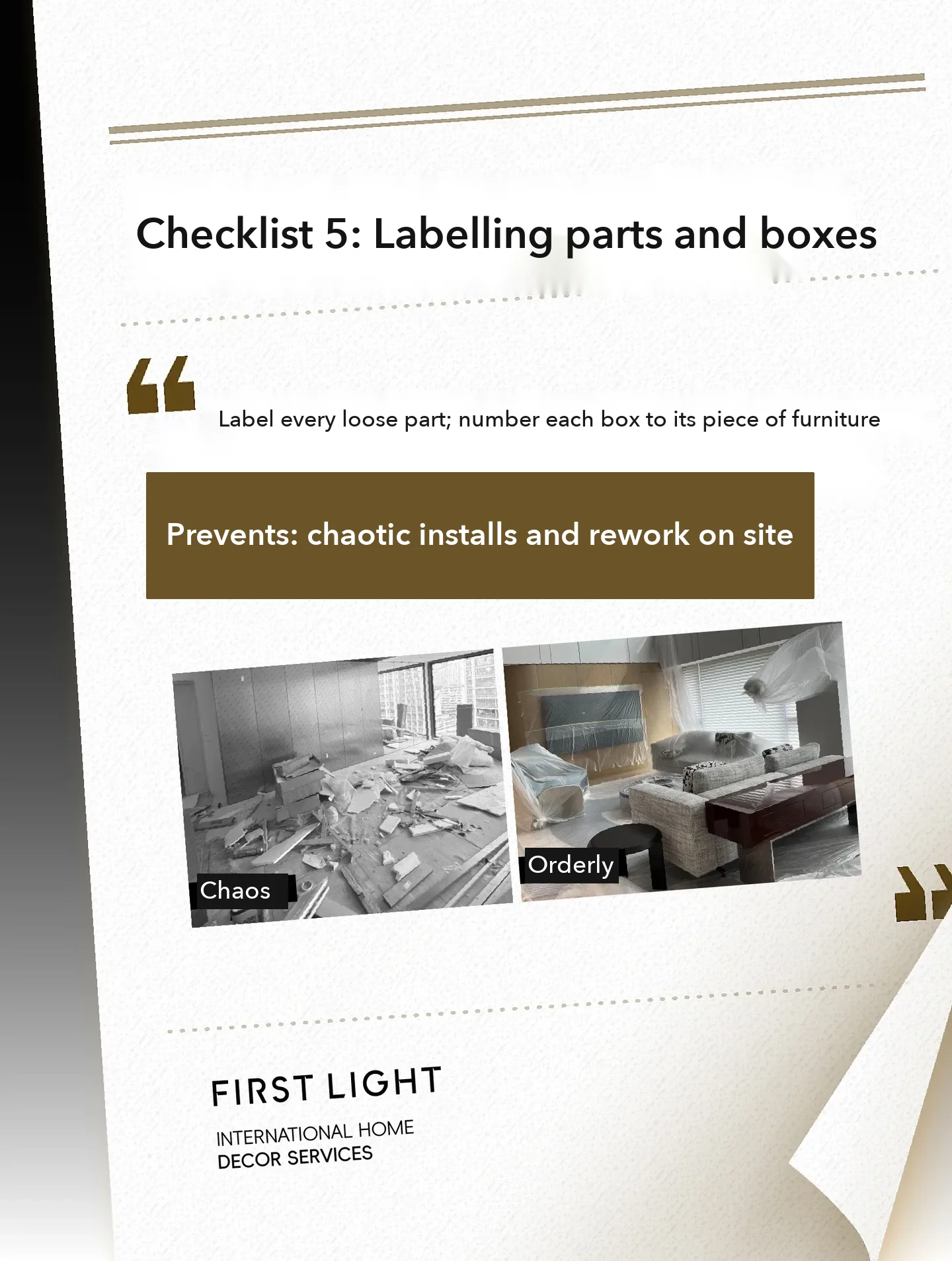
Inspect before the balance is paid, pack for the sea rather than the lorry, and insure the shipment. A design firm that ships to overseas villas lists six checks before sailing: measurements against doors and lifts, packaging, piece and fitting counts, finish quality, labelling of parts to cartons, and shipping documents with insurance. Its warning is blunt: problems found after the ship sails can almost never be returned.
Packing is where buyers disagree most. The Japan buyer had her marble dining table and coffee table crated at the factory and recommends the same for any stone or solid-wood custom piece. Wooden crates and pallets must meet ISPM 15 — the international rule for wood packaging, not for the furniture itself. Our export packing guide covers cartons, frames and crates, and damage, insurance and claims explains what cover to buy and how to claim. For inspection itself, use our furniture inspection checklist.
What happens at the destination: delivery, unpacking and installation?
Assume the basic price delivers to the kerb; carrying in, unpacking, assembly and removing crates cost extra and must be booked in advance. The Japan buyer found that last-mile delivery defaulted to the ground floor outside her building. Because her marble pieces were heavy and crated, she chose a forwarder with its own in-home team and felt it was worth the extra charge.
The Seattle buyer’s lesson ran the other way: her cabinets arrived with no installation instructions, and her installer spent a week working it out. Ask each supplier for assembly drawings, and have parts labelled to cartons and rooms before loading. Measure door frames, stairwells and lifts before you order, not when the lorry arrives — the most common failure in the design firm’s list is a piece that will not go through the door.
How Source Foshan handles it
We run the whole chain from Foshan. Goods from each supplier are delivered to one Foshan consolidation warehouse, where we check every item against the confirmed specification, record it in photos and video, re-pack to export standard and label each carton by room. You release the balance only after approving that inspection report. We then book LCL or FCL, coordinate the export documents, customs and door-to-door delivery, and send loading photos. One whole-home order for a Greater Bay Area residence brought 54 items from 9 suppliers into a single container. Our fee is 3–5% of order value, agreed in writing and shown separately from factory prices; freight is quoted by the carrier or forwarder at the time, not by us.
If you would rather buy from a catalogue that already includes the whole delivery path — list confirmation, protective packing, freight, export, customs coordination, truck delivery and installation with packaging removed — we recommend Arcaya Living, which curates more than 10,000 pieces sourced to confirmed specifications.
How Arcaya Living delivers · Arcaya's five-stage quality process · Browse the collections
FAQ
How much does it cost to ship furniture from China?
It depends on volume, route and what the price includes. Forwarder adverts in 2026 ranged from about RMB 600 per cubic metre to Australia to RMB 1,230 per cubic metre door-to-door to the UK, while one London buyer paid RMB 23,000 for 9 m³ with checks, crating, clearance and assembly. Add duty, VAT or GST and delivery before comparing with local prices.
How long does it take to ship furniture from China?
Allow three to four months from order to installation. The sea leg is often only a few weeks; production, consolidation and clearance take the rest, and Chinese New Year can add a month.
Is it worth importing furniture from China?
It can be for custom pieces, whole-home orders and designs you cannot buy locally, provided quality is checked before shipping.
Do I pay import duty on furniture from China?
Usually yes, plus VAT or GST. The rate depends on the HS code and the destination; at the time of writing the UK charges 20% import VAT and Australia 10% GST. Confirm with your customs broker.
Can new furniture be shipped as personal effects?
Generally not. Personal-effects or transfer-of-residence reliefs are designed for used belongings of people moving country. New furniture bought to furnish a home is normally declared as an import, and a wrong declaration can lead to penalties.
Should I use LCL or a full container for furniture?
Use LCL for a few pieces. Once your packed volume is around half of a 20ft container’s usable space, ask for both LCL and FCL quotes and compare the door-to-door totals.
Keep reading
Sources
- Xiaohongshu maker/seller source note (2026-01-14, 697 likes, 17 comments). View source
- Xiaohongshu buyer source note (2025-10-11, 226 likes, 34 comments). View source
- Xiaohongshu buyer source note (2025-05-03, 214 likes, 302 comments). View source
- Xiaohongshu forwarder source note (2026-06-16, 139 likes, 140 comments). View source
- Xiaohongshu forwarder source note (2026-04-15, 42 likes, 34 comments). View source
- Xiaohongshu buyer source note by @carcar. (2026-05-25, 132 likes, 23 comments). View source
- Xiaohongshu forwarder source note (2025-03-27, 339 likes, 137 comments). View source
Shipping a room — or a whole home — from Foshan?
Send your list or floor plan. We come back with compared factory quotes, an estimated packed volume, and whether LCL or a full container makes sense for your destination.