Ireland / Supplier transparency and shipment planning
Furniture Sourcing from Foshan to Ireland: Costs, Container Maths and How to Check Your Agent
Compare an auditable supplier offer, the complete EUR import scope and the right product evidence. Includes an editable budget model and Irish project worksheet.
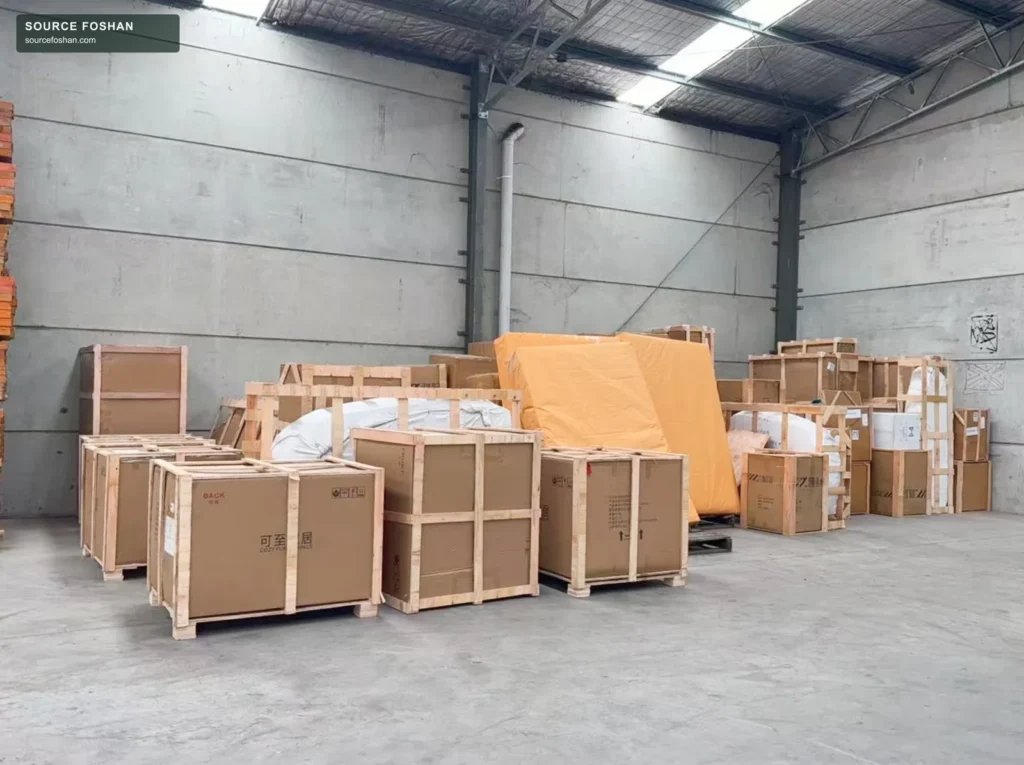
Ireland / Compare the goods, the fee and the handover
To source furniture from Foshan for Ireland, first approve an item schedule, the legal seller and an auditable fee arrangement. Then check product safety, packed dimensions, import documents and delivery to the actual Eircode. Ireland’s standard VAT rate is 23%; duty depends on the classified item. Compressed sofas, restaurant stools and banquettes need different specifications. A low factory price or a claim of “no commission” cannot establish the final cost or suitability.
Official and manufacturer sources checked 24 October 2026. Prices, packing examples and programme allowances below are illustrations. They are not Irish client invoices, current freight offers or a promised delivery date. This guide concerns the Republic of Ireland; Northern Ireland has a different importing route.
01 / Make the commercial trail reviewable
How do I know a Foshan sourcing agent is not hiding factory kickbacks?
Start with the purchasing model. An agent charges for an agreed service; a reseller buys and resells goods at its own price. Either model needs a clear contract, but their invoice trails and responsibilities differ. A supplier’s introduction, a warehouse photo or a “factory direct” badge does not prove which model you have bought.
- Identify the parties. Record the Chinese legal name, registration details, production address, exporter and person responsible for defects.
- Define the fee base. State the percentage or fixed amount, eligible goods value, currency, minimum and separately chargeable work.
- Ask for the underlying offer. Compare a dated factory quotation or pro forma invoice against the agent’s schedule, using the same item, fabric, hardware and packing.
- Reconcile payment. Independently confirm the beneficiary against the contracted seller. A changed bank account needs a separate verification channel; a matching name alone is insufficient.
- Require commercial disclosure. Put supplier commissions, rebates, credits and related-party interests in a written disclosure clause, including how later credits are handled.
- Keep goods and services identifiable. Separate factory money, service fees, samples, testing, warehouse work, freight and destination charges. An export commercial invoice is different from a mainland Chinese VAT invoice.
- Close the loop. Reconcile the accepted specification, purchase order, invoices, inspection findings, carton list and final statement before the agreed balance trigger.
لدى Source Foshan، published service policy states a 3–5% fee on an agreed order-value basis, no supplier commissions and orders from USD 10,000, with factory payments made directly against agreed milestones. Obtain the project-specific scope and exclusions in writing. On an assumed USD 10,000 fee base, 3–5% is USD 300–500; that arithmetic does not price testing, warehousing or Irish delivery. For the responsibility distinction, read agent, trading company and factory purchasing models.
02 / Compare a recovered sofa, not just its carton
Which Foshan suppliers make compressed sofas for Irish buyers?
Two public starting points are KCK.CASA, which describes a Foshan foam factory and advertises MOQ from 10 sets, and Maisen’s compressed-sofa range and FAQ. These are manufacturer descriptions, not evidence of an independently approved Irish shipment. Verify the contracting factory, exact model and required product evidence before treating a website as a supplier shortlist.
KCK.CASA advertises 36 kg/m³ foam and up to 70% less freight volume. Those are its stated product claims, not a market-wide compression ratio or an independent test result. Ask for the packed dimensions and gross weight of the actual configuration, the allowed compressed-storage period, recovery method, dimensional acceptance criteria and remedy if recovery fails.
A hypothetical 100-sofa order at 0.90 m³ per conventional package occupies 90 m³. At an assumed 0.30 m³ per compressed package it occupies 30 m³. That illustrates why carton data matters; it does not prove a threefold increase for your model, safe stacking or a threefold freight saving. LCL rating, handling and destination work still need separate offers.
- Approve an opened sample for comfort, dimensions, foam support, cover fit, seams, odour and stability.
- Agree a compression-and-recovery trial under stated time, temperature and storage conditions, with measurements at agreed intervals.
- Inspect the bag seal, carton identification, moisture protection and allowed stacking.
- Confirm whether a used or opened sofa can be returned economically; Maisen notes that an opened item cannot normally go back into its original carton.
- Require the actual upholstery/filling and safety evidence for sale or use in Ireland. A compact carton is not a compliance certificate.
Do not copy a universal 24–72 hour recovery promise into every purchase order. The model’s instructions and accepted sample determine the check. MOQ, colour mixing and warranty remedies must be confirmed for the specific supplier.
03 / Write the use into the seating specification
Where do I buy bar stools and banquette seating for an Irish restaurant?
Use Foshan showroom visits to compare comfort and finishes, then qualify the workshop responsible for metal frames, upholstery or fitted seating. A residential sofa producer need not have the drawings, fixing details or repeat-use evidence needed for a restaurant banquette. A supplier should identify the actual maker for each category, including subcontracted work.
| العنصر | Specify before quotation | Acceptance evidence |
|---|---|---|
| Bar / counter stool | Finished seat height, counter clearance, footrest, stability, floor protection, material and intended load/use | Dimensioned drawing, sample, appropriate strength/stability report |
| Dining chair | Frame construction, joints, replaceable glides, cleanability and upholstery combination | Approved reference and model-specific report against the agreed standard |
| Banquette | Each run in mm, seat depth, back angle, corners, plinth, wall/bench fixing, access and service openings | Site-checked drawings, module labels, finish sample and installation responsibility |
| Fabric and filling | Named cover/filling, cleaning method, abrasion target and fire-performance requirement | Report tied to the tested combination and actual supplied materials |
A banquette quoted “per linear metre” still needs a dimensioned plan: a corner, high back, removable panel and curved run do not have identical costs. As an illustration, 8 metres at an assumed USD 200 per metre is USD 1,600 before other agreed charges. This is a budgeting input, not a supplier price band. Quote tables, loose chairs, packing and installation separately.
Ask the project’s responsible adviser and test laboratory which edition and severity of structural and ignition testing applies. EN 16139 and EN 1021 may form part of the specified evidence; a report must identify the item and construction tested. “Crib 5 fabric” or a BIFMA logo does not by itself approve every finished restaurant seat. The restaurant warranty and package guide explains why the defect remedy and spare-parts responsibility belong in the order.
04 / Keep USD offers separate from EUR import costs
What does furniture from Foshan to Dublin actually cost?
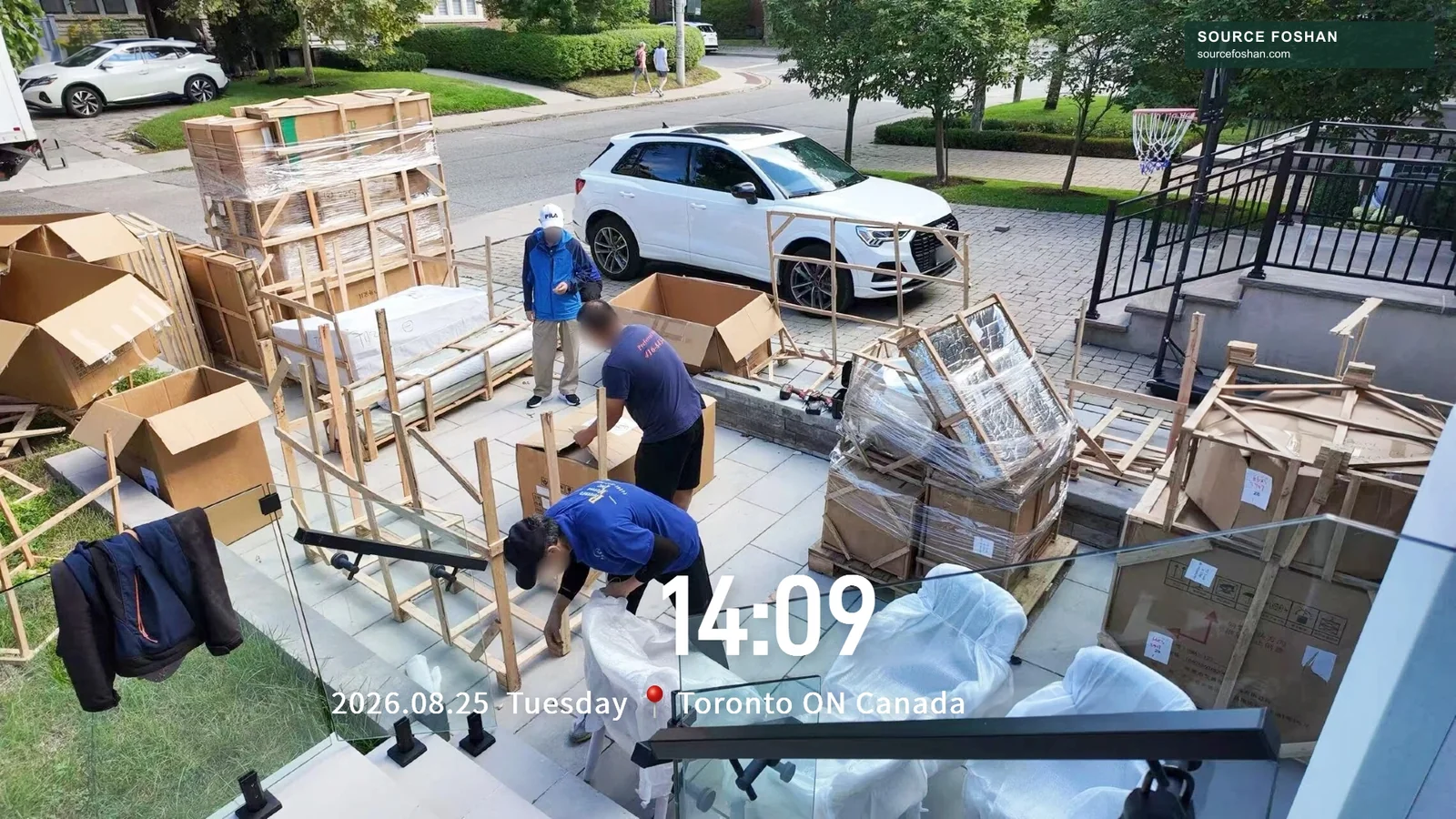
Compare an itemised offer with origin work, sea freight/insurance, duty, VAT, broker/port charges, delivery and installation on the same basis. An EXW factory figure cannot be compared directly with a delivered and assembled Irish quote. Name the Incoterms rule, port/place, importer and handover level.
Editable EUR illustration
What changes between the USD goods offer and the Irish import budget?
The defaults are assumptions. Replace them with confirmed, non-overlapping inputs. The 2% duty is a scenario, not a TARIC determination.
Simplified customs value = converted goods + entered border freight/insurance. The VAT base adds ordinary duty and entered relevant onward costs. Unentered valuation adjustments, trade-remedy duties, service fees, testing, port work, delivery and installation are excluded, not free. This is not a customs declaration or a complete landed quote.
Revenue’s current standard VAT rate is 23%. Its import-VAT guidance includes duties and relevant transport costs in the taxable amount. Postponed accounting and input-tax recovery have conditions; neither means the goods are VAT-free. Your broker must establish valuation and the actual tariff treatment.
Download the Irish supplier and import-scope worksheet. Ask for current Dublin and Cork options and the actual Eircode delivery quote. Price unloading, stairs, two-person handling, assembly, packaging removal, free time and storage explicitly. No live ocean rate or universal LCL-to-FCL crossover is asserted here.
05 / Use cartons and matched freight scopes
What MOQ and container size makes an Irish order worthwhile?
Factory MOQ is normally attached to a model, finish or production run. A mixed shipment can combine accepted orders from different suppliers; it does not automatically cancel each factory’s minimum. Stock, samples and small custom runs need their own terms. Source Foshan’s published USD 10,000 project starting point is a service policy, not an Irish customs threshold.
Maersk’s nominal dry-container volumes are 33.2 m³ for 20 ft, 67.7 m³ for 40 ft and 76.4 m³ for 40 HQ. At a hypothetical 80% space use, the planning volumes are 26.56, 54.16 and 61.12 m³. Doors, weight, carton shapes, safe stacking and restraint still control whether the load fits.
For LCL, compare the actual minimum, weight/measure basis, origin handling and Irish CFS/destination fees with an equivalent FCL handover. Use the LCL/FCL comparison tool; do not assume that 12 or 15 m³ always makes a full container cheaper. Include warehouse receiving dates, storage charges and the response when one factory is late. Buy the pieces the project needs rather than filling a container with slow-moving stock.
06 / Work backwards from usable rooms
How long from first brief to furniture delivered in Ireland?
| المرحلة | Allowance | Release record |
|---|---|---|
| Brief and comparable offers | 1–2 | Item schedule, exclusions, fee basis |
| Samples and drawings | 2–4 | Approved material and technical references |
| Manufacturing | 5–8 | Factory slot after approvals and agreed deposit |
| QC, correction and consolidation | 1–2 | Release findings and carton reconciliation |
| Ocean planning allowance | 5–8 | Actual sailing, transfers, cut-offs and ETA |
| Entry and local handover | 1–2 | Clearance and delivery appointments |
| Separate contingency | 2 | Opening-date buffer |
| Sequential illustration | 17–28 | Not a carrier schedule or delivery guarantee |
Testing, drawing revisions, materials and holiday closures can change the sequence. Ask each factory for its actual closure and restart dates, particularly around Chinese New Year. Obtain a current sailing rather than treating a port-to-port advertisement as a first-enquiry-to-opening programme. Confirm building readiness and installer availability separately from the vessel ETA.
07 / Check the rule for the product and use
What documents and safety requirements apply in Ireland?
- Customs identity and entry: the Irish importer/broker needs the correct registration and entry route. Revenue’s EORI guidance describes ROS registration and the required Eircode.
- Commercial records: itemised commercial invoice, packing list, bill of lading/transport record, material/origin information and the agreed insurance evidence. The broker confirms the commodity codes and any origin documents actually required.
- Duty and measures: use the EU CN/TARIC classification route. Seats, mattresses, cabinets and electrical items are not one tariff entry.
- Product safety: Under the EU General Product Safety Regulation, identify the responsible EU economic operator, risk assessment, traceability, instructions and evidence appropriate to the actual product. Ordinary non-electrical furniture does not acquire a universal CE requirement simply because it is imported; check the Commission’s product-specific CE guidance.
- Wood packaging: Follow Ireland’s ISPM 15 guidance for regulated solid-wood pallets/crates; distinguish packaging from the furniture’s own material requirements.
Irish furniture safety changed in 2026
On 24 July 2026, Ireland’s enterprise department announced revocation of the 1995 domestic-furniture fire-safety order, aligning the framework with the EU General Product Safety Regulation. This does not remove the obligation to supply safe products. Avoid treating old UK fire-label advice as the whole Irish rule. For a restaurant or hotel, have the responsible project adviser define the applicable legal, building, insurer and performance requirements for the supplied construction.
For in-scope furniture and wood-based articles, REACH’s formaldehyde restriction applies a 0.062 mg/m³ limit under its prescribed test conditions after 6 August 2026, subject to its scope and exceptions. A panel described only as “E0” or “E1” is not proof that the finished item meets that requirement.
For covered wood products, check the EUDR product code, operator role and transitional rules. The Commission’s implementation guidance gives 30 December 2026 for large/medium operators and 30 June 2027 for micro/small operators, with an earlier date for micro/small operators already covered by the EU Timber Regulation. Do not use a blanket six-month extension or assume all furniture is covered. Start collecting applicable species, origin and traceability data before placing the order.
08 / One accountable item schedule
How does the Foshan sourcing process work for an Irish project?
- Send drawings or a line list, intended use, quantities, reference photos, budget currency and Eircode.
- Agree the sourcing scope, fee base, legal purchasing model and comparable-offer requirements.
- Review itemised offers with materials, dimensions, packing data, MOQ and exclusions.
- Approve drawings, physical samples and the compliance/test plan before release.
- Accept the purchase order, payment milestones, inspection access, defect remedies and spare-parts terms.
- Inspect against those references, close material findings and reconcile multi-factory cartons before shipment.
- Confirm the actual booking, importer/broker, documents, receiving appointment and agreed local delivery/installation scope.
A 30/70 payment proposal is a negotiated milestone arrangement, not a protection mechanism on its own. Do not assume a deposit is refundable or that the balance can wait until a bill-of-lading copy unless the seller accepts those terms. The supplier payment checklist helps define the release conditions. Use the Source Foshan sourcing service for the item-specific proposal and the Ireland shipping service page to scope the destination handover.
Irish furniture sourcing questions
Are Foshan markets cheaper than buying directly from a factory?
Compare identical specifications, quantities, packing and responsibilities. Stock from a showroom may suit a small mixed order; a factory run may suit repeat quantities. There is no verified universal percentage difference.
Can several factories share my container to Ireland?
Yes, subject to agreed warehouse receiving, cut-offs, inspection and document responsibilities. Mixing does not waive factory MOQs. Ask for the storage and late-supplier charges before committing.
What duty and VAT will I pay?
The standard Irish VAT rate is 23%. The actual duty and other measures depend on the product’s classification and origin; have the broker confirm the customs and VAT bases. The tool’s 2% duty is illustrative.
Do all compressed sofas recover within 24 hours?
No universal recovery time is established here. Obtain the model-specific instructions, allowed storage period, recovery test and remedy. Inspect an opened sample as well as the shipping package.
Does EN 1021 alone approve a restaurant banquette?
No single test report establishes every project requirement. Match the actual cover/filling and construction, strength/stability evidence, intended use and current Irish rules with the project’s responsible adviser.
What is the minimum order worth importing?
Compare the same delivered scope using actual cartons and LCL/FCL quotes. Source Foshan’s published service starting point is USD 10,000; individual factories have their own model/colour minima.
Who checks furniture before the container is sealed?
Name the appointed inspector and scope in the order. Require findings on specification, dimensions, finish, quantity, hardware and packing, with photos and a correction/release record. Sampling is not a guarantee that every hidden defect is absent.
Can the shipment go to Cork or Galway?
Request the current port/routing and an Eircode-based final-delivery offer. Confirm unloading, access, stairs, assembly and packaging removal. Port arrival and room placement are different handovers.
Your next step
Send the item list, intended use and Irish Eircode.
Include sofa/seating construction, quantities, drawings, packed dimensions, budget currency and required handover. Identify unknown cost and compliance lines.
Sources and calculation scope
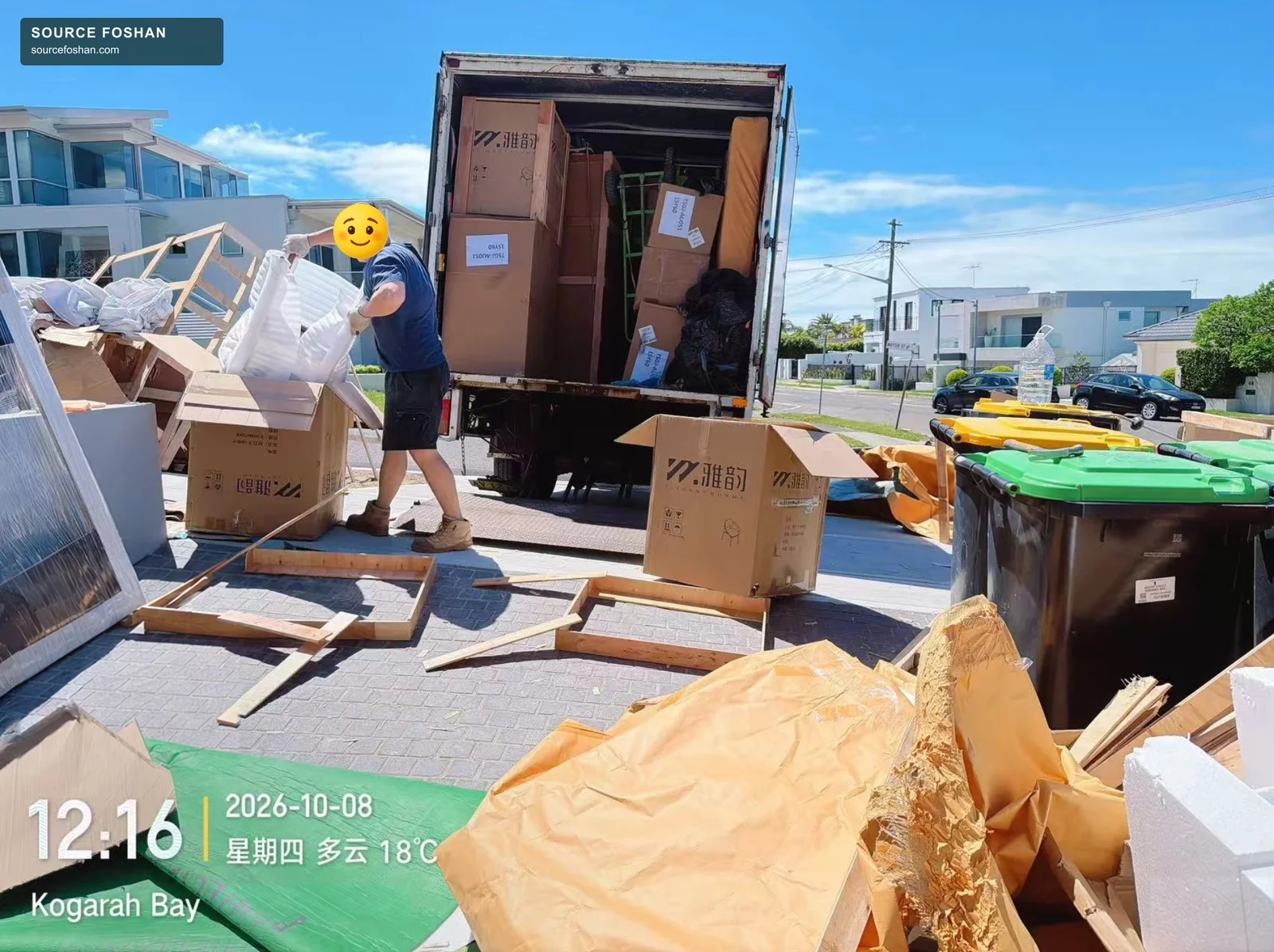
Official Revenue, EU and Irish safety sources are linked beside the relevant guidance. Supplier descriptions are attributed to the named manufacturer. The budget, compression, MOQ decision and programme examples are planning illustrations. Sydney photographs show actual receiving/unloading stages, not an Irish order, customs outcome, compressed-sofa test or freight quotation.