دليل الشراء
Modular sofa specifications for overseas buyers
Specify a modular sofa as a set of identified components and an approved assembly, not as one product photograph or one overall width.

Specify a modular sofa as a set of identified components and an approved assembly, not as one product photograph or one overall width. Your purchase document should show every seat, corner, chaise, arm, ottoman and connector; the exact left/right viewing convention; each module’s finished and packed dimensions; the upholstery code and sample; and the route each packed module must take to the room. Ask the supplier to confirm the final configuration with a top-view drawing, component list and assembly evidence before production release.
This is a procurement method, not a claim that all modular systems use the same joints or sizing. Even within one retailer, named combinations list separate seat, chaise, arm and cover components. IKEA’s published JÄTTEBO right-chaise combination is a useful example of a bill of components, not a specification for a different factory. The buying sofas from China guide covers broader supplier selection; this guide addresses the module identity and handoff problem after a style is chosen.
Start with a fixed-view drawing
Draw the room from above, mark the main entrance, window and circulation path, and put an arrow labelled viewing direction on the sofa elevation. Define “left-hand chaise” as left when facing the sofa from that arrow, or use an explicit coordinate such as “chaise on the east end.” Suppliers, buyers and installers can otherwise describe the same corner from opposite sides. A front photograph alone cannot show which edge is intended to meet a wall or whether an exposed back is fully upholstered.
Give each physical component a stable code: for example, M01 armless seat, M02 corner, M03 right arm, M04 ottoman. Put the code on the plan, component schedule, approved sample label, carton and installation instruction. If a “three-seat” offer actually contains two seat modules, one chaise and two separate arms, record all five parts. Confirm whether the quoted overall width includes arms, gaps and connector tolerances. Ask for a finished dimensioned layout of the assembled piece and an individual dimensioned view of each module.
Write a module schedule that can be checked
A concise schedule is more useful than a long adjectives-only specification. The example below is fictional; its dimensions are illustrative and must not be copied as a product standard.
| ID | Function and orientation | Finished W × D × H | Packed outer W × D × H | Required interface | Finish reference | هوية كرتونية |
|---|---|---|---|---|---|---|
| M01 | Armless seat at west side | 850 × 960 × 760 mm | 900 × 1,010 × 790 mm | M02 at east side | Fabric F-07, approved swatch S1 | C01 |
| M02 | Corner, open to room | 960 × 960 × 760 mm | 1,010 × 1,010 × 790 mm | M01 west; M03 south | Fabric F-07, swatch S1 | C02 |
| M03 | One-seat right-arm section | 850 × 960 × 760 mm | 900 × 1,010 × 790 mm | M02 at north side | Fabric F-07, swatch S1 | C03 |
| M04 | Loose ottoman, optional | 850 × 850 × 430 mm | 900 × 900 × 460 mm | No fixed connector unless specified | Fabric F-07, swatch S1 | C04 |
The actual schedule also needs unit of measure, dimension datums and allowed variation agreed with the supplier. “Depth” might mean the full frame, cushion to back, usable seat or chaise projection; label each separately. Record assembled seat height with the final leg and cushion, plus leg height and underside clearance if these matter to the room. The sofas and sectionals category helps establish the product scope, but the signed schedule governs the particular order.
Make the connection method an approval item
Ask for the connector part number, material, quantity per joint, installation direction and a clear photograph of the underside of two joined modules. Can the modules be separated without tools? Is a missing connector available as a spare? Does the joint require access beneath a heavy frame after the sofa is against a wall? A successful showroom assembly is not enough if the export cartons omit clips or the destination installer does not know which joint goes where.
The supplier should assemble the exact planned configuration before packing and record: plan revision, module IDs, joint close-ups, seam alignment and a short lift or movement check appropriate to the design. Do not invent a universal load or pull-force limit. Agree on the relevant method and acceptance evidence with the supplier or a qualified inspector for that product. A useful buyer hold rule is simple: if the required connector, mating position or installation sequence is undocumented, the configuration has not passed the assembly gate.
Control upholstery across adjacent modules
Approve a physical fabric or leather sample with a supplier code, color, texture, backing and intended cleaning information. Record the approved swatch ID against every module, including the ottoman and replacement covers. Ask whether all visible modules can be cut from the same dye lot or otherwise matched against an agreed range sample. Natural material and lighting differences need a defined comparison method; a phone image under unspecified lighting cannot settle a dispute over shade or nap direction.
For patterned upholstery, mark the pattern direction and repeat on the top-view plan, then specify which seams should align. For fabric, ask which covers are removable and what the exact manufacturer’s care instruction is; do not infer washability from a sales photograph. If a leather offer combines materials on visible and hidden faces, identify those faces on the component drawing. An approved swatch controls material identity, while a preproduction assembled photograph helps reveal whether adjacent modules actually look like one set.
Resolve access before approving the module split
Measure the clear opening of the building entrance, lift, corridor turns and room door, including usable height after door closers and handles. Compare those clearances with the packed dimensions and turning path of the largest individual module, not just with the assembled sofa’s footprint. Ask whether legs or arms ship separately and whether removing them is authorised under the supplier’s assembly instructions. Document who will receive, carry, unpack, assemble and remove packaging at destination.
A first-person Xiaohongshu buyer account describes the buyer having to receive, unpack, move upstairs and join a sofa after delivery and installation expectations were disputed. It is one buyer’s account, not evidence that a named seller breached a contract or that any particular modular system has a defect. Its useful procurement lesson is to put delivery, handling, module joining and packaging removal into the written scope with a named responsible party.
Use one carton-to-room crosswalk
Before the goods leave the factory, require a packing list that maps each module ID to a carton ID, gross mass, packed dimensions, protection type and intended room. Photograph the module label before wrapping and the carton label after sealing. If a warehouse repacks C02, retain the original-to-new-carton mapping. At destination, the receiver should count cartons and note external condition; the installer should then verify the components and connectors before destroying packaging. Counting four cartons does not prove that the correct left or right arm is inside.
For a mixed furniture shipment, put this sofa crosswalk into the larger furniture inspection and shipping workflow so a held or missing module is visible before container release. If a module is missing, do not substitute an apparently similar piece without checking its frame interface, upholstery lot, handedness and dimensions against the approved configuration.
Work through a late change without losing identity
Suppose the fictional buyer sees the plan and wants M03 changed from a right-arm seat to a left-arm seat after the fabric is ordered. A verbal “flip it” request is unsafe: the existing module may have one finished end, a direction-specific connector or an asymmetric cushion. Issue a new drawing revision and ask the supplier to mark whether M03 can be reconfigured or must be replaced by a new code, say M05. Then update the quotation, fabric consumption, inspection views, packing list, installation instruction and destination room plan. Keep M03 in the revision history rather than silently renaming it.
This change-control test is also a buying test: can the supplier return a revised component schedule that reconciles all sections, arms, covers, connectors and cartons to the same top-view drawing? If not, pause production release. IKEA’s published VIMLE corner combination demonstrates that a commercial combination can comprise multiple distinct section and arm products; it does not establish compatibility for another brand.
Release the order with a small evidence packet
The final buyer packet should contain an approved top-view plan with viewing arrow; the signed module schedule and finish sample IDs; connector and assembly details; an access survey compared with packed module sizes; a module-to-carton list; and the supplier’s exact-configuration assembly photographs. Name the person authorised to approve revisions and to hold a shipment with a wrong module. The immediate next action is to send the supplier this packet as a fillable request and ask them to return one reconciled version before the deposit or production release milestone agreed in your contract.
المزيد في أدلة الشراء.
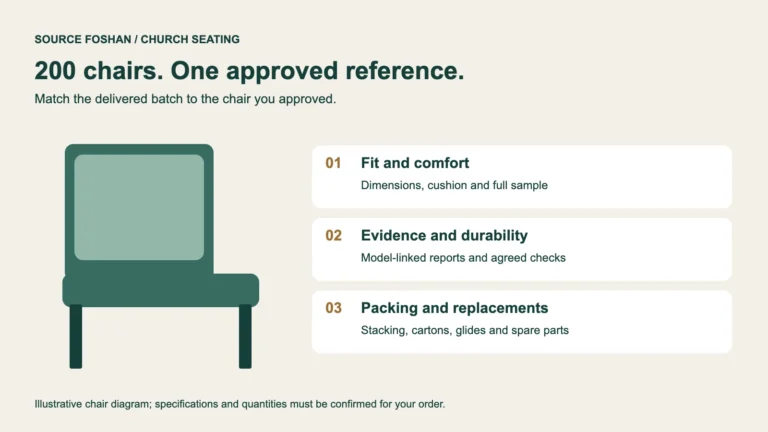
Buying 200 Church Chairs from China: Specifications, Samples and Landed Cost
Use a 200-chair planning example to organise specifications, sample approval, inspection, packing and the cost of delivery to your US site.
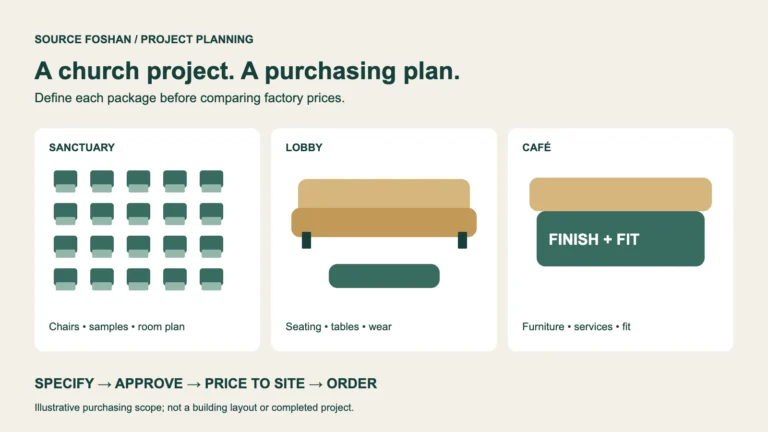
Church Renovation Sourcing from China: Is It Worth It for a US Project?
A practical guide to choosing import candidates, comparing complete installed costs and planning delivery for a US church renovation.

Accent chair specification beyond the showroom photo
Approve an accent chair by its measured seat, construction, finish and delivery configuration, not by a styled showroom photograph.