Notas de campo
How to reconcile Chinese and English Foshan furniture quotes
Keep the Chinese original, translate it field by field , and ask the seller to approve a single bilingual revision before ordering.

The short answer: keep the Chinese original, translate it field by field, and ask the seller to approve a single bilingual revision before ordering. Match model and variant codes, dimensions and units, material codes, quantity, unit price, currency, included services, delivery point, lead time, payment milestones and validity. Do not rely on a smooth English paragraph that says “same as discussed.” A translation can be grammatically correct while omitting a packing charge, changing a dimension datum or treating a colloquial Chinese delivery phrase as a formal trade term.
Los guía de mercados de mobiliario de Foshan helps buyers find and assess showrooms. The published sourcing-report quote comparison guide helps compare different offers. This article solves a narrower problem: how to prevent one seller’s Chinese and English quote versions from turning into two different purchase scopes. The eight licensed photographs below are unrelated illustrations, not a Source Foshan quotation, seller or shipment.

Preserve the original and give the quote an identity
Save the original PDF, spreadsheet, chat message or photograph before converting it. Record sender, company, date, local time, currency and the exact item discussed. Assign a buyer reference such as FS-Q-017-R0. If the seller first gives a spoken price, write a recap in the same chat and request confirmation; do not label your own note a supplier-issued quote. The original Chinese string should remain visible next to the translation, so a later reviewer can see whether a disputed word was in the seller’s document or added by a translator.
A first-person Xiaohongshu furniture buyer account describes failing to record an on-site price and later being unable to substantiate a discrepancy with a subsequent offer. That narrow self-reported gap supports a written, dated price record. The post concerns a Shenzhen shop, not a verified Foshan seller; its claims about the named merchant, service, quality and comparative prices are not adopted here. It says nothing about translation quality. The bilingual controls below are an editorial method, not the author’s method.
The U.S. International Trade Administration’s pro forma invoice guidance lists seller and buyer identities, items, unit and extended prices, dimensions and weights, sale term with delivery point, payment terms, estimated shipment and quote validity among useful fields. It is export-document guidance, not a declaration that one template is legally sufficient in every destination. Use it as a completeness prompt, then check transaction-specific import and contract requirements with the responsible professionals.
Make one line register in two languages
For each commercial line, create columns for field ID, Chinese original, English rendering, code or unit, source document/page, status y seller confirmation. Keep product codes as written; do not translate an alphanumeric model into a marketing name. If the Chinese says 型号 A17-W, the English line should still identify A17-W. Record whether a photo, physical swatch or drawing relates to that exact variant. “Brown sofa” is not a safe replacement for a variant code when multiple widths and fabrics exist.
Translate values and meanings, not just labels. 规格 may be a set of dimensions or a variant description. 尺寸 needs named datums: overall width, seat width, depth, height, assembled or packed. 材质 may identify a visible finish without specifying concealed construction; ask for a component-level schedule where that matters. 数量 must say units, sets or cartons. The translator should flag ambiguity in the seller’s source rather than silently make a buying decision. If the original is incomplete, leave an unresolved field and send a question to the seller.

Use a compact glossary as a prompt, never as a substitute for the seller’s actual document:
| Chinese label | Working English rendering | Clarification to request |
|---|---|---|
| 型号 / 款号 | model / item code | Exact orderable variant and revision |
| 规格 / 尺寸 | specification / dimensions | Named datums, units, assembled or packed |
| 材质 / 面料 | material / upholstery | Component, grade and sample code |
| 单价 / 合计 | unit price / line total | Currency, quantity basis and arithmetic |
| 包装 / 木架 | packing / wood frame | Layer, carton count, raw-wood status and cost |
| 运费 / 安装费 | freight / installation charge | Route, destination, access and exclusions |
| 含税 / 不含税 | tax included / excluded | Which tax, jurisdiction, invoice and import charges |
| 交期 / 有效期 | lead time / quote validity | Starting event, date, time zone and exceptions |
These are context-dependent working translations. In particular, 含税 does not tell an overseas buyer that import duty or destination taxes are included. Ask which charge is meant and which party handles it. A bare 运费 does not specify whether freight ends at a Foshan warehouse, export port, destination port, building entrance or room. A seemingly precise English translation that fills those blanks without seller approval is worse than a marked unknown.

Translate the product version and the exclusions
The item’s appearance, price and lead time often depend on the selected finish, upholstery, hardware or size. Put one variant code on both language versions and one approved sample reference beside it. If the Chinese quote says 布艺 but the English says “premium linen,” do not accept the added grade or fibre claim until the seller supplies a material code and description. If the English summary says “all accessories included,” list those accessories and match the source line. A seller may intend a set price while the buyer assumes per-piece pricing; show the unit of measure explicitly.

Ask the seller to fill a separate included / excluded / to be quoted table. Cover export packing, extra wood frame or crate, consolidation receipt, loading, inland pickup, international freight, insurance, destination clearance, delivery, unpacking and assembly as relevant. The guía de embalaje de exportación gives detail on packing scope; this bilingual task is to keep the exact charge and responsible party identical in Chinese and English. A Chinese note saying 木架另计 should not disappear from the English version because the translator considered it minor. If the seller offers an optional service, list its price and decision owner rather than adding it to the product unit price silently.
Do not turn colloquial delivery language into an Incoterm
Showroom messages may use phrases such as 出厂价, 到港价 o 包到门. These can be commercially useful, but their precise obligation is not established by a literal English translation. Ask the seller for the agreed delivery term, exact named place or point, version and costs/risks allocated, or for a plain-language responsibility table if no formal rule is intended. The International Chamber of Commerce’s Incoterms 2020 EXW text itself specifies a named delivery place. Do not assume 出厂价 automatically means EXW or that 包到门 settles import clearance, duty, unloading and installation. If a formal Incoterm is used, write it precisely and check that the chosen rule fits the route with a qualified trade adviser.
The quote should also have an accountable issuer. A mall booth, producer and exporter may be different entities. Identify who sells the goods, who issues the invoice and who receives payment. If the name in the Chinese file differs from the English letterhead, ask for a written explanation and verification before changing your purchase order. This is a transaction control, not a claim about any particular seller. A bilingual file helps only if the named parties correspond to the actual transaction.
Reconcile numbers and issue a signed-off revision
Check each line’s quantity × unit price = line total, then sum the lines, separately showing packing, freight and discounts. Record the quotation currency and whether any conversion is merely a buyer estimate. Do not replace a seller’s RMB value with a live FX equivalent as if the supplier offered that currency. If an English version shows a different total, ask which source line changed and issue a new revision. Never edit the supplier’s PDF locally and forward it as though it were the seller’s own document.


Consider this fictional example. The Chinese quote lists 椅子 C2, eight pieces at RMB 1,250 each, 木架另计 y 送至佛山仓库. The product subtotal is RMB 10,000. A draft English summary says “eight dining chairs, delivered, wooden packing included.” The English has changed two material terms: it turned an extra charge into an inclusion and treated delivery to a Foshan warehouse as unspecified final delivery. No arithmetic error is needed for the offer to be wrong. Keep the Chinese line beside the English, mark packing and destination as unresolved, and ask the seller to state the wood-frame cost and named delivery point in both languages. All codes and figures here are invented teaching values.
Version the resolution: R0 original Chinese, R1 buyer bilingual questions, R2 seller-confirmed bilingual quote. Keep dates, sender and response links. Ask the seller to confirm any material edits rather than relying on a translator’s confidence. If the seller cannot issue a bilingual file, retain the Chinese original and an English buyer translation with a clearly labelled discrepancy register; do not claim the seller approved English wording it has not seen. For contractual use, the parties should expressly agree which language version controls and how conflicts are resolved, with appropriate legal review for the transaction. This article does not assert a universal governing-language rule.


Before approval, run a three-person readback if available: the sourcing owner checks item/specification identity, the commercial owner checks totals and scope, and a fluent reviewer checks ambiguous Chinese against the original. One person may perform more than one role in a small purchase, but the checklist should keep the functions visible. The approver sees both versions plus unresolved fields. No order or deposit is released against a draft translation with open material discrepancies.
The next action is to take one current Foshan quote and build the seven-column bilingual register. Circle every untranslated code, undefined tax, delivery phrase and missing packing line. Send one numbered question set to the seller, obtain a revised quote, and approve the actual revision rather than the most polished-looking English summary.


Photo credits and limits
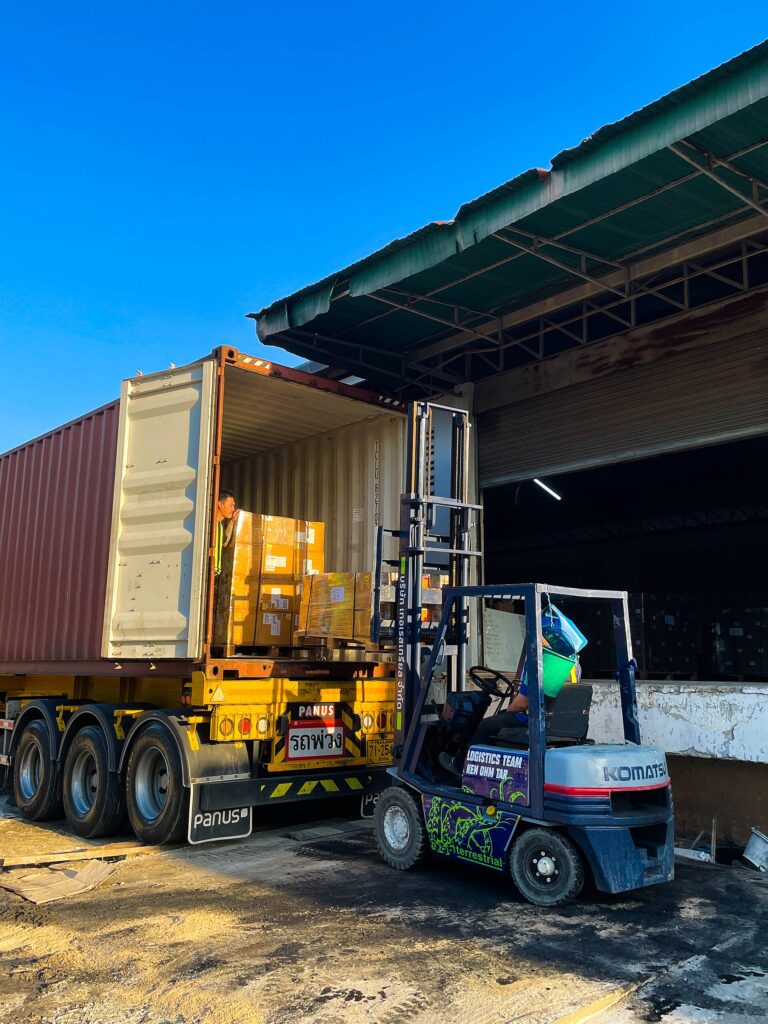
Each image caption links the photographer, original Wikimedia Commons page and licence. The eight genuine, unrelated photos illustrate a showroom, historical label, ruler, swatches, calculator, document trays, container loading and signed paper. They are not a Source Foshan visit, the Xiaohongshu transaction, a Foshan quote, the fictional chair offer or a verified shipment. Replace provisional illustrations with permission-cleared documents and item photos before publication when available.