Australia / Hospitality sourcing
Foshan Furniture Sourcing for Australia:Warranty, After-Sales Support and a 120-Seat Restaurant Package
A practical buying guide to the promise after delivery — and the furniture package before opening night.
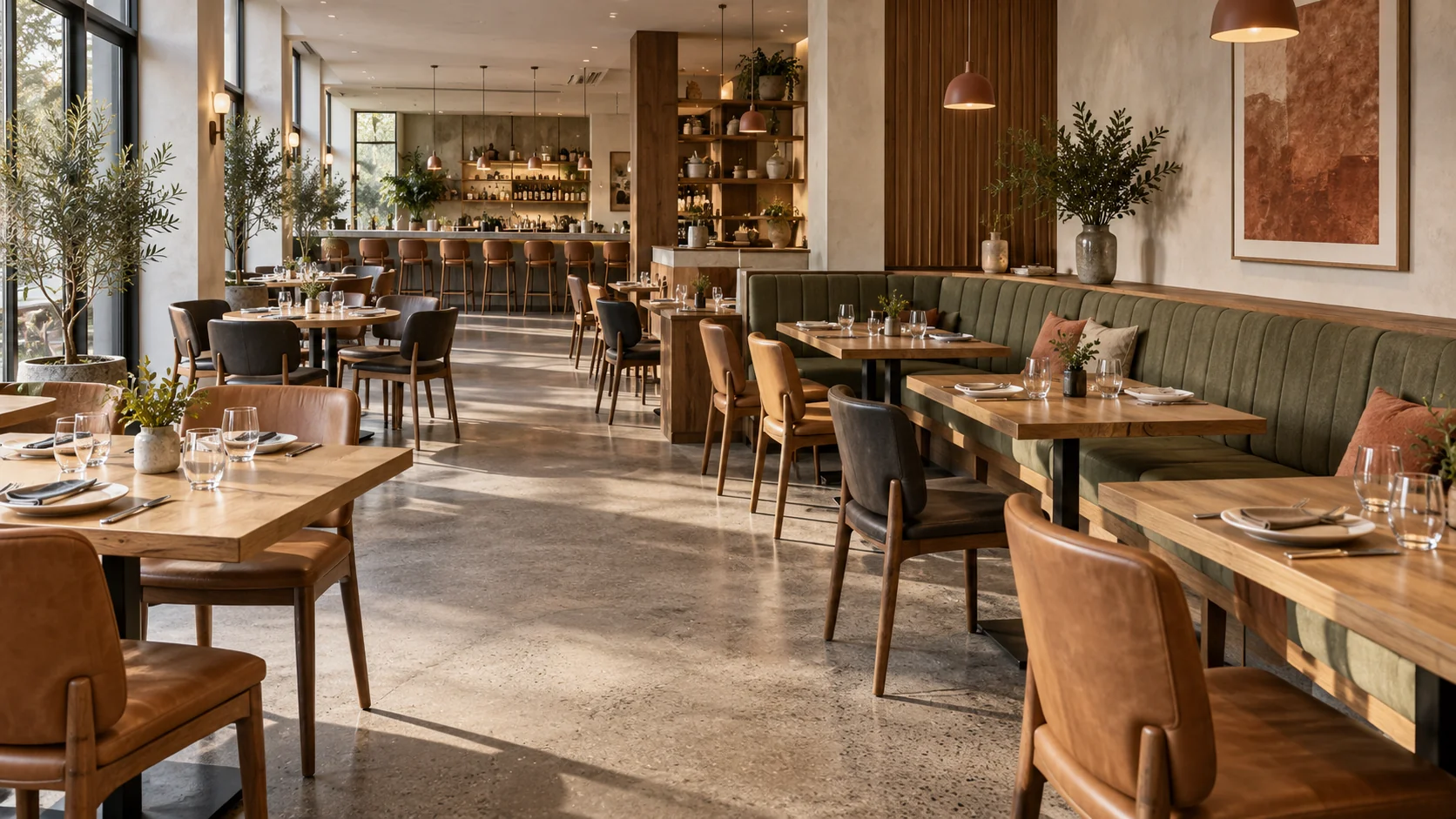
Yes. Foshan furniture suppliers offer warranties and after-sales support for Australian orders. The policies reviewed here advertise two to three years, with longer cover on some products. Confirm commercial use, component periods, exclusions, claim evidence and who pays for parts, freight and Australian labour in the purchase order before paying a deposit.
This guide is for Australian restaurant owners, fit-out buyers and designers ordering a coordinated furniture package. Use the written-warranty checklist for an existing quotation, or the 120-seat budget and seating mix for a new venue. Source Foshan can coordinate sourcing and inspections in Foshan; the supplier’s warranty and our service responsibilities must each be agreed in writing.
The package, prices, packing volumes and timing allowances are an illustrative planning model dated 16 October 2026. They are not a supplier quotation or a completed 120-seat client project. Furniture only: kitchen equipment, building works, approvals and installation are outside the package.
01 / Get the promise in writing
Do Foshan furniture suppliers offer warranty and after-sales support?
Yes, but a factory export warranty is often organised around parts, manufacturing defects and an agreed claim procedure. Do not assume that a local technician, collection service or replacement chair delivered to your venue is included. A headline such as “five-year warranty” says little until it is tied to the exact chair, intended commercial use and cost allocation.
ZP Seating, Foshan
2–3 years advertised
EASEN, Foshan
2 years commercial
Lezhifan, Foshan
3 years under normal use
Yumeya, Heshan — regional comparison
10 years on covered frames
Supplier-published policies checked 16 October 2026. Model-specific terms still belong in the signed PO.
These are supplier-published policies, not independent verification or offers secured by Source Foshan. They do not establish universal “1–3 years on frames, 1–2 years on hardware” rules. Ask for separate durations for the frame, welds/joints, foam, springs, fabric, coating, gas lift and powered mechanism wherever present.
Use la lista de verificación del contrato de compra de muebles to attach the component schedule to the order. Allocate the factory remedy, shipping risk and sourcing-agent work separately using the matriz de responsabilidades del abastecimiento de mobiliario.
Check exclusions for wear, fading, cleaning chemicals, leather markings, unauthorised repairs, misuse, indoor products used outside and moisture damage. Distinguish an accepted natural grain variation from a structural crack or timber supplied outside the agreed moisture specification. An exclusion should not quietly cancel a measurable manufacturing requirement.
What belongs in the English PO?
Specify the seller’s legal name; model and drawing revision; commercial-use conditions; component-by-component warranty periods and start date; defect definitions; evidence; decision deadline; remedy; parts, freight and Australian labour costs; dispute escalation; and parts availability. Do not rely on a chat message when the signed order says something different.
“The supplier warrants the products listed in the signed component schedule against the defined manufacturing defects during the stated warranty periods. The buyer will provide the PO and batch reference, photographs and a description of the fault. The supplier will acknowledge a complete claim within two working days and provide a written assessment within ten working days. The signed remedy schedule shall allocate replacement parts, freight, local repair costs and any credit or replacement. These terms do not exclude rights that cannot lawfully be excluded.”
Example wording for negotiation; complete the schedules and obtain appropriate contract advice before signing.
A 2–5% retention can be proposed, with a defined release date such as 90 days after delivery and an agreed process for unresolved defects. This is a negotiation option, not a measured factory norm or a substitute for enforceable remedies. Australian statutory consumer guarantees may apply to qualifying purchases, including some business purchases, independently of a voluntary warranty; assess the transaction and cross-border position using ACCC guidance.
02 / Keep the venue operating
How does a warranty claim actually work from Australia?
A Foshan furniture warranty claim from Australia starts with the PO, batch reference and clear defect evidence. Agree a parts, repair, credit or replacement remedy in writing. Keep a safe spare chair on site and take a suspect structural item out of service while the claim is assessed.

- Record the fault and preserve the packaging. Take a whole-item photo, front/back/underside views, a close-up with scale, the carton and batch labels, and a short continuous video showing any movement or mechanism fault. Keep the original files. There is no universal required unboxing-video length; follow the insurer’s and supplier’s evidence rules.
- Match it to the order. Send the PO, model, finish/fabric code, batch/carton number, delivery date, quantity affected and installation/use history. Ask for label positions before production; not every chair has a serial number.
- Obtain a written assessment. Propose acknowledgement within two working days and a decision within 5–10 working days of a complete evidence pack. These are service targets to agree, not a verified industry response average.
- Agree a remedy and cost owner. Use a glide, hardware kit or replaceable seat for a component fault; an approved local repair or credit for an economical repair; replacement for a qualifying unsafe or unrepairable item. A cosmetic credit requires your acceptance.
- Confirm dispatch and close-out. Record the part revision, quantity, tracking, fit confirmation and any remaining labour credit. Do not close the case merely because the part has left the factory.
For a time-sensitive small parts parcel, allow roughly 5–10 working days after dispatch as a planning assumption; stock, flight routing, customs and final delivery can extend it. A provisional USD 5–10 per chargeable kg transport allowance can help compare options, but small-parcel minimums and volumetric weight may dominate. It is not a live courier rate. Obtain a parcel-specific delivered quotation to Sydney or Melbourne. Gas cylinders, batteries and motors may need carrier acceptance.
Spell out whether the supplier pays air freight for accepted manufacturing defects, supplies parts ex-factory only, or reimburses an approved local repair cap. “Free parts with your next container” may be useful for replenishment but leave a restaurant without usable seats for months.
If the carton or item is damaged in transit, follow the furniture cargo-insurance and damage-claim procedure as well. Notify the relevant parties promptly while the cause is investigated; a factory warranty and a cargo policy cover different risks.
03 / A transparent planning example
What does it cost to furnish a 120-seat restaurant from Foshan?
For a 120-seat restaurant in Australia, this illustrative package allows USD 10,250–19,840 FOB for furniture. The model combines 72 loose dining chairs, 40 booth positions and 8 bar stools. Waiting seats are additional. Freight, import charges and the assumptions behind the landed-cost estimate are shown separately below.
The layout assumes 20 freestanding tables serving 72 places and 10 booth tables serving 40 places, plus an eight-seat bar. For costing, 40 booth positions use 24 linear metres at 600 mm per position, including both sides of opposing booths. Your designer must confirm the actual layout, accessible seating, circulation, exits and seat widths.
Confirm booth dimensions, module joints and site-measurement responsibility before using the linear-metre allowance. To compare supplier offers, use one furniture specification across the quotations, including spare parts, packed dimensions and the named loading port.

Swipe the table to see every column →
| Elemento | Cantidad | Unit allowance | Total de la línea |
|---|---|---|---|
| Upholstered metal-frame dining chair | 72 | $40–75 | $2,880–5,400 |
| Custom booth seating | 24 linear m | $180–320 / m | $4,320–7,680 |
| Composite/laminate tabletops, mixed sizes | 30 | $40–95 | $1,200–2,850 |
| Metal/cast-iron table bases | 30 | $25–55 | $750–1,650 |
| Taburetes de bar | 8 | $50–95 | $400–760 |
| Waiting sofa | 1 | $350–700 | $350–700 |
| Freestanding host/service station | 1 | $350–800 | $350–800 |
| Furniture total | 120 operating seats + waiting area | $10,250–19,840 | |
Unit allowances are Source Foshan’s illustrative budgeting assumptions, not a survey average or binding factory prices. A solid-wood dining chair can be modelled at USD 65–120 instead; substituting all 72 chairs changes the furniture total to USD 12,050–23,080. Stone tops, curved booths, fire-tested upholstery, samples and special packing need separate prices. Name the port and Incoterm: an EXW Foshan offer is not FOB Nansha.
What reaches the Australian cash budget?
Using the metal-chair BOM, allow USD 2,000–4,000 for ocean transport, USD 80–150 for cargo insurance and USD 1,500–3,000 for Australian port/broker/metro delivery charges. These are scenario allowances, not freight offers. The local-charge allowance is treated as inclusive of any applicable local service GST; inspection, storage, remote delivery and difficult access can add more.
Assuming the goods qualify for 0% preferential duty, import GST is 10% of customs value plus relevant international transport and insurance. That produces approximately USD 15,063–29,389 equivalent in this model, including import GST and the stated local charges. Actual customs assessment uses AUD and the applicable customs exchange rate. Eligible import GST credits affect the eventual business cost, but not necessarily the upfront cash requirement. See ABF’s calculation rules.
Interactive / All inputs in USD equivalent
Build your landed-cost scenario
Edit the allowances, then use the result in your restaurant brief. The model separates import GST from the local-charge allowance.
Includes USD 1,816 import GST and USD 0 duty.
Enter a valid, non-negative amount in every visible field.
Excludes sourcing/service fees, samples, lab tests, installation, storage, quarantine intervention and site works unless you add them to an allowance. The 5% choice is a comparison, not the classification of your products.
JavaScript is off. Calculate: duty = goods × duty rate; import GST = 10% × (goods + duty + freight + insurance); total = goods + duty + freight + insurance + import GST + local charges. You can still send the brief below or contact us by email.
04 / Work backwards from opening night
How many containers does a 120-seat venue need, and how long to Sydney or Melbourne?
One 40HQ is a plausible starting plan, subject to the packing list. Our model allows about 35–56 CBM, using 0.12–0.20 CBM per loose chair, 0.55–0.80 CBM per linear metre of booth, 6–10 CBM for tops/bases, 1.6–2.8 CBM for stools and 4–6 CBM for the waiting sofa/service station, plus a modest packaging allowance. These are assumptions to replace with carton dimensions.
A 40HQ fleet example has 76.3 CBM of internal volume; a 40GP example has 67.7 CBM. Neither number guarantees that mixed furniture fits. Large booth modules, crate geometry, safe stacking, door openings and weight determine usable space. If the final load exceeds the approved plan, compare a second shipment, partial LCL or revised knock-down packing before paying the balance.
Stackable chairs can reduce cube, but request a carton specification showing how many chairs nest in each stack. For illustration, 72 chairs at 0.12 rather than 0.20 CBM save 5.76 CBM. You cannot apply that saving to a fully assembled armchair that does not stack.
Swipe the table to see every column →
RFQ, specification and quote comparison
1–2 semanas
Layout, materials, port and scope agreed
Drawings and pre-production sample
2–3 semanas
Signed sample and drawing revisions; overseas sample shipping extra
Production after approvals
4–7 weeks
Material readiness and production slot confirmed
Inspection, rework buffer and loading
About 1 week
Open defects closed; reserve more if reinspection needed
Export booking / origin handling
Allow 1 week, partly overlapping
Final packing list and available sailing
Australian clearance and metro delivery
1–2 weeks after arrival
Documents complete, release and delivery slot secured
Swipe the table to see every column →
| Destino | Port-to-port allowance | Booking question |
|---|---|---|
| Sydney | 14–24 days | Direct southbound service or transshipment? |
| Melbourne | 18–28 days | Which east-coast port is called first? |
| Brisbane | 18–30 days | First call or after Sydney/Melbourne? |
| Fremantle / Perth | 18–32 days | Connection port, waiting time and Perth delivery? |
Nansha, Yantian and Shekou are different loading options. The carrier service profile illustrates South China east-coast services and Singapore connections; obtain an actual ETD, ETA and transshipment plan for your booking. A first quote to delivery plan of 12–18 weeks is reasonable for this example when stages overlap; the conservative sum can exceed 20 weeks. Add at least four weeks of opening contingency and reassess holidays, redesigns and late materials.
For destination paperwork and delivery planning, use the Australia furniture shipping guide. Ask the forwarder to confirm the sailing and a delivered quotation against the final packing list before treating an opening date as secure.
05 / Specify the duty of use
Is Foshan restaurant furniture contract-grade, and how do I avoid residential-grade chairs?
Foshan can supply commercial furniture; the city name is not a performance grade. Lecong showrooms and Longjiang production businesses include different product types and supply chains. Shopfront appearance, a seller’s “factory” label or a district address cannot establish structural performance.
Los contract furniture specification guide helps define the commercial duty of use. For this Australian restaurant order, keep the exact chair model, fabric, test scope and agreed construction together so the sample, test evidence and production goods can be compared.
Request the exact model’s accredited test report, including edition, severity/rated load, photographs, result and construction. Furntech-AFRDI’s fixed-height chair list distinguishes AS/NZS 4688 levels 4–6 and AFRDI 151 rated-load certification. Do not describe AS/NZS 4688.1 alone as a complete durability pass. BIFMA distinguishes public/lounge seating X5.4 from office seating X5.1; a test for another chair is not evidence for yours.
- Frame: record metal alloy/grade, tube section, measured wall thickness, joints and weld finish. A 1.5–1.8 mm tube can be an RFQ starting point for an appropriate design, not an Australian minimum or proof of strength. ZP advertises that range for its own double-rib construction.
- Espuma: request density, hardness and compression/fatigue results. For preliminary seat costing, specify 35–45 kg/m³ conventional high-resilience foam for supplier review; moulded foam needs its own specification. Density alone is not a contract-grade standard.
- Upholstery: start the high-use discussion around 40,000+ Martindale and obtain the exact fabric’s abrasion, colourfastness, cleaning and fire evidence. Warwick’s guidance uses that range for heavy commercial applications. Martindale and Wyzenbeek numbers are not interchangeable.
- Mesas: record top dimensions/weight, base footprint, fixing pattern, levellers and assembled stability. A universal base-weight figure is unhelpful without the top’s span and height.
- Test details: obtain the applied static loads, cyclic loads, cycle counts, stability results and failure criteria from the relevant report. A marketing photograph with weights on a chair cannot replace them.
“Please quote this model for daily restaurant use in Australia. Provide the exact-model structural test report and edition, rated user load, frame material and wall thickness, seat foam specification, fabric abrasion and fire-test details, packed CBM, commercial warranty and spare-parts schedule. Identify any difference between the tested sample and our production specification.”
Social sourcing can identify useful questions: a Foshan seller’s booth-customisation post illustrates the range buyers ask about, while a buyer-reported chair warranty dispute illustrates why fault evidence and misuse definitions matter. These are a seller claim and an unverified residential account respectively, not proof of commercial quality or the frequency of failed claims.
For a broader supplier brief, use our restaurant furniture sourcing guide y Foshan furniture sourcing service.
06 / Clear the paperwork before production
What certificates and documents does Australia require for imported restaurant furniture?
Prepare a shipment-specific document pack with your customs broker. Customs, biosecurity and the venue’s product specification are separate checks; there is no single certificate that clears every restaurant chair.
Swipe the table to see every column →
01Commercial invoice and packing list
Prepared / checked by: Exporter / supplier
Legal parties, descriptions/materials, quantities, values, Incoterm, carton numbers, weights and packed dimensions.
02Conocimiento de embarque o carta de porte marítimo
Prepared / checked by: Carrier / forwarder
Consignee, ports, release method and shipment references match the entry documents.
03HS classification and preferential origin proof
Prepared / checked by: Broker, exporter and authorised issuer
Seats commonly fall within 9401 and other furniture within 9403; classify each product. Verify the exact ChAFTA rate and origin rule.
04Packing declaration and wood-packaging treatment
Prepared / checked by: Packer / exporter and treatment provider
Solid timber packaging must meet BICON conditions, including acceptable treatment and required marks/documents. ISPM 15 is not synonymous with fumigation.
05Furniture biosecurity documents
Prepared / checked by: Supplier and broker
Check current BICON cases for finished timber, rattan, bamboo, bark and other plant materials. Packaging compliance does not establish furniture compliance.
06Mechanical / upholstery fire-test reports
Prepared / checked by: Manufacturer and relevant laboratory
Match the exact model, material assembly and test method to the venue/specifier’s requirements.
07AFRDI certification, if specified
Prepared / checked by: Certified supplier; verify with Furntech
Check the exact listing and scope. Blue Tick is a product certification programme, not a general customs import permit.
ChAFTA does not make all Chinese furniture automatically duty-free. Zero preferential duty may be available for qualifying tariff lines when origin and documentation requirements are met. DFAT identifies GACC and CCPIT as China’s authorised COO issuers. A Declaration of Origin is an alternative for goods covered by an appropriate advance ruling on ChAFTA origin; do not substitute a generic supplier declaration. Use the FTA Portal y ABF classification guidance with your broker.
Import GST remains 10% on the applicable taxable importation value. A GST-registered importer may claim a credit when the creditable-importation conditions are satisfied; registration alone is insufficient. Keep the import declaration and evidence identifying the importer. See ATO importation guidance.
For wood and plant materials, review DAFF’s packaging rules y wooden furniture documentation guidance before booking. Obtain the current commodity conditions from BICON; treatment and documentary requirements depend on the product and processing.
AS/NZS 3744 methods assess upholstered-furniture ignitability; BS 5852 addresses specified smouldering/flaming ignition sources. A fabric-only report does not necessarily establish the performance of the finished foam/fabric assembly. Have the venue’s Australian certifier or specifier confirm the required method and result before ordering. Intertek’s testing scope explains the different tests, while ACCC Product Safety distinguishes applicable mandatory standards from voluntary ones. Do not treat “fire-retardant” or an overseas logo as a universal approval.
07 / Prevent the claim
How do we protect you before the warranty is needed: QC, spare parts and payment terms
Prevent warranty disputes by agreeing the sample, inspection standard and release documents before production. Source Foshan’s Foshan-based team can coordinate supplier comparisons, sample approvals, production checks, pre-shipment inspection and the evidence handover. Agree the work, fee, reporting and after-sales role in the service scope; an agent’s presence does not create a factory warranty.
- Before production: approve seat height/depth, table clearances, booth modules, finish samples, fabric codes, fixing details, drawings and the defect/remedy schedule.
- During production: check frames, welds/joints, foam and upholstery batches before the construction is concealed. Resolve substitutions in writing.
- Before balance release: agree a sampling plan, for example general inspection level II with major AQL 2.5 and minor AQL 4.0, plus a separately defined critical-defect rejection rule. AQL 2.5 is a sampling parameter, not permission to ship 2.5% unsafe chairs.
- Report scope: identify the lot and sample, show measured dimensions, assembly/rocking checks, finish/stitching, approved functional checks, carton marks, hardware, quantities and packing. Photograph every found defect and the evidence needed to reproduce each check. There is no universal required photo count; specify a coverage list.
- After inspection: close corrective actions, reinspect where needed, then supervise loading against the approved carton list and record the seal. Leave several working days between inspection and sailing for rework.
SGS describes the stages of furniture inspection; QIMA describes independent sampling and defect reporting. Neither a loading photo nor a sampled visual pass replaces required laboratory testing.
Build the inspection scope from the pre-production, furniture and packing checklist, then use the illustrative inspection report and blank fields to record the lot, findings, corrective actions and release decision. The example explains the report format; it is not a restaurant test certificate.
Carry the inexpensive spares in the first shipment
For this example, propose two or three spare dining chairs, replaceable glides/fasteners for each model, a labelled upholstery repair quantity and a spare base or fixing kit where a single failure would take a table out of use. A 2–3% chair reserve and 3–5 metres of matching fabric are starting assumptions; patterned fabrics, wide modules and dye-lot matching may require more. Price and pack spares separately so they do not disappear from the count.
A 30% deposit / 70% balance is a possible structure to negotiate, with the balance conditional on inspection and agreed shipping documents. “Balance against bill-of-lading copy” works only if the supplier accepts it and the release arrangement provides meaningful control. An alternative proposal is 30% deposit, 65% after the inspection/document milestone, and 5% retained for 90 days after delivery. Define the milestone, dispute process and retention release; none is a guaranteed supplier offer.
Use la deposit and balance milestone guide to connect the payment schedule to inspection and document approval. Confirm who can authorise release and what happens if rework delays the sailing.
For a venue-specific scope, combine the restaurant furniture sourcing process with our quality and shipping process. State who inspects, who signs off each stage and who arranges Australian unpacking and installation.
Questions before the deposit
Foshan restaurant furniture for Australia: FAQ
What is the MOQ for restaurant chairs from a Foshan factory?
There is no uniform MOQ. EASEN states 50–100 pieces per SKU for standard dining chairs, while some supplier listings advertise much smaller quantities. Ask for separate prices at 30, 50 and 100 pieces per model/colour and state whether a mixed order is acceptable. Custom fabric, frame tooling and finish batches can raise the minimum. A proposed USD 8,000–15,000 mixed-order value is a negotiation example, not a factory-wide substitute for MOQ.
Can I still get replacement parts three years after the order?
Possibly, if the model and component remain available. Record model, drawing revision, component/mould references where available, fabric and finish codes, dye lot and hardware dimensions. Agree an availability period and discontinuation notice, and buy critical spares with the first order. A discontinued mould or fabric colour can prevent an exact match even during a long frame warranty.
Should I ship LCL or a full 40HQ for a single venue fit-out?
Compare full delivered quotations once the final carton cube is known. At around 15–18 CBM, it is worth pricing FCL alternatives, including 20GP where suitable; that is a comparison trigger, not a universal break-even point or an automatic reason to buy a 40HQ. Include LCL deconsolidation, terminal, storage and final delivery charges. Extra handling may increase exposure to damage, but this guide has no measured LCL-versus-FCL damage rate. The illustrative 35–56 CBM package makes a 40HQ comparison sensible.
Who pays if furniture arrives damaged in Australia?
Manufacturing defects follow the agreed supplier remedy and any applicable legal rights; transit damage follows the transport risk allocation, carrier position and cargo policy. Notify relevant parties promptly without waiting for them to agree on fault. Keep delivery exceptions, cartons, photographs and unboxing records. An insurance allowance of 0.2–0.5% of insured value may be a starting budget assumption, but minimum premiums, excesses, packing exclusions and cover terms can change it. The calculator uses an editable fixed allowance.
Do I pay import duty and GST on furniture from China to Australia?
Check the exact classification, origin and current preferential rate. Qualifying lines may receive 0% ChAFTA duty with valid origin documentation; that is not automatic for every item. Import GST is generally 10% of customs value plus duty and relevant international transport/insurance. A credit depends on the importer’s registration and creditable purpose, supported by the import records.
Can Foshan factories match my designer’s custom booth seating and table sizes?
Specialist manufacturers offer custom dimensions and upholstery. Send dimensioned drawings, wall/site measurements, access limits, fixing details and fabric references; review the quotation and pre-production sample before manufacture. Allow 2–3 weeks for sampling as a planning target. Define what a linear metre includes, how curved sections are measured, tolerances, module joints and responsibility for final site measurements. A photo alone is insufficient for a fitted booth.
How do I verify a Foshan supplier is a real factory rather than a trading office?
Verify the Chinese legal entity and unified social credit code in the official enterprise register. Compare its registered business and address with a workshop visit or live walkthrough; examine the relevant production equipment, work in progress, capacity and subcontracting. Match the PO, invoice and payment beneficiary, and ask for comparable commercial references with permission to verify them. A workshop photograph or company-name bank account alone does not establish ownership or capacity.
What is a realistic timeline from first quote to opening night?
Use 12–18 weeks as a coordinated planning range, with 1–2 weeks for the brief/quotes, 2–3 for sampling, 4–7 for production, inspection/loading and booking allowances, roughly 2–5 for the ocean leg, and 1–2 for clearance/delivery. Some work overlaps; a sequential or delayed project can exceed 20 weeks. Add at least four weeks of opening contingency and book only against confirmed factory and sailing milestones.
Your venue / Your specification
Discuss your Australian restaurant package
- Confirm the furniture list, seat mix and sourcing scope
- Identify warranty, specification and inspection gaps
- Plan the next quotation and delivery steps
Share your floor plan or item list, Australian delivery city and opening target. We will use your brief to confirm the sourcing scope, identify missing specifications and explain the next quotation step. State your budget in USD or AUD and tell us whether it includes freight and import costs.
Send drawings or reference images later by WhatsApp or email, or use the full project form with attachments.
Name and email are required.
We use these details to respond to your project enquiry. Privacy policy. Prefer email? hello@sourcefoshan.com.
Sources and estimate method
Checked 16 October 2026. Warranty comparisons come from the named suppliers’ publications and should be confirmed in the signed order. Government and certification sources are linked beside the relevant claims. The budget is a bottom-up quantity × unit-allowance model; shipping and response times are explicit planning assumptions. No completed restaurant order, freight invoice or warranty settlement is represented by these estimates.
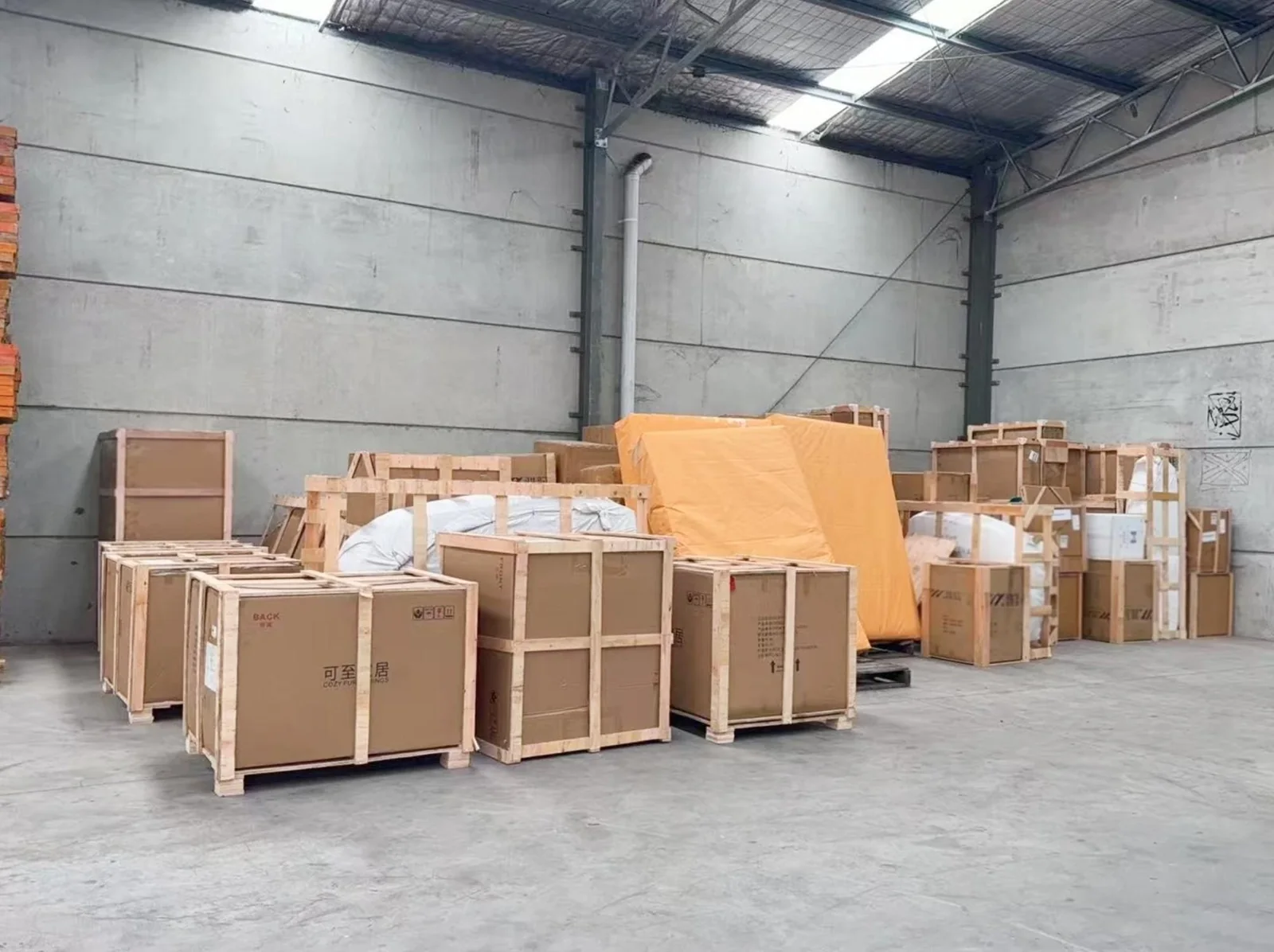
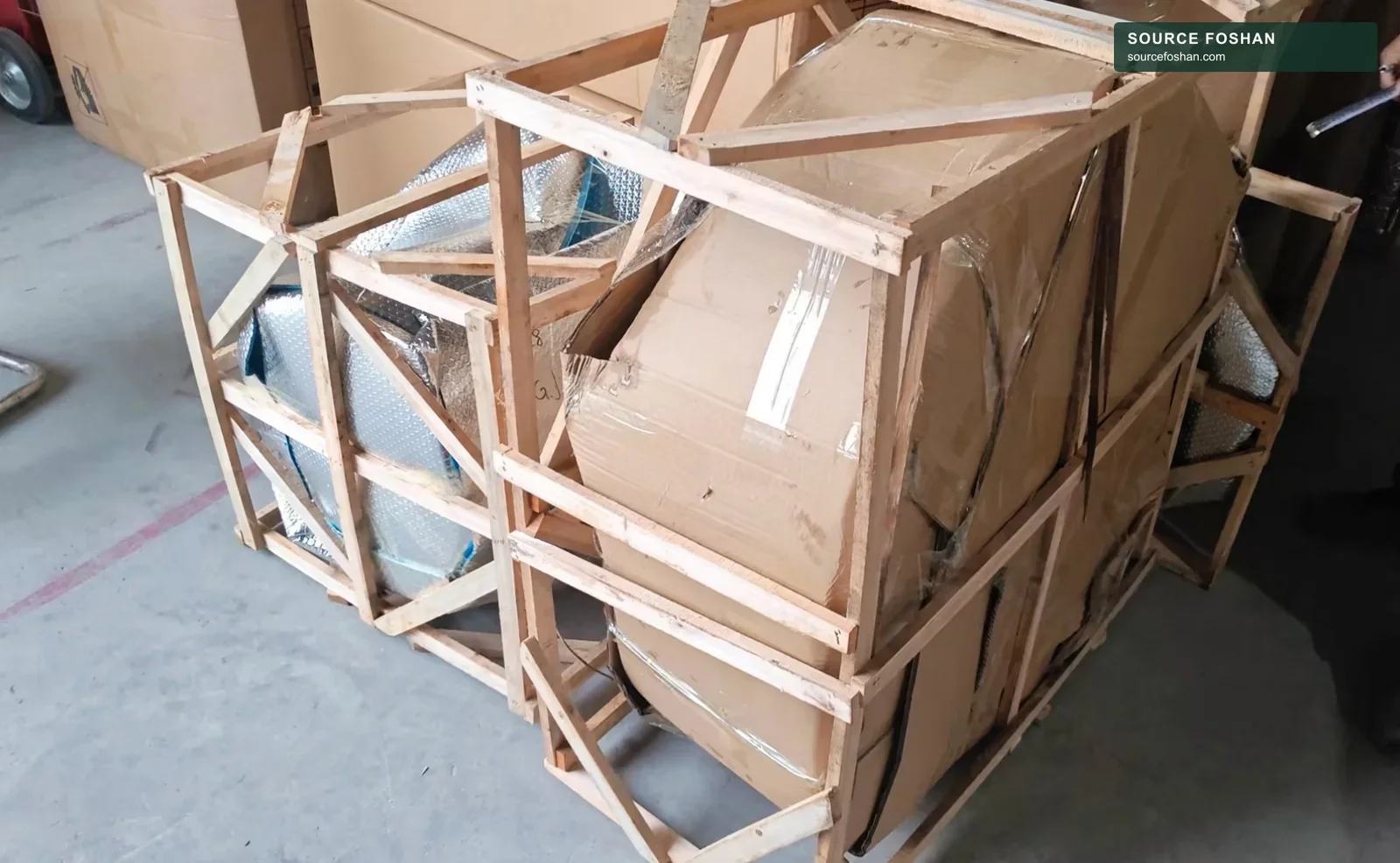
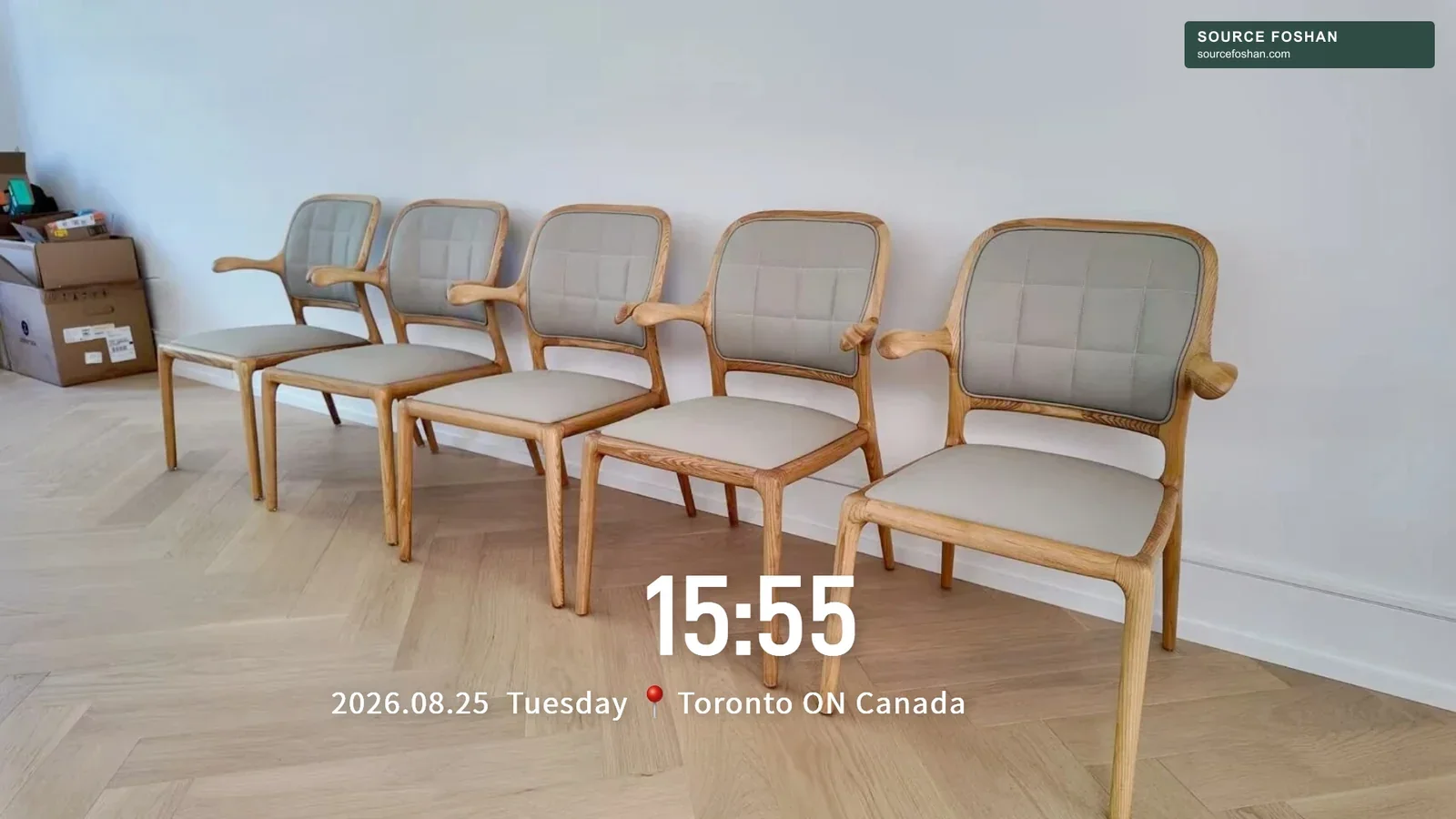
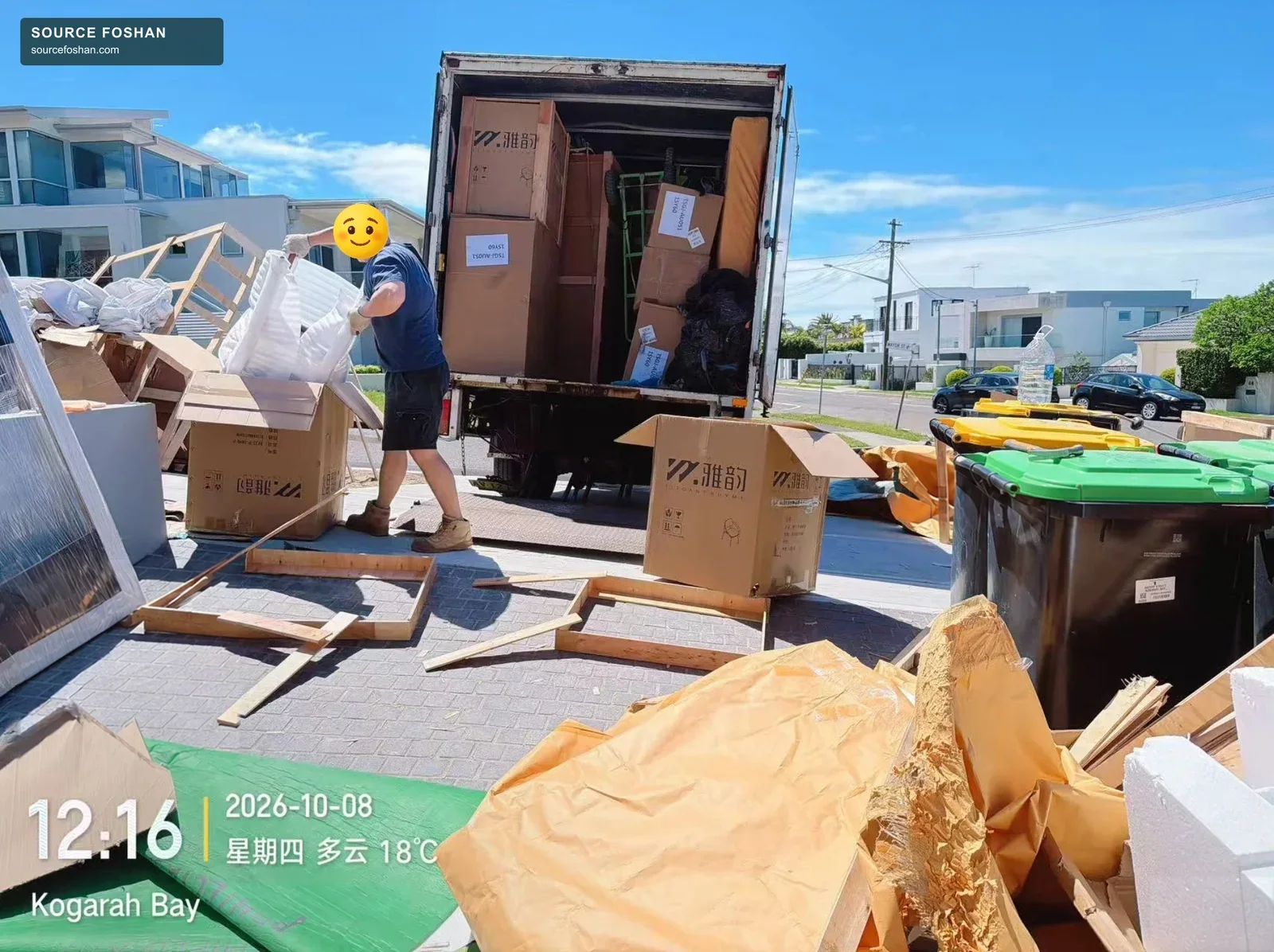
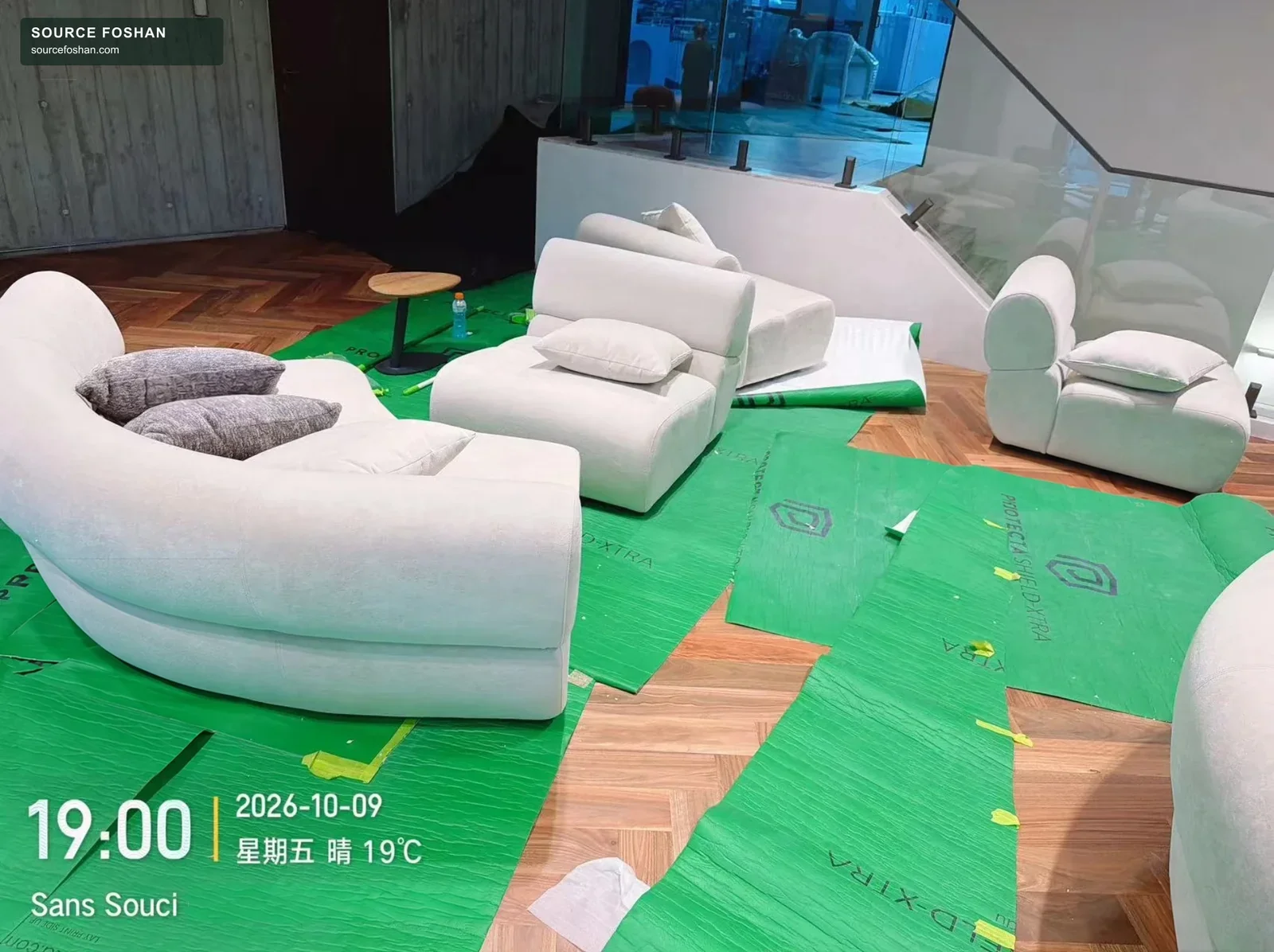
The photographs are authorised Source Foshan project records, with English explanations identifying their actual context. They illustrate packing, item identification and delivery coordination. Restaurant material and performance claims require the model-specific documents described above.
Acerca de Source Foshan · Ask us to check your specification