South Africa & Australia / Imported versus local furniture
Is China Furniture Cheaper Than Local Retail? South Africa and Australia Costs
Compare matching specifications and complete delivery scopes. Includes editable South African and Australian cost models, retail references and a downloadable worksheet.
South Africa & Australia / Compare the complete handover
Importing furniture from China can cost less than local retail when the same specification and delivery scope still leave a margin after sourcing, freight, duties, tax and destination work. There is no universal saving percentage or minimum CBM that proves it. In the separate illustrations below, the entered South African import sum is ZAR 283,950 against an assumed ZAR 300,000 local offer; the Australian sum is AUD 22,220 against an assumed AUD 25,000 offer. These are editable scenarios, not measured customer savings.
Reviewed 28 October 2026. Retail references are identified snapshots, not specification-matched factory alternatives. All basket prices, exchange assumptions, freight, fee and comparison inputs are illustrative. Unquoted work is excluded, not free.
01 / A similar photograph is not the same product
Is Foshan furniture cheaper than local retail in South Africa or Australia?
Compare an accepted item schedule rather than a showroom label. Keep dimensions, construction, material, finish, upholstery, hardware, intended use, packing, warranty remedy and final assembly the same. A solid-timber table and a timber-look board table cannot establish a fair percentage saving simply because both seat six.
Local retail prices can include stock availability, local consumer remedies and a different delivery/assembly arrangement. An imported goods offer may leave you responsible for customs, access, unloading and resolving replacement parts. Put a price and an owner beside each difference before choosing.
| Referentie | Observed page information | What still needs matching |
|---|---|---|
| Coricraft Lodge upholstered 3-seater, Annabelle Grey | ZAR 13,869 promotional display; 237 × 100 × 80 cm | Cover/construction, current variant/promotion, availability, delivery and remedy |
| Freedom BOWRAL dining table, product 24322263 | AUD 2,299 regular display; 180 × 90 × 75 cm; member pricing differs | Timber/finish, table only versus set, membership, delivery and assembly |
These public references show why the comparison needs item-level evidence. They do not establish that a Foshan maker supplies either brand or can reproduce its product. We have no paired factory quotation for those exact specifications here. Check the linked retailer’s current offer and your postcode before using it. The hypothetical local baskets below are independent assumptions, not sums of these references.
For a sourcing proposal, use your own drawings or authorised references to specify a lawful alternative. Avoid copying protected branding or treating a retailer photo as permission to duplicate a design. The agent, reseller and factory comparison explains which party sells the goods and which service you are buying.
02 / One scope, two separate currency models
What does a landed-cost comparison actually look like?
Start with an illustrative USD 10,000 goods schedule: sofa USD 1,000; two frames at USD 500; two mattresses at USD 350; four bedsides at USD 150; dining table USD 700; six chairs at USD 100; two wardrobe allowances at USD 1,200; living storage USD 800; two armchairs at USD 500; outdoor group USD 1,200. These assumptions total USD 10,000. An assumed 30 m³ packed volume is a separate input, not measured carton data or a loading promise.
| Entered line | South Africa · ZAR | Australia · AUD |
|---|---|---|
| Assumed customs value | 170,000 | 15,500 |
| Ordinary duty assumption | 20% → 34,000 | 0% → 0, conditional scenario |
| Freight and insurance allowance | 24,000 | 2,500 |
| Import VAT / GST | 33,150 | 1,800 |
| Other entered costs, including fee | 22,800 | 2,420 |
| Sum of entered import lines | 283,950 | 22,220 |
| Assumed matched local offer | 300,000 | 25,000 |
| Local offer minus entered import sum | 16,050 / 5.35% | 2,780 / 11.12% |
The customs-value assumptions correspond arithmetically to USD 10,000 × 17.00 ZAR/USD and × 1.55 AUD/USD, respectively. Those are planning conversion inputs, not today’s exchange rates or a customs valuation ruling. The broker must apply the correct valuation adjustments and official exchange basis.
South Africa’s other entered costs comprise an assumed ZAR 6,800 sourcing fee and ZAR 16,000 destination/services allocation. Australia’s comprise AUD 620 and AUD 1,800. The fee examples use 4% of each assumed goods basis. Destination allocations need itemised quotes; review applicable local tax within them. Unknown testing, inspection, treatment, storage, installation and trade-remedy costs are outside the model where not specifically included.
In the South African example, another ZAR 20,000 of genuinely additional work changes the entered import sum to ZAR 303,950: it then exceeds the assumed local offer by ZAR 3,950. In the Australian example, another AUD 3,000 changes the sum to AUD 25,220. A modest headline difference is not a guaranteed saving. Download the two-country comparison worksheet.
03 / South Africa
How do freight, ordinary duty and 15% VAT change the South African total?
For the China-origin scenario, SARS calculates added tax value using customs value plus a 10% uplift and non-rebated duties. VAT is 15% of that base. The uplift is a tax-base calculation, not a separate 10% cash fee. Do not add the actual freight to that simplified VAT base again while also applying the uplift.
Editable planning illustration
What changes when you replace the ZAR assumptions?
China-origin ordinary illustration: VAT = (customs value × 1.10 + ordinary duty) × 15%. Freight is a cash line outside that simplified VAT base. Positive difference favours the entered import sum; negative favours the entered local offer. Inputs are assumptions, not full quotes. Valuation adjustments, other duties, testing, treatment and all unentered costs need review, not a zero assumption. Local tax in service lines must be reconciled.
Seats, desks, cabinets and mattresses need their actual tariff classification. The 20% input is an assumption, not a rate established for every line. Use the South African sourcing, container and guesthouse guide for importer documents, consolidation and a room-package illustration. Get an actual ocean-port and inland quote for a Johannesburg destination.
04 / Australia
How do freight, ChAFTA and 10% GST change the Australian total?
ABF’s import-GST guidance uses customs value, duty and the relevant international transport/insurance in the taxable import value. The ordinary furniture illustration below applies 10% GST and omits any inapplicable wine-tax line. Avoid duplicating freight already included in another valuation line.
Editable planning illustration
What changes when you replace the AUD assumptions?
Ordinary illustration: GST = (customs value + ordinary duty + additional international freight/insurance) × 10%. Zero duty is conditional. Positive difference favours the entered import sum; negative favours the entered local offer. Inputs are assumptions, not full quotes. Valuation adjustments, other duties, testing, treatment and all unentered costs need review, not a zero assumption. Local tax in service lines must be reconciled.
ChAFTA preference depends on classification, origin rules and supporting documentation. A Chinese dispatch address alone does not establish eligibility. The tool’s zero-duty default is conditional; confirm the claim before ordering. The Melbourne shipping guide covers the separate port, biosecurity and postcode-delivery scope.
DAFF requires timber, wooden articles and bamboo to meet the applicable BICON import conditions. Product material, wood packaging and container cleanliness are distinct checks. Inspection, treatment, storage or re-export can add cost if requirements are not met; a crate mark alone does not approve every furniture material.
05 / Give every cost one home
What should EXW, FOB, CIF or DDP comparison quotes include?
| Quoted basis | Comparison question | Common missing or duplicated line |
|---|---|---|
| EXW factory | Who collects, loads, exports and consolidates? | Factory pickup, export work and receiving |
| FOB named shipment port | What is included up to the agreed on-board handover? | Origin costs already inside goods/forwarder scope |
| CIF named destination port | Which freight/insurance and destination charges are included? | Port arrival treated as local room delivery; risk assumed to remain with seller throughout |
| DDP named destination | Who can lawfully act as importer and account for tax? | Unclear duty/tax evidence, exclusions, unloading and installation |
A CIF label does not mean every destination cost is paid or that transit risk stays with the seller until arrival. A DDP label does not settle assembly or every site-access requirement. For container handover to a carrier before vessel loading, discuss the appropriate term, including FCA, with the responsible providers. Use the verantwoordelijkheidsmatrix to assign seller, agent, forwarder, broker and installer tasks.
Source Foshans published policy states a 3–5% fee on an agreed order-value basis, no supplier commissions and orders from USD 10,000. The proposal sets the basis, included work and extras. Samples, laboratory work, additional inspections, storage, freight and installation need explicit treatment. No universal insurance premium or standard free-storage period is assumed here.
06 / Break-even is specific to the order
At what order size does importing beat buying locally?
For a fixed matched basket, the entered import sum is the minimum local comparison price at which this simplified arithmetic breaks even: ZAR 283,950 or AUD 22,220 with the defaults. This does not establish a universal USD 8,000, 15 m³ or one-container threshold. The published USD 10,000 service starting point is a commercial policy, not a savings theorem.
A useful order-size test is fixed import costs ÷ per-unit advantage after variable costs, provided that the per-unit advantage is positive and the rates/specification remain unchanged. If an assumed local all-in unit is USD 500, an equivalent imported unit including variable costs is USD 350, and genuinely fixed costs are USD 3,000, the arithmetic equality is 20 units; the entered imported sum is lower above 20 whole units. This is a dimensional example, not a factory quantity discount or freight crossover.
Freight often has minimums and steps, while taxes, inspection and product mix change with quantity. Compare matched LCL, 20 ft and 40 HQ offers at your actual cartons. Maersk lists nominal volumes of 33.2, 67.7 and 76.4 m³ for 20 ft, 40 ft and 40 HQ; assumed 80% planning space gives 26.56, 54.16 and 61.12 m³. Actual dimensions, weight, stacking and doors decide fit. The LCL/FCL decision guide compares complete transport scopes.
07 / Separate cash from eligible tax recovery
Can a registered business remove VAT or GST from the comparison?
Establish the importer, taxable use, registration and required records with your accountant. SARS’s import-VAT guide describes input deductions and import/payment documentation. ABF’s importing requirements identify GST registration and ABN requirements for input credits or GST deferral. Eligibility and timing matter; buying through an agent does not transfer another entity’s credit automatically.
The models retain import tax in the cash sum. Do not subtract import tax while comparing with a local tax-inclusive price if the local input tax would also be recoverable. Private-use buyers should not assume business recovery. Mixed, exempt or input-taxed activities may change the result. This page does not calculate your deductible amount.
08 / Price the timing and remedy you need
When is importing a poor fit even if the goods price is lower?
Local stock may suit an urgent single replacement, a small order with high fixed import costs, a product you need to try immediately, or a project whose opening date cannot absorb overseas corrections. Confirm actual availability and delivered price; local made-to-order goods also have a production schedule.
For overseas custom work, agree drawings/samples, factory slots, QC/corrections, consolidation, booking, ocean routing, entry and installation separately. As planning examples, the linked South African programme is 16–27 sequential weeks including buffer; Australian programme needs a route-specific allocation. No carrier quote or local-versus-import average is asserted. Ask factories for their actual holiday closures and restart dates.
Resolve expensive surprises before paying: sample/tooling changes, finish mismatch, non-compliant products, unconfirmed packing, currency movement, port free-time limits, demurrage/detention, stairs and assembly, spare-parts freight and loss of room revenue. Children’s furniture, electrical accessories and regulated timber need item-specific requirements, not a blanket certificate list.
A cheaper sofa photograph is not a complete risk comparison. Have the defect list, inspection scope, acceptance record, warranty remedy, claims evidence and transport responsibility written into the order. Record delivery exceptions and unpacking, retain packaging and notify the seller/carrier/insurer within their respective deadlines. See the cross-border warranty and after-sales guide.
09 / Make the next offer comparable
How do I request itemised prices with factory details and shipping?
- Send the comparison brief: item codes, quantities, dimensions, materials, references, intended use, destination postcode, budget currency and date.
- Identify the commercial parties: seller, actual maker, agent, exporter, importer and proposed corporate beneficiary.
- Ask for comparable lines: unit price/currency, actual MOQ, finish and hardware, carton quantity/dimensions/weight, packed CBM, sample/production basis and exclusions.
- Price the same handover: goods, sourcing, origin, freight/insurance, duty/tax, port/broker work, biosecurity and delivery/installation. State validity and unknowns.
- Approve the references and release gates: drawings/samples, required evidence, inspection, corrections, payment triggers, packing and remedies.
For 50/100/250/500 units, request each accepted quantity price and packing layout. Do not assume a standard percentage reduction: MOQ, materials, tooling and split finishes change the offer. Agree when the actual factory identity and evidence will be provided. The sourcing service en landed-cost-werkblad help organise this scope.
Import-versus-retail comparison questions
Does your quote include shipping to Boston or another US destination?
Request the named US destination, actual cartons, importer and final handover. A factory goods price alone does not include shipping. US tariff/trade-remedy and entry requirements need a separate current assessment; neither this South African nor Australian tax model applies.
Can I get prices for 50, 100, 250 and 500 units?
Ask for each quantity against the same specification, finish mix and packing. There is no verified universal quantity discount. Compare any tooling, sample, inspection and freight changes as well as the unit price.
Will I know the factory name and location?
Agree maker/seller disclosure and qualification in the service scope before committing. Verify the legal entity and actual production address; a showroom or trading company can sell products made elsewhere.
Should dimensions and carton sizes be known before I pay?
Approve the product dimensions and packing basis needed for your decision. Mark provisional carton estimates separately from confirmed packed data. Fitted work needs verified measurements and accepted drawings.
Does this prove importing is cheaper in the UK, Canada or New Zealand?
No. Those destinations have different tax, product and trade-remedy rules. Use their current country guides and matched quotes. Canada in particular needs product-specific trade-remedy review rather than a generic duty percentage.
What is the minimum worthwhile order?
Source Foshan’s published service starting point is USD 10,000 in goods. Economic break-even depends on the exact local comparison, import scope and cartons; it is not a universal CBM threshold or a guarantee of savings.
Is your service fee already in the models?
The other-cost defaults include an illustrative 4% goods-basis fee plus a destination allocation. The published policy is 3–5% on an agreed basis; use the accepted written scope, and enter every charge once.
Who pays if imported furniture arrives damaged or wrong?
Separate seller defects from transit damage, follow the agreed evidence and notice rules, and review the relevant insurance and warranty remedy. A lower purchase price does not establish free return freight or automatic compensation.
Your next step
Send the matched item list and delivery postcode.
Include the local offer, goods specification, quantities, intended use, packed data, timing, currency and exact handover. Identify unknown costs and material differences before comparing.
Sources and model boundaries
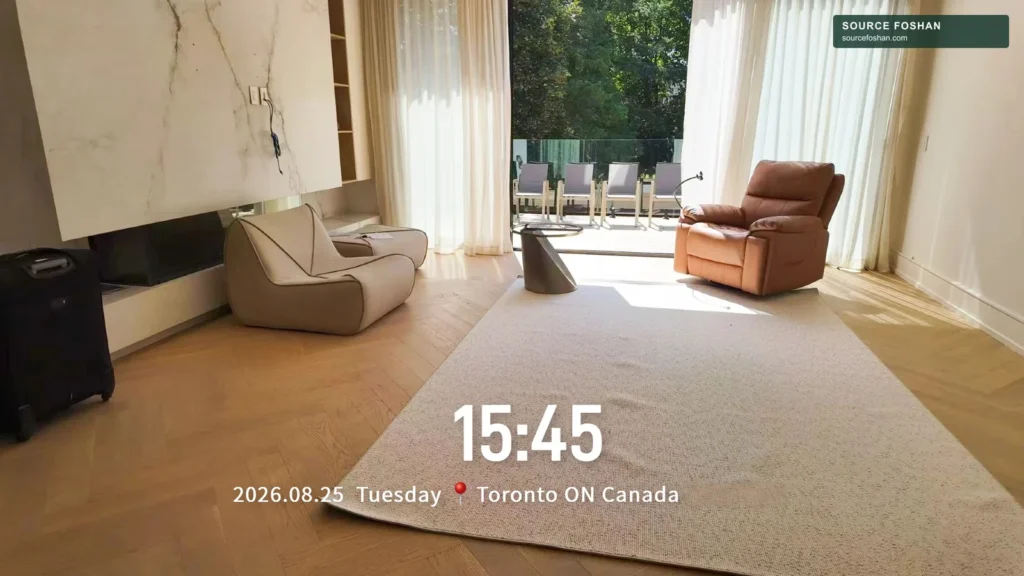
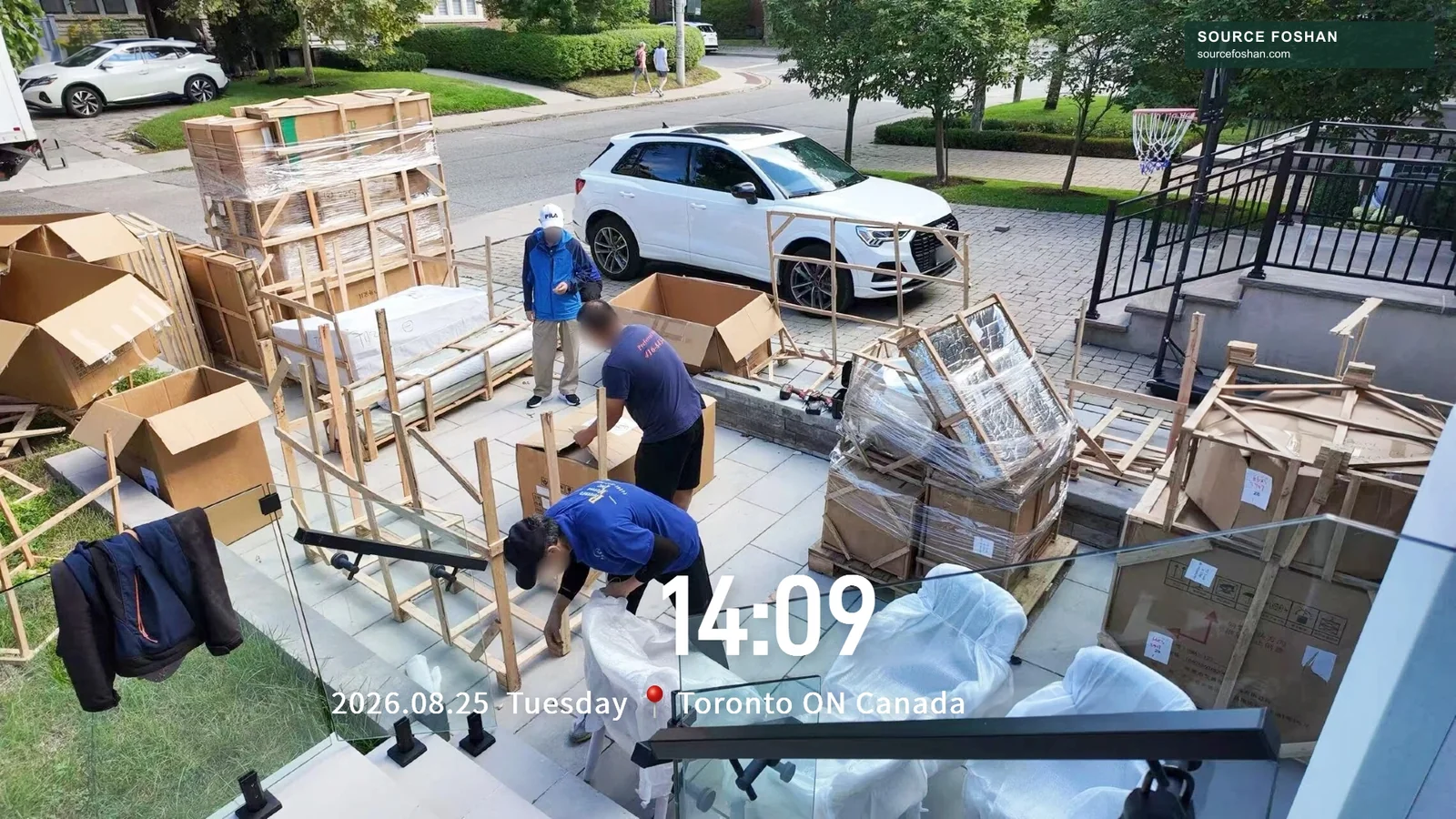
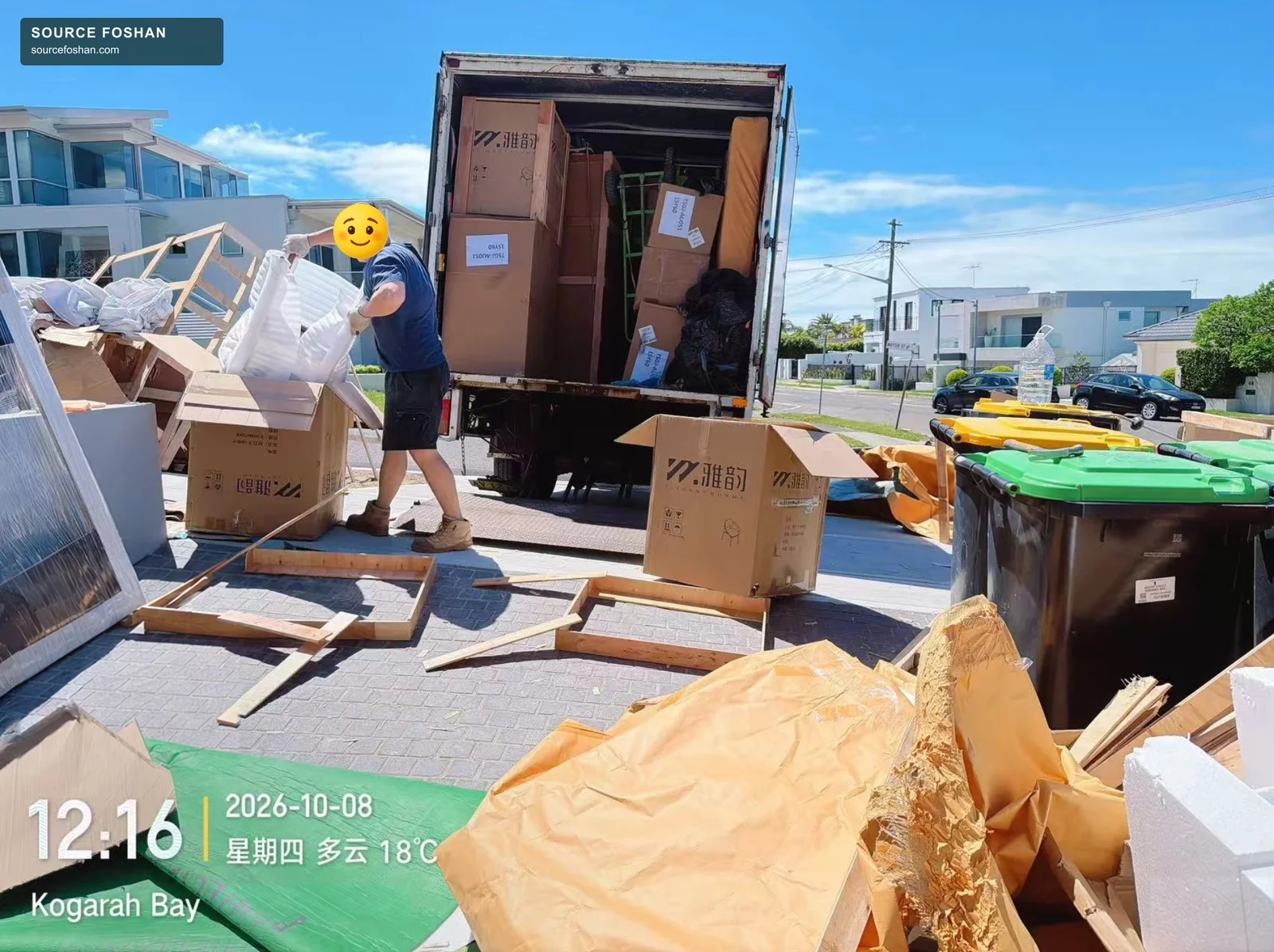
Retail references are attributed product-page observations. Tax and import requirements link to the relevant authorities. Goods, exchange, freight, local-basket and break-even examples are explicit assumptions; no matched factory quote, actual comparative customer invoice or measured saving is asserted. First-party Toronto/Sydney images document residential handling elsewhere, not the hypothetical comparison’s prices.