Sourcing guide
Furniture Sourcing Agent in Foshan: Fees, Deposits, MOQs and What One Agent Covers
A Foshan furniture sourcing agent charges 3–5% of order value; Source Foshan takes no commission from suppliers, so you see the factory's quotation and our fee as separate numbers. Deposits start at 10%, 30% on a production run and 30–50% on made-to-measure cabinetry, with the balance after inspection. One agent consolidates 6–12 suppliers into a single 40HQ in 5–20 weeks. This guide covers fees, deposits, MOQs, category price bands, crating and ISPM 15, and how to compare agents.
- 300+geprüfte Lieferanten
- 60+abgeschlossene Projekte
- 18Zielländer
- 100%vor dem Verladen geprüft
Updated by the Source Foshan sourcing team in Foshan.
Auf einen Blick
- 01
Source Foshan charges 3–5% of order value and takes no commission from suppliers; you see the supplier’s quotation and our fee as two separate numbers.
- 02
Deposits start at 10% of order value, 30% on a factory production run, and 30–50% on cabinetry and other made-to-measure work; the balance is settled after inspection.
- 03
One agent consolidates 6–12 suppliers into a single 40-foot high-cube: 65–68 m³ of space but only about 26–28 tonnes, so tile and sanitaryware load low as ballast.
- 04
Showroom stock can be bought from one or two pieces; factory production in a custom size or finish usually starts at 10–30 sets per collection and colour.
- 05
Plan 5–20 weeks door to door for residential work, 5–6 months for hotel FF&E because of the model-room stage.
A factory sells you what that factory makes; an agent assembles a project across factories. In practice that is five jobs a single supplier cannot do: comparing 3–5 quotations per line item, getting a custom size or finish accepted below a factory’s standard MOQ, receiving and inspecting goods from every supplier in one place, loading them into one container in the right weight order, and being a Chinese company you can hold to a contract if something arrives broken.
If your project is one sofa from one showroom, you do not need an agent. If it is 40–60 items from nine suppliers — which is what a whole-home project usually turns out to be — coordination is the entire job. See how a 54-item, nine-supplier residence was consolidated into one container.
Three models exist, and the one you are offered tells you more than the number attached to it.
| Model | How it works | Suits | What to watch |
|---|---|---|---|
| Percentage of order value | A stated % of what you spend with suppliers, on top of the supplier’s own price | Most residential and FF&E projects | Whether it is charged on goods only or goods plus freight |
| Fixed project fee | One agreed number for the whole project, whatever the final spend | Defined scopes: one house, one hotel floor | Fix what happens if the scope grows mid-project |
| Man-day rate | Paid per day of sourcing, market visits or inspection | Buyers who mainly need eyes on the ground | Open-ended by nature — cap the days in writing |
The model that is not on this list is the one to worry about: an undisclosed mark-up. An agent who quotes a very low fee — or none — and will not show you the supplier’s own quotation is being paid by the supplier, not by you. That inverts whose side they are on at exactly the moment it matters: when a factory proposes a cheaper foam, a thinner frame or a substitute finish.
What Source Foshan charges: 3–5%
Our service fee is 3–5% of order value, and we take no commission from suppliers. Where a project sits in that band depends on how much coordination it needs — how many suppliers are involved, how much is made to order, and whether the specification arrives as a finished schedule or a folder of reference photos. The figure is agreed in writing before you commit, and you see the supplier’s own quotation alongside it, as two separate numbers.
Deposits: from 10%, more on made-to-order work
Production starts against a deposit once you confirm. It begins at 10% of order value and rises with how much risk the factory carries if the order stops:
| What you are ordering | Typical deposit | Why it differs |
|---|---|---|
| Showroom stock in standard finishes | from 10% | The factory can resell it |
| Factory production runs — for example a bulk lounger programme | 30% | A production slot is reserved and materials are bought |
| Cabinetry, wardrobes and other made-to-measure work | 30–50% | Cut to your dimensions; unsellable to anyone else |
The exact figure is set per product line and written into the proforma invoice before you pay anything. The balance is settled after inspection — you see photographs of what was actually built before the rest of the money moves. Payment goes to the company account in the name 先培(佛山)家居有限公司, never to a personal account.
What the fee does not cover, on any model: the suppliers’ own prices, international freight, destination customs duty and taxes, and local delivery. Those are quoted separately and paid to the parties providing them.
Seven checks separate a sourcing agent from a trading company with a website. Ask for all seven in writing before you pay anything.
| Check | What a straight answer looks like |
|---|---|
| Fee model | A stated percentage or fixed fee, and the supplier’s own quotation shown to you. A refusal to show factory prices means the income is an undisclosed mark-up. |
| Supplier commissions | “We take none” — in the contract, not only on the website. |
| Legal entity | A Chinese company name and unified social credit code you can look up, plus a corporate bank account in that exact name. Never a personal account. |
| Physical presence | An address in Foshan you can visit, and an inspection team that is employed rather than subcontracted per job. |
| Quotes per item | 3–5 comparable quotations per line, with the differences explained: frame, foam density, hardware brand. |
| QC evidence | Photographs of hardware, drawers, finish and measurements per item before the balance payment, plus a loading record. |
| Consolidation | Their own warehouse, a stated free-storage window, and one packing list with measured CBM per line. |
Source Foshan’s own answers: a 3–5% fee and never a supplier commission; registered as 先培(佛山)家居有限公司, unified social credit code 91440604MAKLLJJ0X1; an office in Chancheng District, Foshan; and an in-house QC team.
Send your list. Get compared options from Foshan within one business day.
Real suppliers, real prices and lead times side by side, from a local team that walks the showrooms and factories every week. No commitment.
Ex-works Foshan, from quotations our team collected in 2026. Use them to size a budget; a real quotation moves with fabric grade, frame and finish. Each row links to the page that carries the full specification.
| Category | Ex-works price | Realistic MOQ | Production | Full page |
|---|---|---|---|---|
| Solid-wood dining | 213 cm oak trestle table ≈ USD 750; upholstered side chair ≈ USD 135 | 1–2 from showroom stock; 10–30 for a custom size or finish | 30–60 days | Dining tables |
| Upholstered sofas | USD 295–635 per sofa, performance fabric | 1–2 from stock; 10–30 per fabric | 35–50 days | Sofas & sectionals |
| Beds & bedroom | 193 cm upholstered shelter bed ≈ USD 805 | 1–2 from stock; 10–20 custom | 30–60 days | Betten |
| Outdoor & pool | Stackable aluminium lounger USD 95–160; rope or HDPE USD 160–280; teak USD 280–550 | 10–30 sets per colour; 50–200 for bulk programmes | 35–60 days | Outdoor sourcing |
| Hotel FF&E | USD 1,500–3,000 per key (3★), 3,000–6,000 (4★), 5,000–9,000 (5★) | From about 20 keys, or 10 apartments | 60–90 days | Hotel & resort FF&E |
| Cabinetry & built-ins | Quoted per project | Project-based | 45–70 days | Kitchen cabinetry |
| Lighting (Guzhen) | Certification adds cost and 2–4 weeks | 1 piece from showroom stock; 10–50 for a custom finish | 30–45 days | Furniture & interiors |
Indoor residential figures are converted from factory quotations in CNY at 7.1 CNY/USD, September 2026. Outdoor and per-key figures are the same ones published on our category pages, so the numbers do not contradict each other from page to page.
Lighting, mattresses and soft furnishings: the three categories that trip buyers up
Ask the team about thisThese three sit outside the furniture factories, and each has a rule that catches people out.
Lighting comes from Guzhen, not Foshan — about an hour away
Guzhen in Zhongshan is the “Lighting Capital of China”: around 45,000 lighting and related enterprises, roughly 70% of China’s domestic lighting market, exporting to more than 130 countries. It is about an hour from Foshan by road, which is why lighting is bought there and trucked to the Foshan warehouse to join the container rather than shipped separately.
Two things to settle before you order, because both are expensive to fix later:
- Voltage. 110 V for North America, 220–240 V for the UK, EU, Australia and most of the Middle East. Factories default to whatever their usual market is; state it on the purchase order, per item.
- Certification. UL or ETL for the US and Canada, CE for the EU, SAA for Australia, CCC if anything stays in China. An uncertified fixture needs testing, which adds cost and typically 2–4 weeks. Ask whether the certificate covers the exact model or a “similar” one — the second answer is the one that fails at customs.
Hotel mattresses: the US standard decides the whole specification
Mattresses shipped to the United States must meet two federal flammability standards. 16 CFR 1632 covers cigarette (smouldering) ignition; 16 CFR 1633 covers open flame — a 30-minute test in which peak heat release must stay under 200 kW. Both are prototype standards: a qualified prototype is tested, and every mattress built afterwards must match it in materials, components, design and assembly, with records kept for as long as that prototype is in production plus three years. For imported sets the label must carry the foreign manufacturer’s name and full address including country, plus the importer’s address. Ask for the prototype test report before production, not after. The UK and EU use BS 7177 and EN 597 instead, so a mattress qualified for one market is not automatically shippable to the other.
On freight: export mattresses are normally roll-packed, compressed and rolled rather than shipped flat. The difference in container volume is large enough to change the shipping line of your budget, so ask for both loading counts when you compare quotations.
Curtains and rugs are measured work, not catalogue items
Curtains are priced per window once the finished drop, heading type, lining and track or motor are known — a quotation given before someone has the measured schedule is a guess. Rugs are priced per square metre, and hand-knotted versus machine-woven is a multiple, not a percentage. Both are made to measure, which puts them on the critical path: order them at the same time as the furniture, not after the walls are finished.
Yes — from several suppliers into one container, because the agent owns the warehouse step. No factory makes all of it. The constraint people get wrong is weight, not volume: a 40-foot high-cube gives 65–68 m³ but caps at roughly 26–28 tonnes, so tile and sanitaryware go in as ballast at the bottom and light, bulky furniture and lighting fill the space above. A 20-foot container holds about 28 m³. Below roughly 15 m³ of cargo, loose freight (LCL) is usually cheaper than booking a box. Full mechanics, documents and timing are on furniture shipping and consolidation from China.
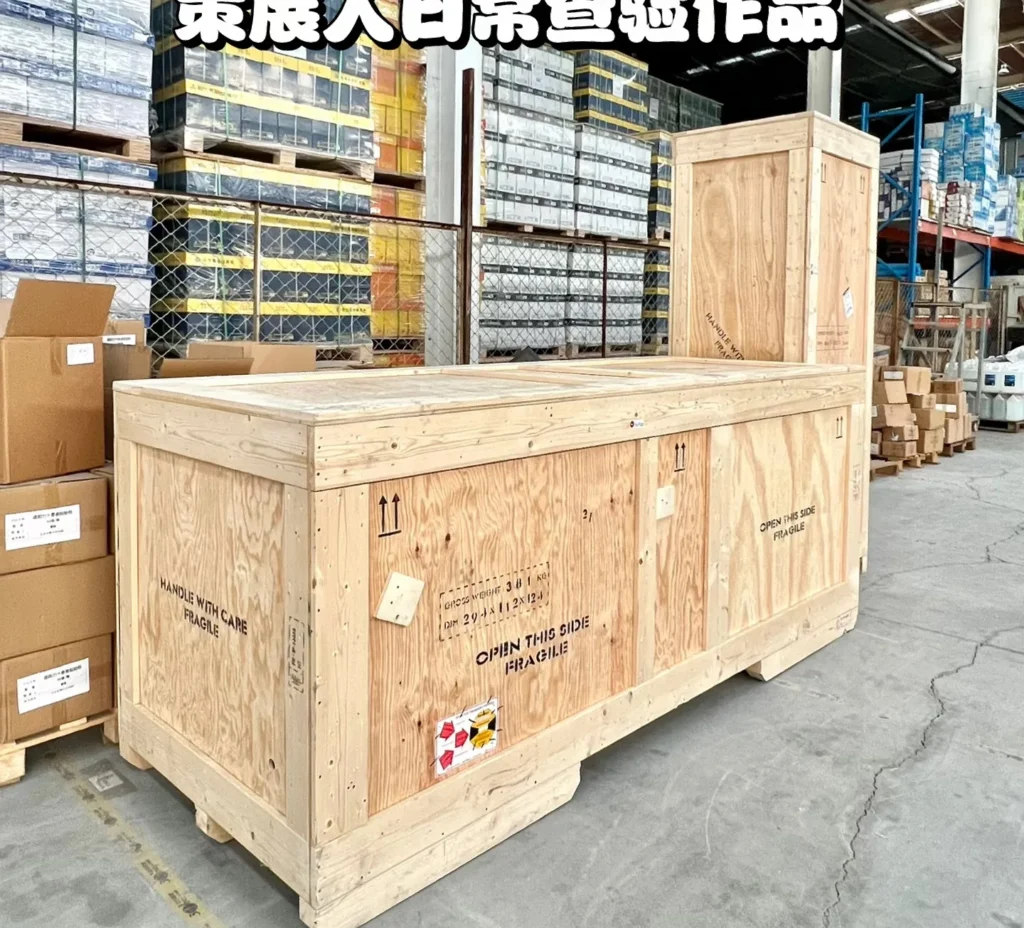
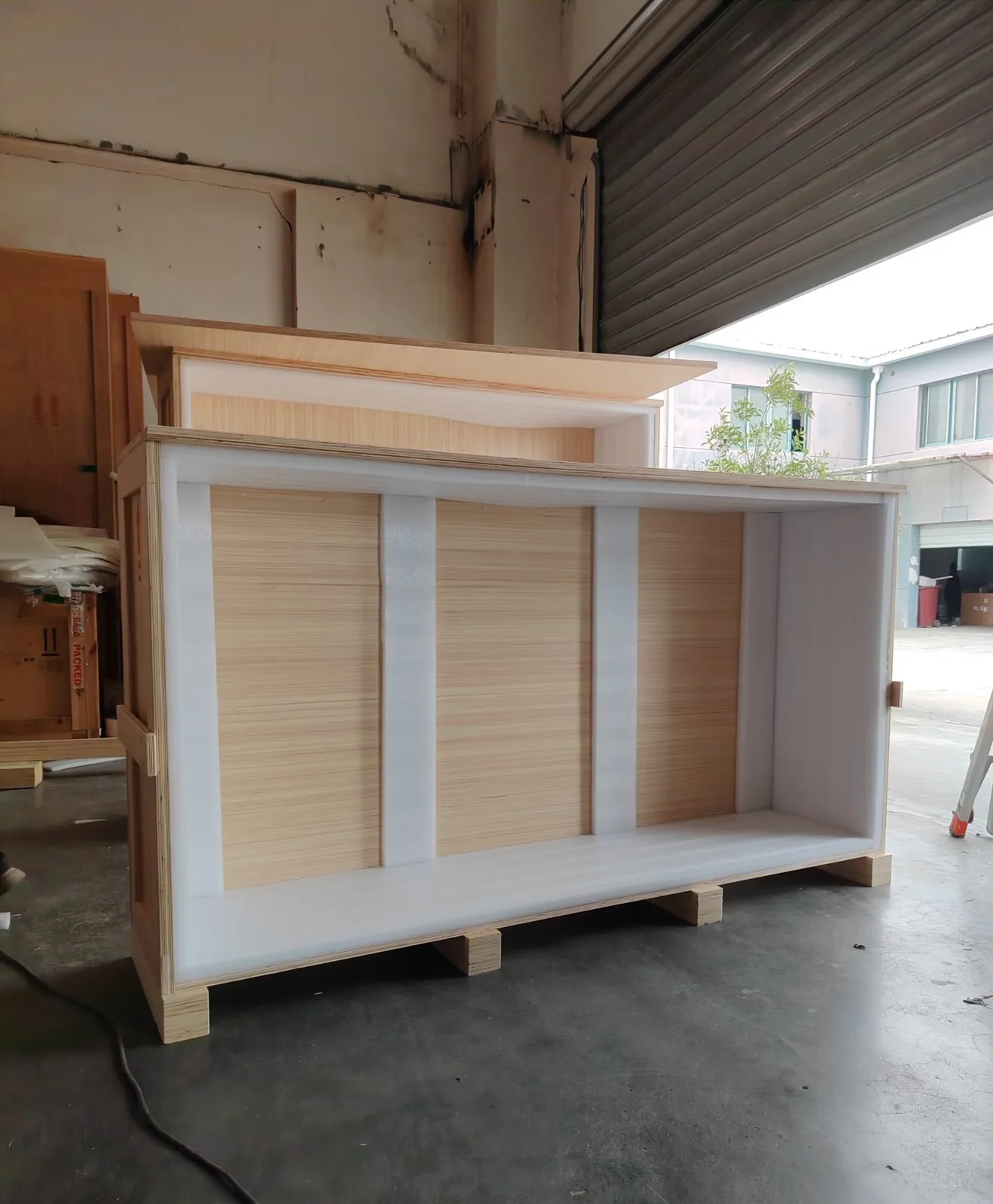
Fumigation applies to the wooden packaging, not to your furniture. Under ISPM 15, solid-wood packaging — pallets, crate walls, battens, skids, dunnage — must be heat-treated or fumigated and carry the IPPC mark. Plywood, multi-ply, MDF, particle board, cardboard, plastic and metal are exempt, because the manufacturing process already treats them. Most export crates are hybrids: plywood panels on solid pine battens and skids, and in that case the solid parts still need treatment and the mark.
| Packing level | What it protects against | ISPM 15 | Use it for |
|---|---|---|---|
| Closed crate — all six sides boarded | Rain, crushing, forklift impact | Needed if the frame is solid wood; not for all-plywood | Stone, glass, finished case goods, anything irreplaceable |
| Open frame — battens only | Knocks, not water | Needed — the battens are solid wood | Bulky, robust items inside a dry container |
| Pallet | Forklift handling only | Needed | Boxed goods already in their own cartons |
Four details prevent most of the problems we see: fit hinges to crate lids so an inspector can open a crate instead of prying it apart; leave 2–3 cm of cushioning around the item; add skids with forklift entry above about 100 kg and steel strapping above about 500 kg; and put desiccant in the crate, because a container crossing the tropics condenses inside. Building a crate from an approved drawing takes roughly 3–7 days, which is why crating is scheduled before production finishes, not after.
A fumigation certificate is normally valid for about 21 days, and groupage cargo can only be fumigated together when it shares the destination country, port, voyage and inspection office — one reason consolidation timing is planned around the sailing rather than around the last supplier.
- Weeks 0–2 — Brief and compared quotes. Send a furniture list, an FF&E schedule or a floor plan. You get line-by-line quotations with 3–5 supplier options on the items that matter.
- Weeks 2–5 — Samples or a model room. Fabric and finish samples for residential; a mock-up room for hotels.
- Weeks 5–6 — Order and deposit. From 10% of order value, 30% on a production run, 30–50% on made-to-measure work, to the company account.
- Weeks 6–14 — Production. 30–90 days depending on category; case goods and upholstery run in parallel.
- Weeks 14–15 — Inspection and consolidation. Every item received, checked, photographed and crated; the balance settles against the inspection, not against a promise.
- Weeks 15–20 — Loading and sea freight. 3–6 weeks at sea depending on destination, then customs and delivery.
- We are not the cheapest quote in your inbox. We compare suppliers and show you the comparison; we do not chase a price by silently downgrading foam density or frame timber.
- We do not take supplier commissions, which is also why we will not “get you the factory price and charge nothing”.
- We do not sell our own brand. There is no house catalogue we are trying to push into your container.
- We do not handle destination customs clearance in your country. We prepare the documents; a local broker clears them.
Directly, and in the way most buyers in this trade prefer — WhatsApp. Source Foshan replies within 12 hours, Monday to Saturday, China Standard Time (UTC+8).
- WhatsApp: +86 151 9256 9580
- WeChat: 15192569580
- Email: hello@sourcefoshan.com
- Office: Room 101, Building 1, No. 17 Sanyou South Road, Shiwan Town Subdistrict, Chancheng District, Foshan, Guangdong, China — visitors welcome by appointment
- Company: 先培(佛山)家居有限公司, unified social credit code 91440604MAKLLJJ0X1
A useful first message: destination country, what you are furnishing, roughly how many items or keys, and your target month on site. That is enough for a first answer without a call.
Whole-home residence, Greater Bay Area. 54 items from nine suppliers, received and checked in one warehouse, loaded into a single container. Read the project record.
Orange County, California. One 40HQ container unloaded at 09:41 and fully installed by 21:48 the same day. Read the delivery notes.
Singapore, after sales. An edge repaired and colour-matched on site, signed off at 14:15 — what happens when something arrives imperfect. Read the repair record.
Send your piece count and destination
Quantities, rooms or a rough list are enough. You get compared factory options, packed volume and a shipping route within one business day.
Markierte Felder sind erforderlich.
No spam, no obligation. Replies come from the sourcing team in Foshan, usually within one business day.
Frequently asked questions
How much does a furniture sourcing agent in China cost?
Source Foshan charges 3–5% of order value, agreed in writing before you commit, and takes no commission from suppliers. You see the supplier’s price and our fee as two separate numbers. Deposits start at 10% of order value, 30% on a factory production run, and 30–50% on cabinetry and other made-to-measure work; the balance is settled after inspection. An agent who will not show you the factory quotation is earning an undisclosed mark-up instead of a fee — not illegal, but not the same service.
Do you charge a commission or mark up the factory price?
A fee of 3–5% of order value, not a mark-up. Source Foshan does not take commissions from suppliers. You receive the supplier’s quotation and our fee as separate lines, and the deposit goes to 先培(佛山)家居有限公司 — a company name and unified social credit code (91440604MAKLLJJ0X1) you can verify before paying.
What is the minimum order to fill a container from Foshan?
About 15 m³ is the decision point. A 20-foot container holds roughly 28 m³ and a 40-foot high-cube 65–68 m³; below 15 m³ loose freight (LCL) is normally cheaper than booking a full box. A whole-home project of 40–60 items across several suppliers typically fills one 40HQ, and 20 one-bedroom apartments take two to three.
Can I order just a few pieces, or do factory MOQs apply?
Showroom stock in Lecong can be bought from one or two pieces. Factory production in a custom size, fabric or finish usually starts at 10–30 sets per collection and colour, and bulk outdoor programmes from the Zhejiang cluster start at 50–200 sets. Combining small orders from 6–12 suppliers into one container is precisely what removes the MOQ problem.
Can tiles, doors, sanitaryware and furniture go in the same container?
Yes, through one agent rather than one factory. Goods arrive at one warehouse from each supplier, are checked, then loaded together. Weight is the limit before space: a 40HQ offers 65–68 m³ but only about 26–28 tonnes, so heavy tile and sanitaryware are loaded low as ballast and light furniture and lighting fill the volume above.
How long does it take from order confirmation to delivery?
Plan 5–20 weeks door to door for residential work. Quotation and sampling take 2–5 weeks, production 30–90 days by category, inspection and loading 1–2 weeks, sea freight 3–6 weeks by destination, plus local clearance. Hotel FF&E runs 5–6 months from brief to installed rooms because of the model-room stage.
Do you inspect the goods before they ship?
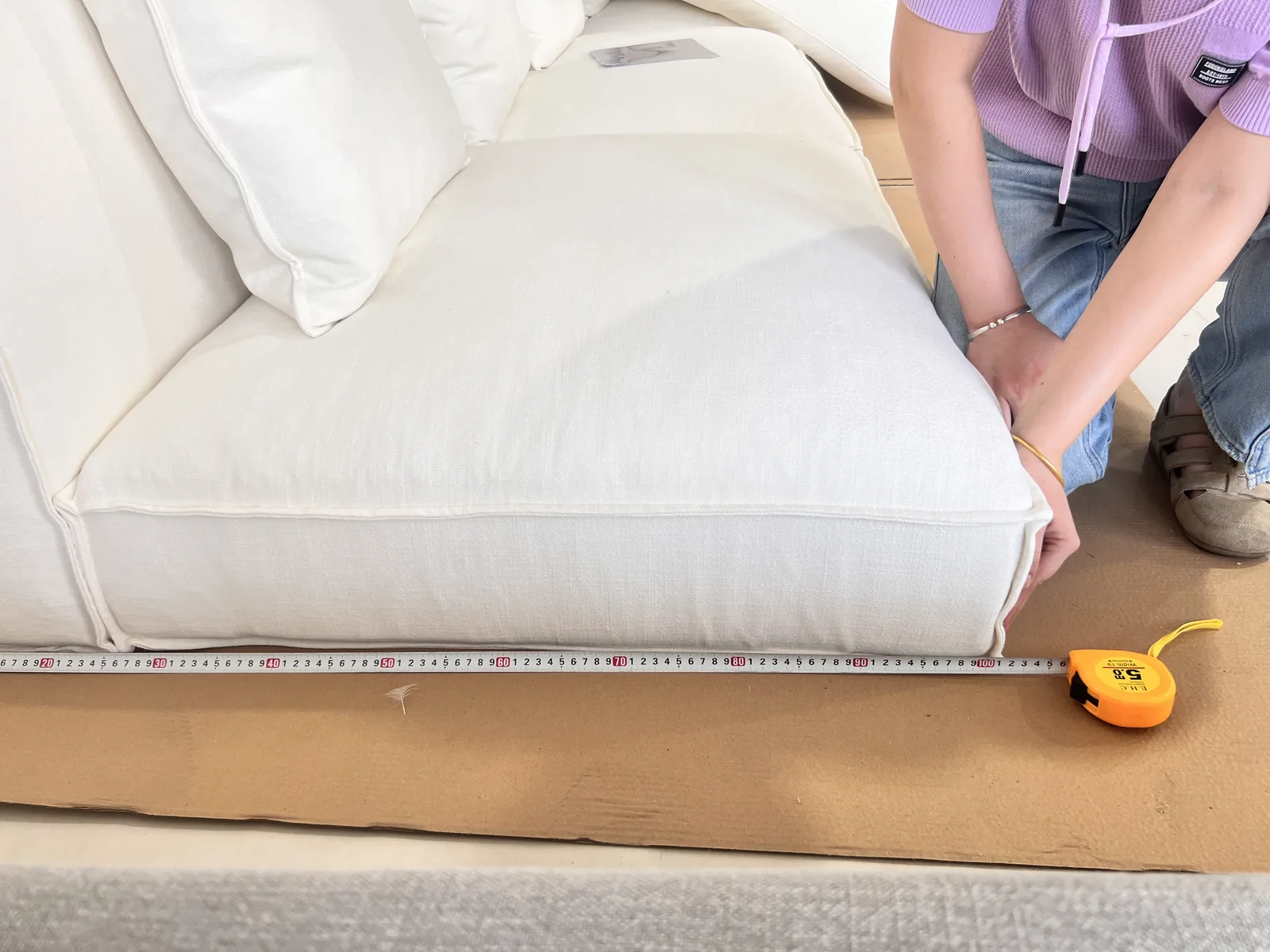
Yes, and before the balance payment. Each item is received in the consolidation warehouse and checked against its line in the order — hardware, drawer runs, finish, dimensions — and photographed, with a record of how the container was loaded.
Does lighting from China come with the right voltage and certification?
Only if you specify it, per item, on the purchase order. Lighting comes from Guzhen in Zhongshan — about 45,000 lighting enterprises and roughly 70% of China’s domestic lighting market, an hour from Foshan — and a factory will build to whatever voltage its usual market uses. State 110 V or 220–240 V, and name the certification: UL or ETL for North America, CE for the EU, SAA for Australia. Testing an uncertified fixture adds cost and typically 2–4 weeks.
What standards must hotel mattresses meet for the United States?
16 CFR 1632 for cigarette ignition and 16 CFR 1633 for open flame, in which peak heat release must stay below 200 kW across a 30-minute test. Both are prototype standards, so ask for the prototype test report before production starts. Imported labels must carry the foreign manufacturer’s name and full address including country, plus the importer’s address. For the UK and EU the equivalents are BS 7177 and EN 597.
Can you work from an interior designer’s FF&E schedule or spec book?
Yes. Send it as Excel or PDF with drawings or reference images. You get line-by-line quotations, alternatives flagged where a specification is not made in Foshan, and the volume each line adds to the container so the shipping plan is visible from the first quotation. Designers usually start at working with designers.
Sources and further reading
- eCFR — 16 CFR Part 1633, Standard for the Flammability (Open Flame) of Mattress Sets — 30-minute test, 200 kW peak heat release, prototype and record-keeping rules
- eCFR — 16 CFR Part 1632, Flammability of Mattresses and Mattress Pads — cigarette ignition standard and imported-label requirements
- Xinhua — China’s lighting capital sees robust export growth — Guzhen enterprise count and export markets
- HKTDC Research — Zhongshan city profile — Guzhen lighting cluster share of the domestic market
- IPPC — ISPM 15, wood packaging material in international trade — which packaging needs treatment and the IPPC mark
Field notes · from the blog
What buying in Foshan is actually like, from people who paid for the lesson.
 Furniture HS codes: a buyer’s guide to classifying Chapter 94 before you order
Furniture HS codes sit in Chapter 94: 9401 seats, 9403 other furniture, 9404 mattresses, 9405 lighting. How to classify each piece before you order.
Furniture HS codes: a buyer’s guide to classifying Chapter 94 before you order
Furniture HS codes sit in Chapter 94: 9401 seats, 9403 other furniture, 9404 mattresses, 9405 lighting. How to classify each piece before you order.
 Six mistakes Chinese buyers say they made buying furniture in Foshan — and the paperwork that prevents each one
Avoid six common Foshan furniture buying mistakes with an itemised quote, signed specifications, inspection checklist and payment safeguards.
Six mistakes Chinese buyers say they made buying furniture in Foshan — and the paperwork that prevents each one
Avoid six common Foshan furniture buying mistakes with an itemised quote, signed specifications, inspection checklist and payment safeguards.
 Shipping furniture from China: the complete 2026 guide to costs, containers, paperwork and delivery
Shipping furniture from China, step by step: LCL or a 33/67/76 m³ container, advertised rates, duty and VAT basics, packing, insurance and a 4-month…
Shipping furniture from China: the complete 2026 guide to costs, containers, paperwork and delivery
Shipping furniture from China, step by step: LCL or a 33/67/76 m³ container, advertised rates, duty and VAT basics, packing, insurance and a 4-month…
Send your list. We will tell you honestly how it would run.
A floor plan, an FF&E schedule, a product link or a rough brief is enough. Our local team in Foshan replies within one business day with real options, prices and lead times — no commitment.
Starten Sie Ihr ProjektWhatsApp +86 151 9256 9580 · hello@sourcefoshan.com · WeChat 15192569580