Reference · HS codes, duties & compliance
Furniture HS codes: a buyer’s guide to classifying Chapter 94 before you order
Furniture HS codes sit in Chapter 94: 9401 seats, 9403 other furniture, 9404 mattresses, 9405 lighting. How to classify each piece before you order.
- The first six digits of an HS code are the same in every country that uses the Harmonized System; the US, UK, EU, Canada and Australia each add their own 8–10 digit national lines and duty rates.
- For furniture, two facts decide most codes: what the piece is (seat, other furniture, mattress, luminaire) and what its frame is made of (wood, metal, plastics, bamboo, rattan).
- Hardware such as hinges and drawer slides usually falls outside Chapter 94 (often heading 8302), and a stone or glass top shipped on its own is normally classified with stone or glass, not furniture.
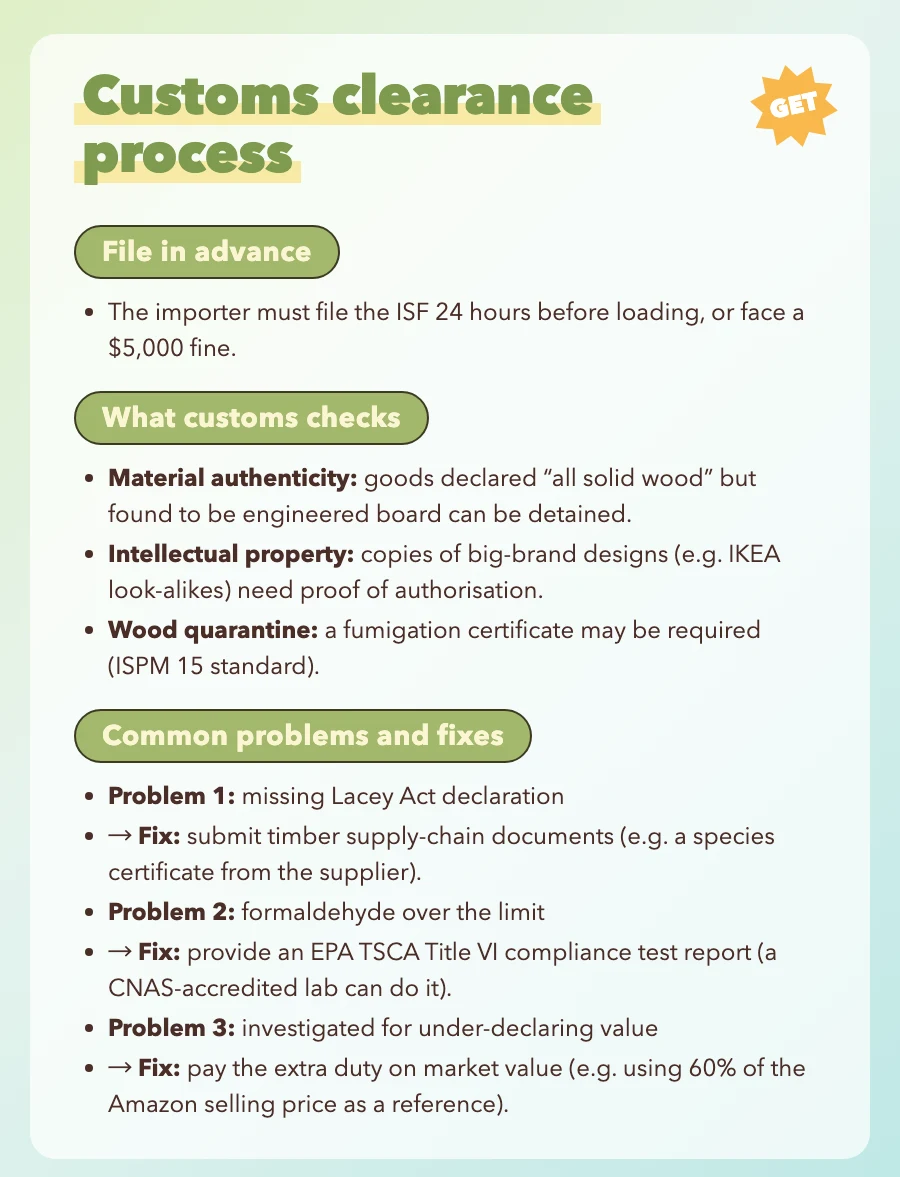
- A Guangdong customs-clearance account on Xiaohongshu warns that US invoices must name the material — “oak frame, linen cover”, not just “solid wood sofa” — and that wood needs a Lacey Act declaration of species and origin.
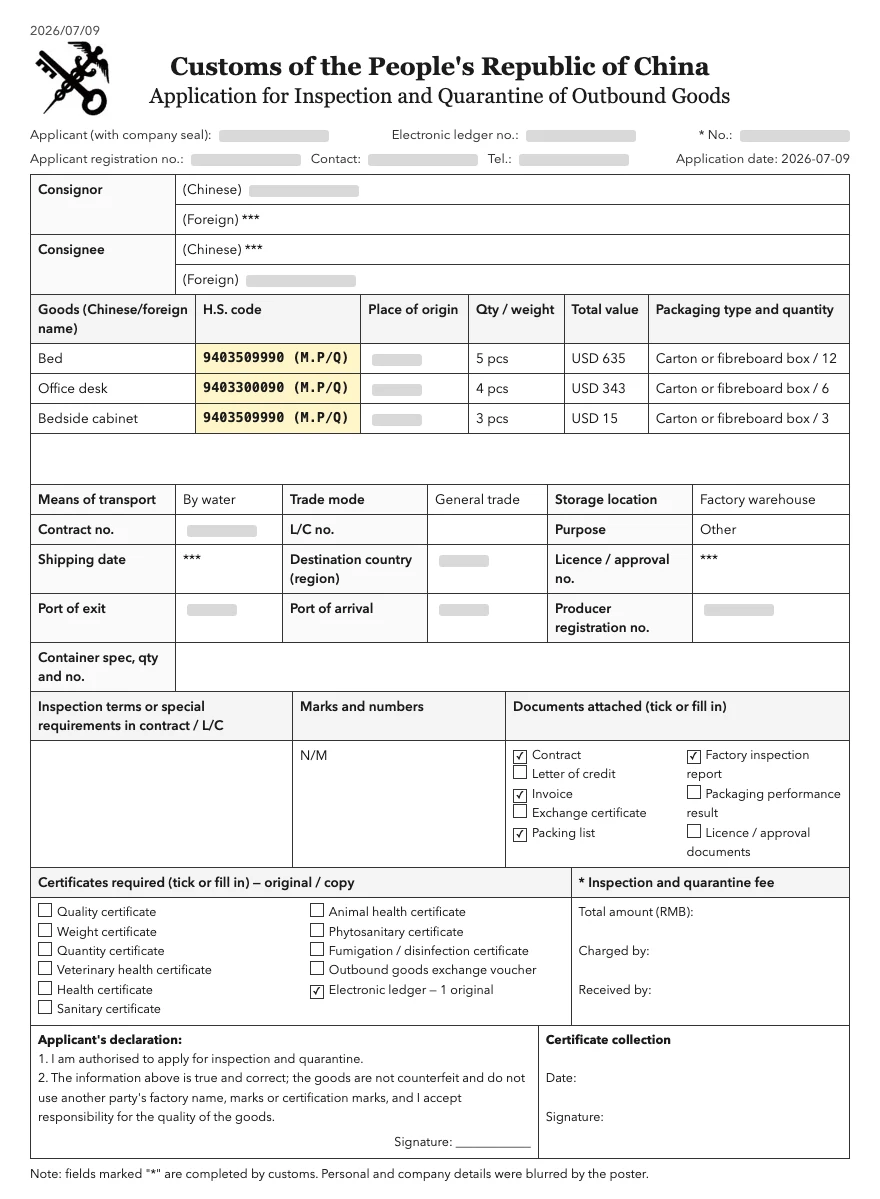
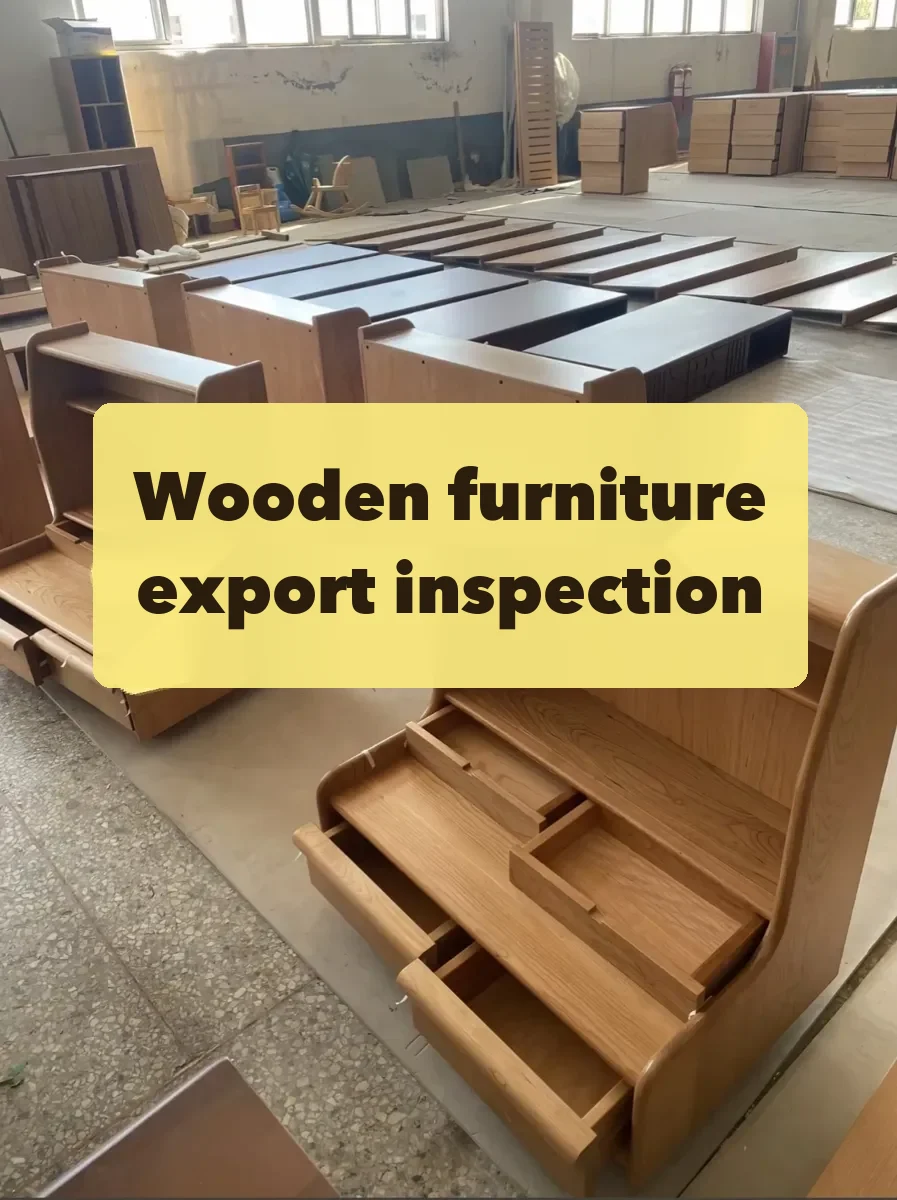
- China treats wooden furniture as a statutory-inspection export: a Chinese inspection agent’s post shows beds and bedside tables declared under 9403509990 and desks under 9403300090.
Most furniture HS codes sit in Chapter 94 of the Harmonized System: 9401 for seats and sofas, 9403 for other furniture such as tables, beds, cabinets and wardrobes, 9404 for mattresses and mattress supports, and 9405 for lighting. The first six digits are shared internationally; each country adds its own digits and sets its own duty. Classify every line from its material and function before you order, then confirm the full national code and current duty with your customs broker.
What is the HS code for furniture?
There is no single HS code for furniture: Chapter 94 splits it into headings by function, then into six-digit subheadings mostly by frame material. A buyer who writes “furniture, HS 9403” on every invoice line is guessing, and customs can reclassify the lot.
| Heading | What it covers | Typical pieces | Spoke guide |
|---|---|---|---|
| 9401 | Seats, including sofas and sofa beds, and their parts | Sofas, armchairs, dining chairs, office chairs, bar stools | Sofa HS codes |
| 9403 | Other furniture and its parts, split by use (office, kitchen, bedroom) and material | Tables, beds, wardrobes, sideboards, kitchen cabinets, desks | Wooden furniture codes |
| 9404 | Mattress supports, mattresses, quilts, cushions and similar bedding | Mattresses, box springs, slatted bases, loose cushions | Beds and mattresses |
| 9405 | Luminaires and lighting fittings (reorganised in HS 2022 around LED sources) | Chandeliers, pendants, floor and table lamps | Parts, hardware and lighting |
Our furniture HS code quick reference lists the common lines; this guide explains how to arrive at the right one for a mixed order, and where the duty surprises hide.
How do you find the right HS code for a piece of furniture?
Work in four steps: function, frame material, exceptions, then the national line. Customs classifies by the General Interpretative Rules, which in practice means the heading text and chapter notes come first, and the product’s essential character decides mixed cases.
- Function. Is it a seat (9401), other furniture (9403), bedding (9404) or a luminaire (9405)? A bed is not a seat; a sofa bed is.
- Frame material. 9401 and 9403 split by wood, metal, plastics, bamboo, rattan and “other”. An upholstered chair on a solid oak frame is 9401.61; the same chair on a steel frame is 9401.71.
- Exceptions. Chapter 94 excludes parts of general use such as hinges and fittings, and loose sheets of glass or stone. Flat-pack furniture is classified as the finished article.
- National line. Take the six digits to the destination tariff — the US HTS, the UK Trade Tariff, the EU’s TARIC, Canada’s Customs Tariff or Australia’s Working Tariff — and pick the national subdivision there.
For mixed materials, ask what gives the piece its character. A dining table with a solid walnut top on thin steel legs is usually treated as wooden; a steel-frame desk with a laminate top is a harder call and worth a broker’s opinion or a binding ruling. The spoke on outdoor, rattan and metal furniture works through several of these.
Treat the HS code as part of the product specification, not as a shipping detail. The code follows from the frame material and function you signed off, so the moment someone swaps a solid-wood frame for metal, or splits a cabinet into parts, the code, the duty and sometimes the anti-dumping exposure change with it. If nobody writes the HS code next to the material on the spec sheet, the first person to classify your order will be a customs officer.
Which furniture HS codes do buyers most often get wrong?
The recurring errors are office furniture coded by look instead of material, beds coded as seats, and parts and hardware coded as furniture. Even professional posts slip: one Xiaohongshu note from a US customs-clearance account lists a “metal-frame office desk (9403.30)”, but 9403.30 is wooden office furniture; metal office furniture is 9403.10.
- Office chairs. Swivel chairs with height adjustment moved to 9401.31 (wooden) and 9401.39 (other) in HS 2022; older lists still quote 9401.30. See office furniture HS codes.
- Headboards and bed frames. A wooden bed is bedroom furniture (9403.50); a loose headboard is usually a part (9403.91 if wood); a box spring is a mattress support (9404.10).
- Cabinet doors and carcasses shipped as parts. They may still fall within a US anti-dumping order whatever HS line they are entered under.
- Lighting and fittings. Built-in LED strips, handles and slides are not automatically “furniture parts”.
A wrong code does not only change the duty. It can trigger the wrong regulatory checks, a Lacey Act declaration that does not match, or a query that holds the container at the port.
What does the comment section add?
The comment threads under the customs posts are short; read with the related posts in the same search, they show where exporters themselves get stuck.
- The Lacey declaration is not free. A reader asked whether the Lacey Act filing adds a charge at US clearance; the account replied that the declaration carries a fee — worth budgeting per shipment.
- DDP offers are everywhere. Under the Chinese inspection guide, a forwarder advertises “US door-to-door, duties included” shipping with “low inspection, low duty” — a pitch buyers should read as a warning to ask who is importer of record and what value is declared.
- Exporters confuse inspection with fumigation. Several related posts that surface alongside these notes exist only to explain the difference between China’s export inspection of wooden goods and ISPM 15 treatment of packaging.
What paperwork has to match the HS code?
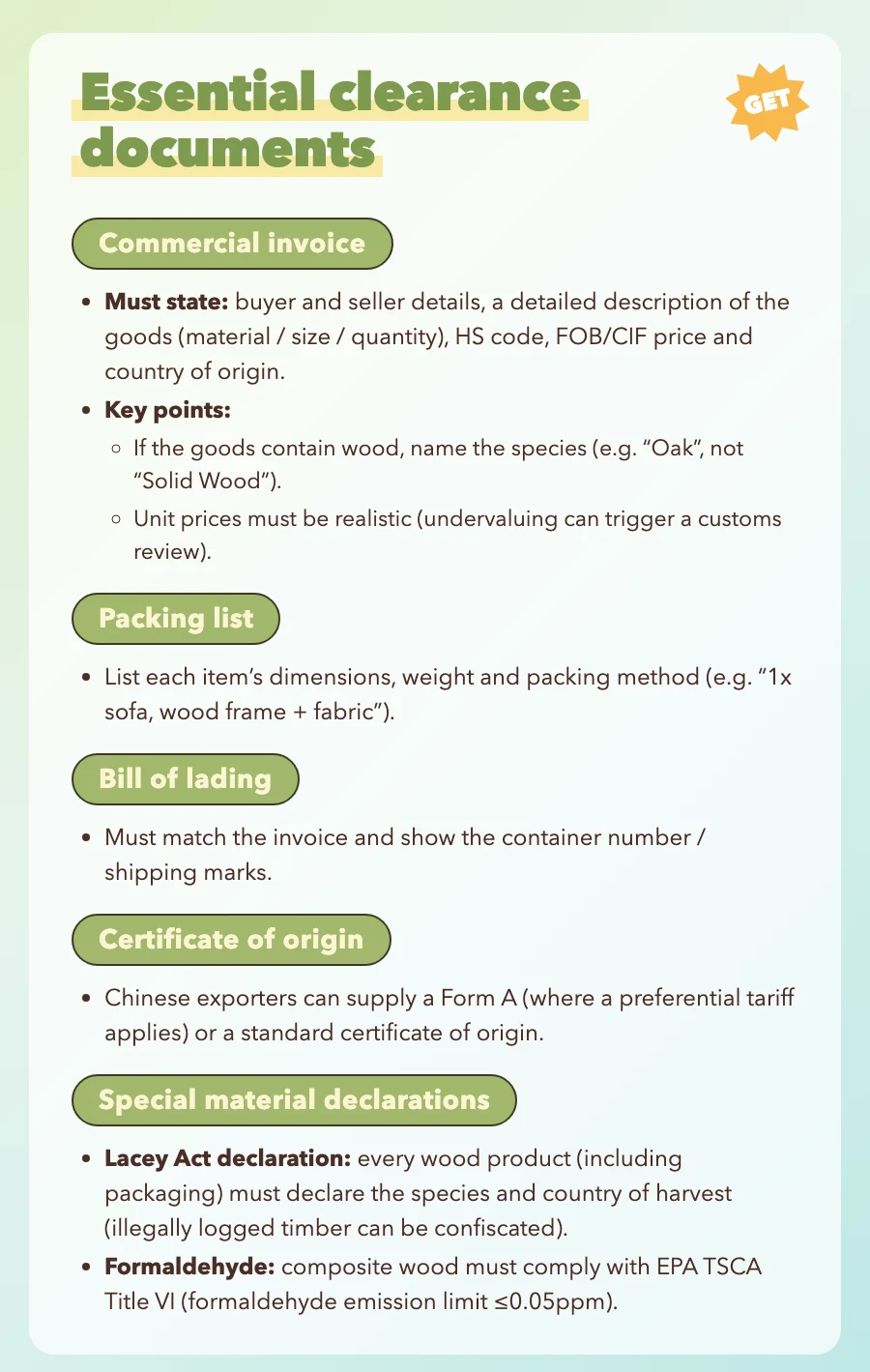
The commercial invoice, packing list, bill of lading and any certificates must describe each line the same way, with material, quantity and value matching the code. The US-focused Xiaohongshu note puts it plainly: write the species (“oak”), not “solid wood”, keep unit prices realistic, and make sure the bill of lading matches the invoice and the carton marks.
For wooden pieces bound for the US, the same post lists a Lacey Act declaration (genus, species, country of harvest) and, for composite panels such as MDF and particleboard, evidence of compliance with the EPA’s TSCA Title VI formaldehyde rules. A commenter asked whether the Lacey declaration costs extra at clearance; the answer was that filing it does carry a fee.
On the Chinese side, the factory or its agent handles export declaration. A post from a Chinese inspection agent describes wooden beds, sofas with wooden frames and solid-wood tables as statutory-inspection goods that cannot be declared for export without passing inspection first — something to allow for in the loading date. Our order paperwork checklist covers the rest.
How much duty will I pay on furniture from China?
That depends on the destination, the full national code and any extra measures on Chinese goods — so the only safe answer is a line-by-line check of each code (at the time of writing — confirm with your broker). Base duty rates on many furniture lines are low or zero in several markets, but the base rate is rarely the whole story for goods from China.
- United States. Section 301 duties have applied to many Chinese furniture lines since 2018 and have changed repeatedly, alongside newer tariff actions. Read our guide to US tariffs on furniture from China for what to check.
- Anti-dumping. The US has had anti-dumping and countervailing duty orders on wooden cabinets and vanities from China since 2020, at high, company-specific rates. See anti-dumping duties on cabinets and vanities.
- Other markets. The UK, EU, Canada and Australia each apply their own tariff and VAT or GST at import; trade agreements and origin rules can change the result.
The Xiaohongshu note quoting a “0%” rate for fabric sofas is a reminder of the trap: a base rate in one column says nothing about the additional duties layered on top for Chinese origin. Treat any rate you read online, including in this guide’s links, as correct only at the time of writing — confirm with your broker.
Does solid wood furniture need fumigation or ISPM 15?
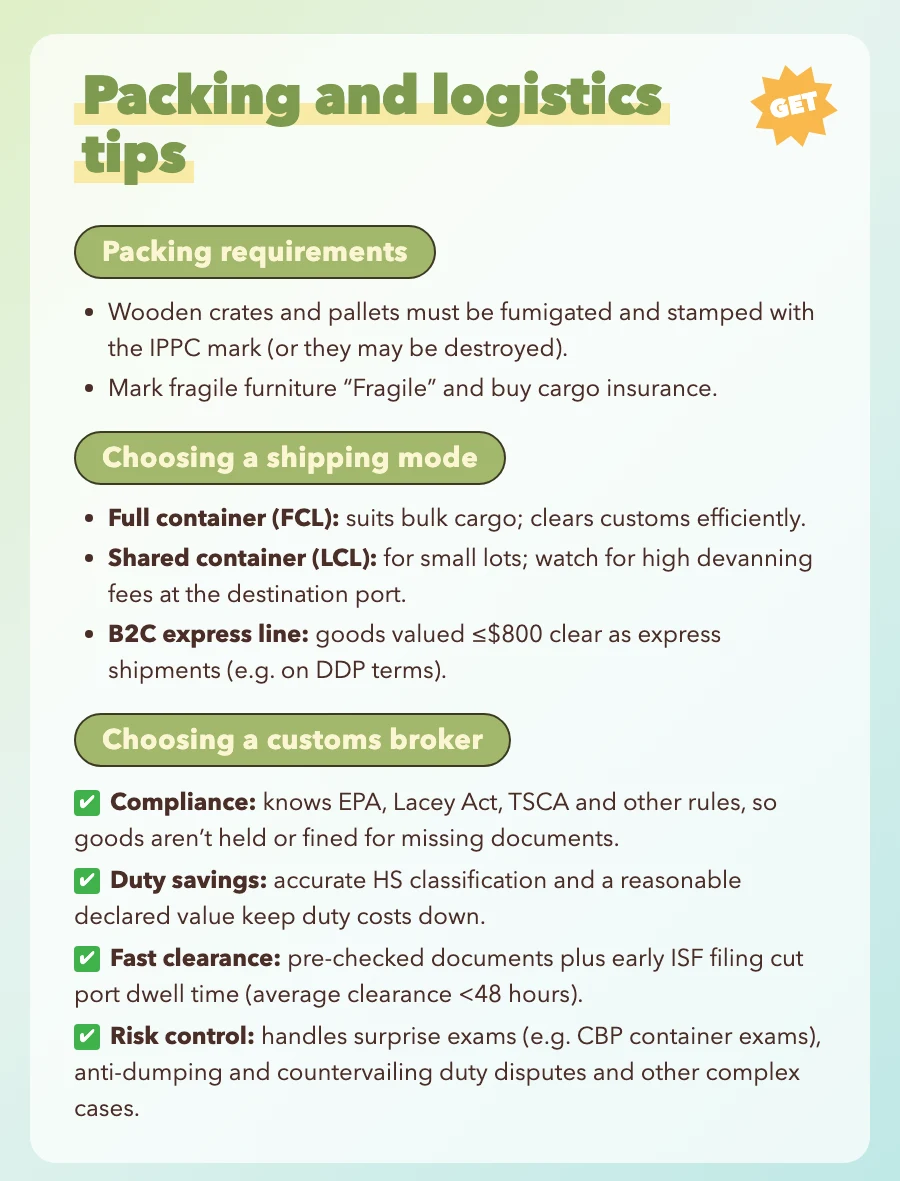
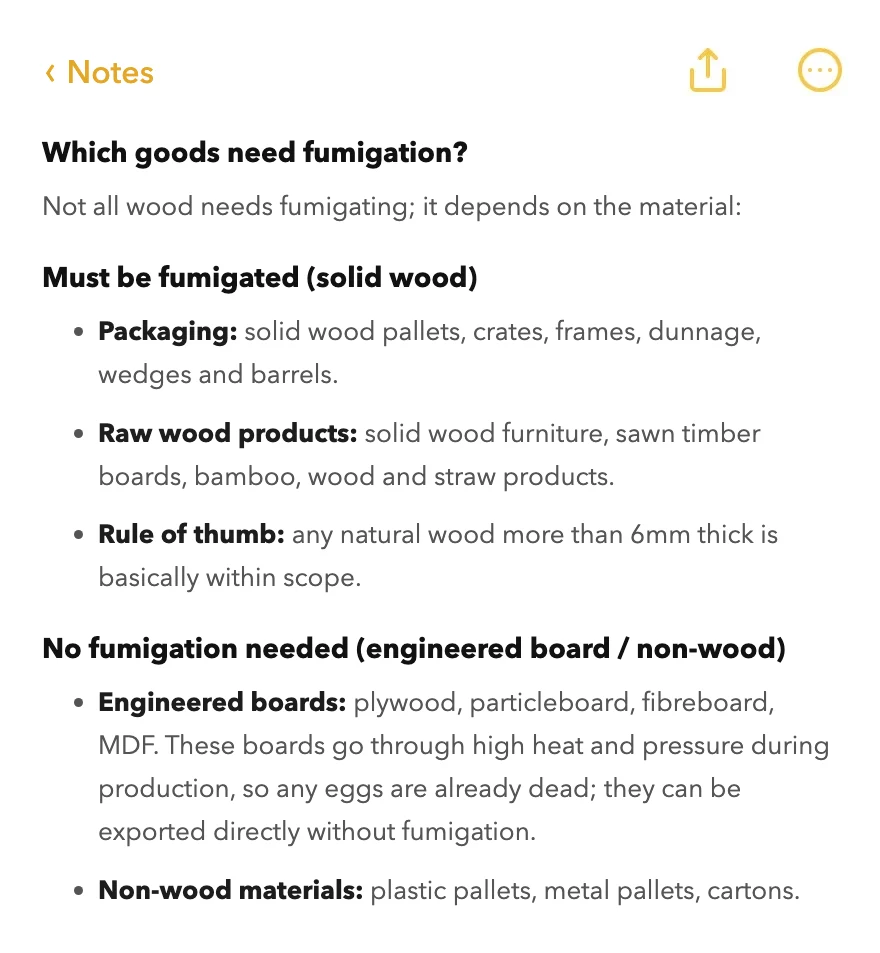
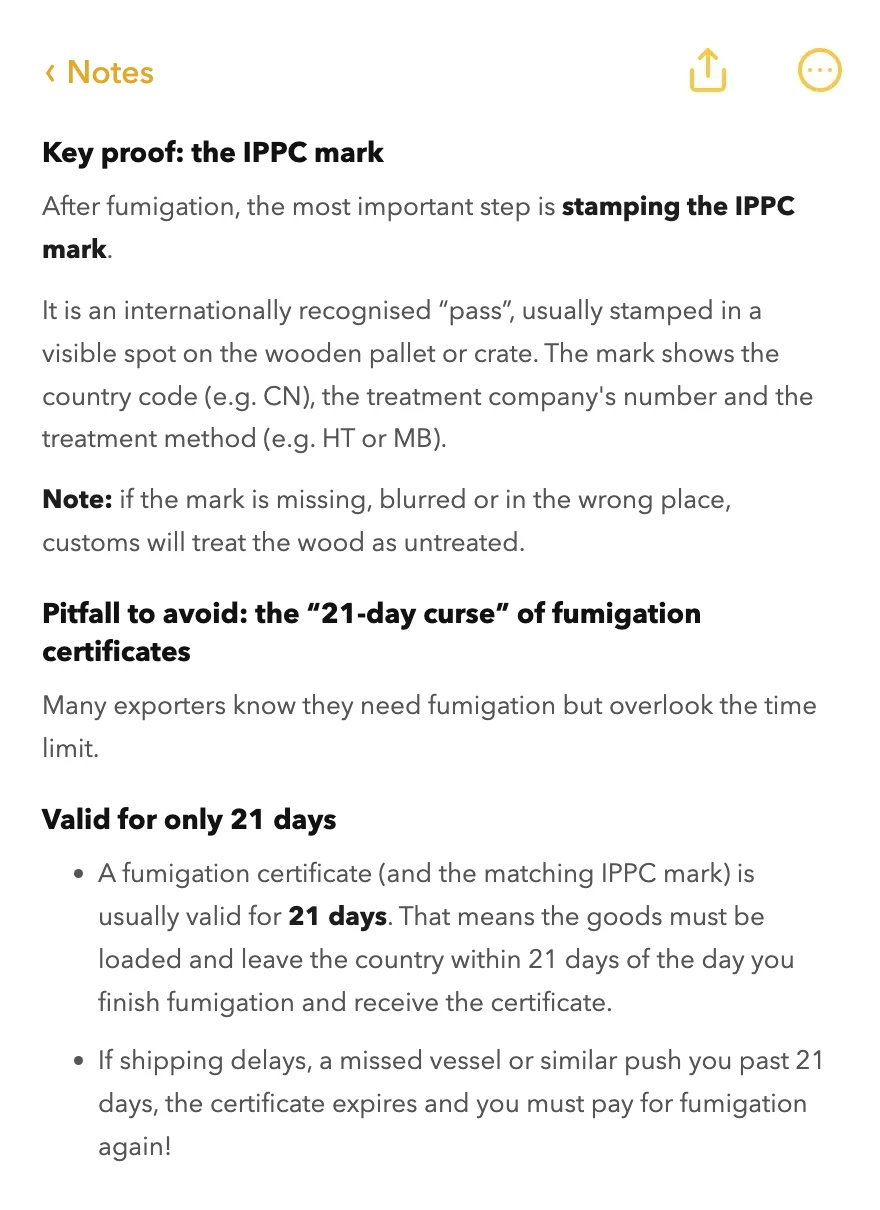
ISPM 15 applies to wooden packaging — crates, pallets and dunnage — not to finished, processed furniture, but solid timber furniture can still face biosecurity checks. Packaging must be heat-treated or fumigated and carry the IPPC mark; plywood and other processed-wood crates are exempt. The same US clearance note recalls a whole container being refused because the IPPC stamp on the packaging was illegible.
Australia and New Zealand look more closely at solid timber, bamboo and rattan pieces themselves. Our guide to ISPM 15, fumigation and solid wood furniture explains when to treat, when not to, and how to keep packing declarations consistent with the goods. For the freight side of the same shipment, see furniture shipping and consolidation from China and the wider guide to shipping furniture from China.
How Source Foshan handles it
We write the material and construction of every item into one specification before quotes are collected, so the classification discussion happens while the design can still change. When goods from several suppliers come into our Foshan consolidation warehouse, we re-pack to export standard, label by room and coordinate the export documents, customs and door-to-door delivery with the forwarder, so the invoice, packing list and labels describe each line the same way. Every item is inspected against the confirmed spec before loading, with a photo and video report. We do not give legal or tax advice: your customs broker confirms the national code and duty, and we supply the material, construction and photo evidence they need.
If you would rather order from pieces whose materials are already confirmed — which makes classification far simpler — we recommend Arcaya Living. Its catalogue of 10,000+ pieces is sourced to confirmed specifications, and its delivery path covers export packing, freight, customs coordination and installation.
Browse Arcaya's collections · How Arcaya delivers and installs · Arcaya's quality process
FAQ
What is the HS code for furniture?
Furniture is classified in Chapter 94: 9401 for seats and sofas, 9403 for other furniture, 9404 for mattresses and bedding, 9405 for lighting. The six-digit subheading depends on the frame material and, for 9403, on the room it is designed for. Your destination country adds further digits.
Is the HS code the same in every country?
Only the first six digits. The US, UK, EU, Canada and Australia each add national digits and set their own duty rates, so always look up the full code in the destination tariff and confirm it with your customs broker.
What HS code is used for a sofa?
Most upholstered sofas with wooden frames fall under 9401.61, and upholstered sofas with metal frames under 9401.71. Sofa beds are 9401.41 (wooden frame) or 9401.49 (other). Garden seats and loose cushions are handled differently.
Are furniture hinges and handles classified as furniture?
Usually not. Base-metal mountings and fittings for furniture, such as hinges, handles and many slides, are normally classified under heading 8302 outside Chapter 94, even when shipped with the furniture as separate lines.
Who is responsible for the HS code on an import?
Legally, the importer of record answers for the classification in the destination country, usually through a licensed customs broker. The exporter declares its own code for Chinese export; the two should agree at six digits, but the import classification is yours.
Can I get a binding ruling on a furniture HS code?
Yes. Most customs administrations, including US CBP and the UK’s HMRC, issue advance classification rulings on request. For a large or repeat order of an unusual piece, a ruling is cheaper than a dispute after arrival.
Keep reading
Sources
- Xiaohongshu forwarder source note (2025-04-07, 43 likes, 3 comments). View source
- Xiaohongshu guide source note (2026-07-13, 4 likes, 2 comments). View source
- Xiaohongshu forwarder source note (2026-04-24, 745 likes, 15 comments). View source
Mixed order, several materials, one container?
Send your item list with materials and destination. We build the specification sheet your broker needs to confirm codes and duty before any deposit is paid.