Buying guide · Sourcing agents & services
Furniture sourcing agents in China: what they do, what they cost and how to choose one
What a furniture sourcing agent in China does, how agents are paid (3–5% fee, commission or markup), who you are really buying from and how to choose one.
- A sourcing agent works for the buyer; a trading company and a showroom work for the sale. Ask which one you are talking to before you compare prices.
- A Chinese export blogger suggests agents charge roughly 3–5% for finding factories and collecting quotes, and about 10% for the full chain from samples to after-sales claims.
- A US buyer furnishing a 600 m² building with 139 pieces interviewed five agents and trading companies before choosing the one that answered every question.
- An agent explained on Xiaohongshu that some agents take payment through their own company, while others have the client pay the factory directly and earn only a commission.
- Source Foshan charges a 3–5% service fee agreed in writing before any factory is contacted and takes no supplier commissions.
A furniture sourcing agent in China finds and vets factories, collects comparable quotes, places and follows the order, inspects the goods and organises export on your behalf. Agents are paid in one of three ways — a written service fee, a commission on the order, or a margin hidden in the price — and that choice decides whose side they are on. Choose one who puts the fee in writing, lets you pay the factory directly and holds the balance until you have seen the inspection report.
What does a furniture sourcing agent in China actually do?
A good agent does six jobs: shortlist suppliers, compare quotes against one specification, place the order, follow production, inspect before loading and organise shipping. Showroom tours and translation help, but those six jobs are where money is saved or lost.
- Shortlist and vet. Visit or verify factories and showrooms, check that the seller is the maker (or say plainly that it is not), and drop the ones that will not write materials into a contract.
- Specify and compare. Turn a photo or drawing into a written specification — frame, foam, fabric or leather grade, finish, dimensions — and collect two or three quotes against that same sheet. Our guide to what a good sourcing report looks like shows the format.
- Order and pay safely. Contract with the real supplier; deposit to the supplier’s company account.
- Follow production. Weekly photos and video, and site checks on custom pieces.
- Inspect. Check every item against the signed specification before the balance is paid.
- Consolidate and ship. Receive goods from several suppliers, re-pack, label, book the container and coordinate documents.
This is how our own furniture sourcing and consolidation service is structured. If you are still deciding whether China is right for your project at all, start with how international furniture sourcing works and where China fits.
How are furniture sourcing agents paid, and what does it cost?
There are three models — a written service fee, a commission on the order, or a margin built into the price — and only the first is fully visible to you. The percentages that circulate are similar across models; what differs is who pays and whether you can see it.
| Model | How it works | What to check |
|---|---|---|
| Service fee | A percentage of order value or a fixed fee, invoiced by the agent as its own line | Agreed before any factory is contacted; factory prices shown separately |
| Buyer-paid commission | A percentage of the order, paid when the order is placed or shipped | What the percentage covers: quotes only, or inspection, shipping and claims too |
| Retainer | A monthly fee for an agent working on your account | Hours and tasks included; who pays travel to factories |
| Margin or supplier rebate | The agent resells at a higher price, or the factory pays the agent a share | Whether the quote you see is the factory’s own document |
On Xiaohongshu, a Guangdong export blogger coaching new agents suggests about 3–5% for finding factories and collecting quotes, and about 10% for the whole chain including samples, inspection, loading supervision and after-sales claims. A commenter pushed back that even large trading houses take around 5%, and others mention monthly retainers from USD 300 to USD 1,500. Asked whether she adds a margin on top of the factory price, the blogger replied that both approaches are possible, depending on the client. That is exactly why the model matters more than the number — see our full breakdown of sourcing agent fees: commission, kickbacks and the transparent service fee.
The single most useful question to ask any furniture sourcing agent is not “how many factories do you know?” but “who pays you?”. An agent paid only by you can afford to tell you a factory is wrong for the job; an agent paid by the factory cannot. For an overseas buyer who will not be in the room when the balance is due, that alignment is worth more than a lower headline fee.
Agent, trading company, factory or guide — who are you really buying from?
Ask whose name will be on the contract and whose bank account receives the deposit; the answer tells you the business model faster than any website. Four kinds of seller look alike from abroad:
- Factory direct: lowest price for what it makes, but usually one category, limited English and little help with mixed orders or shipping.
- Trading company: buys from factories and resells; convenient for mixed orders, but the factory is normally kept confidential and the margin is inside the price.
- Sourcing agent: acts for the buyer, in principle for a disclosed fee, and lets you see the supplier.
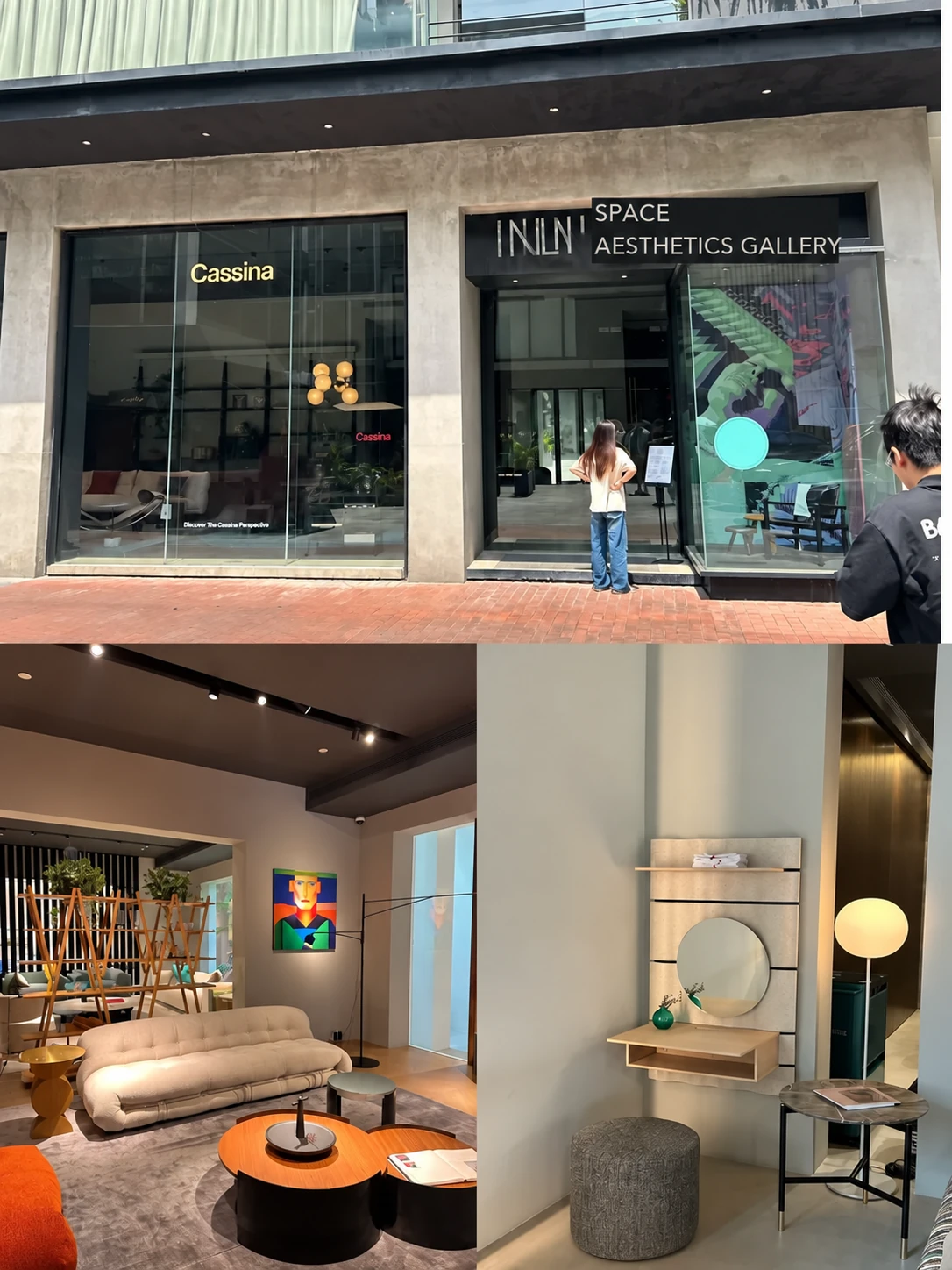
- Showroom intermediaries and tour guides: common in Foshan’s malls; buyers report that some free or very cheap guides are paid by the shops they bring clients to.
None of these is wrong in itself; what matters is knowing which one you have. Our comparison of sourcing agent, trading company or factory direct goes through how to tell them apart, and how the Foshan tour-guide model works explains what buyers report about shop commissions and how to check for them.
What does the comment section add?
The comments under the Zhejiang agent’s post are short, but three of them go straight to how agents get paid and what can go wrong.
- Two ways to take the money. Asked how payment works, the agent replied that an agent willing to take more risk for more profit collects payment through its own company; otherwise the client pays the factory and the agent earns only its purchasing commission.
- Commission or mark-up? Another reader asked directly whether she charges a commission or adds a premium to the merchants’ prices — the question every buyer should ask in writing.
- After-sales is the hard part. A commenter in the United States warned that mixed orders are exhausting, furniture after-sales is a headache and a list with many SKUs can become unmanageable; the agent agreed and said she wanted to learn the full loop first.
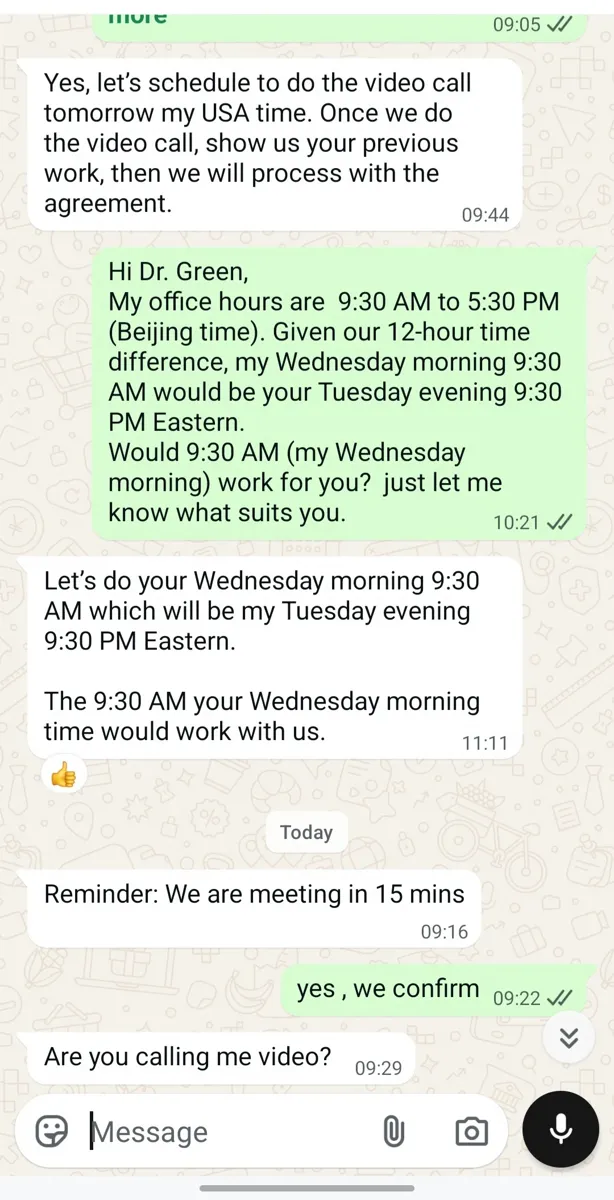
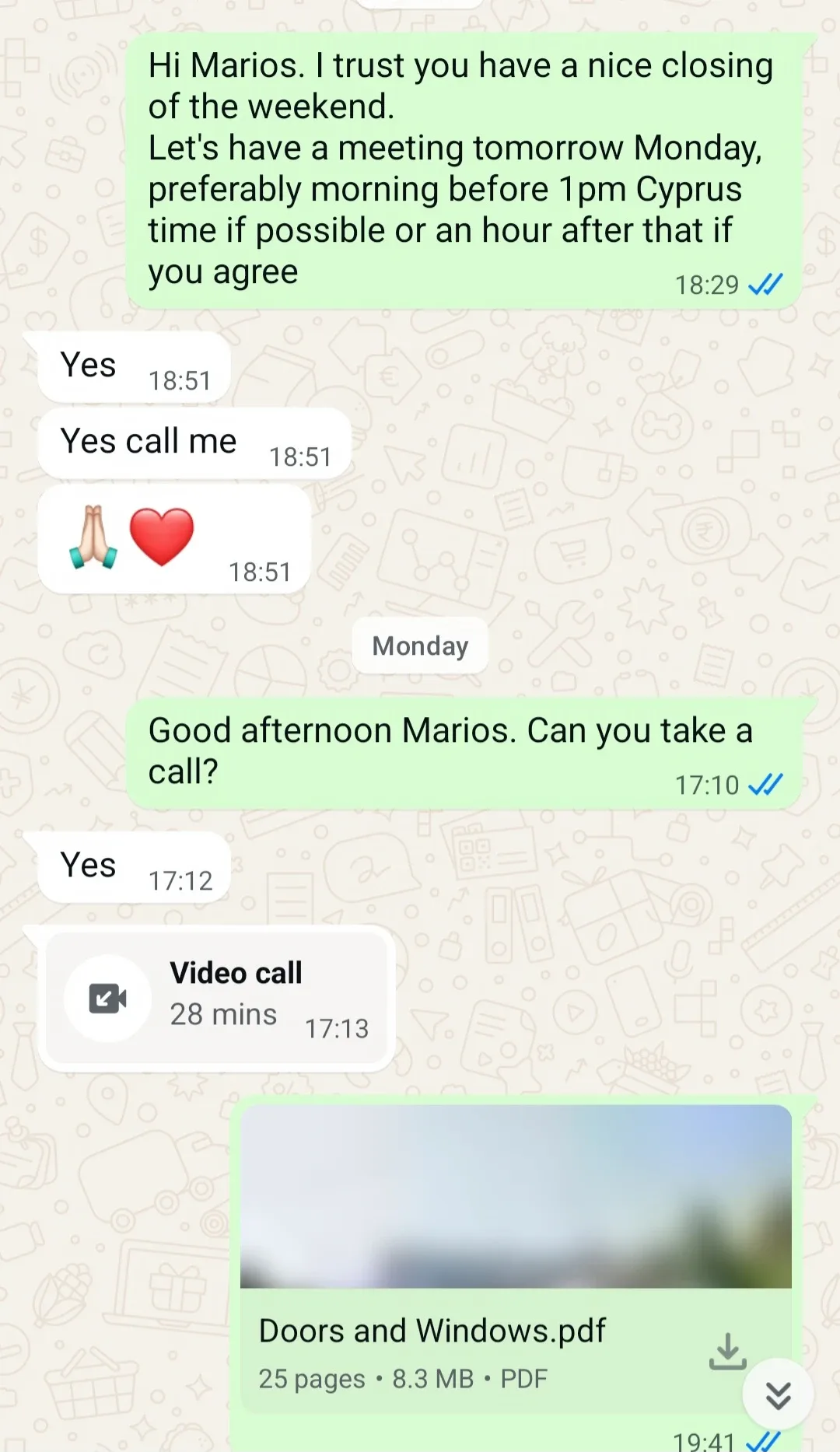
- Clients vet agents too. The agent notes that the doctor checked her business licence, registered address and past cases, and asked for a video call before an agreement — a sensible minimum for any buyer.
Is Alibaba cheaper than using a China furniture sourcing agent?
Alibaba is often cheaper for a single standard item from one supplier; an agent usually wins once an order involves several suppliers, custom sizes or a whole room. A buyer in Paris who ordered a modular sofa through Alibaba described the platform honestly: many factories there do not accept individual orders, the price was quoted by module and material, freight alone came to roughly a third of the total, and the whole process took three and a half months with no tracking number. The sofa arrived and held up — but it was one supplier, one product and one shipment.
For a mixed list, someone has to reconcile quotes, check each workshop and combine the goods into one container. Our guide to Alibaba or a sourcing agent for furniture sets out where each one works.
Can you source furniture from China without visiting?
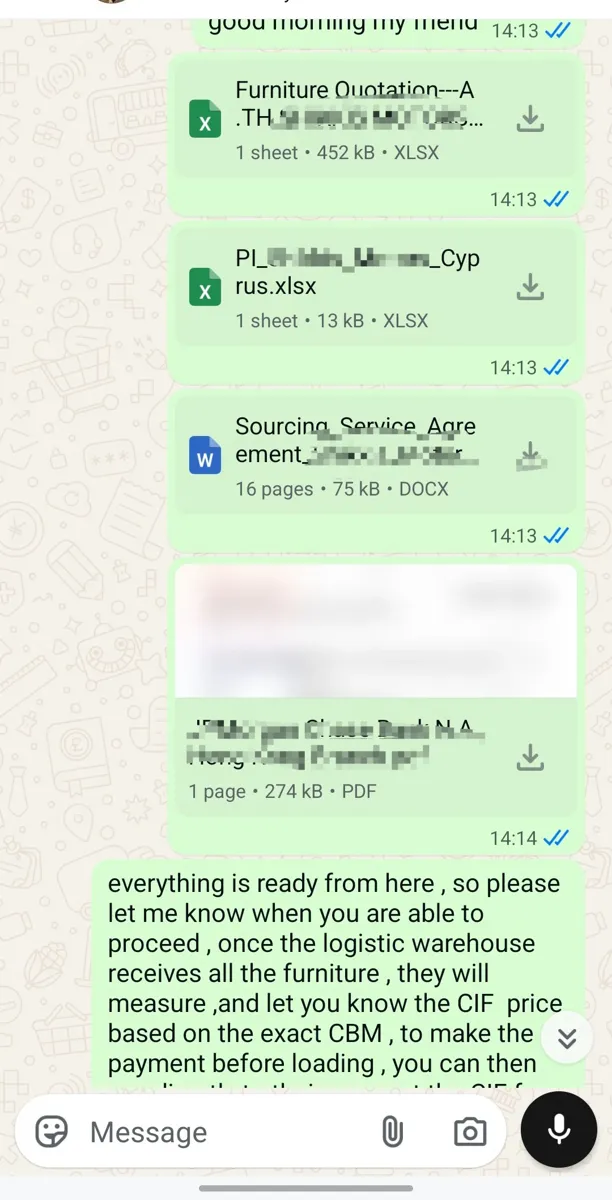
Yes, provided every decision is backed by a written specification, a video walk-through and an inspection report you approve. In the most useful Xiaohongshu thread we found, a Zhejiang-based agent prepared the final agreement with a US client over a video call across a 12-hour time difference, sent the quotation and a sourcing-service agreement as files, and explained that freight would be priced once the warehouse had measured the finished goods.
What remote buying cannot do is let you sit on a sofa or smell a finish. That gap is closed with fabric and leather swatches, a pre-production sample for anything custom, and photos at frame, upholstery and packing stage. We explain the routine in sourcing furniture without flying to China. If you do want to see Foshan in person, plan a Foshan visit with a route agreed before you land.
How do you choose a furniture sourcing agent in China?
Choose on process and paperwork, not on the size of the supplier list: fee in writing, supplier named on the contract, deposit to the supplier’s company account, balance after inspection. The US buyer mentioned above did her own due diligence before signing — business licence, registered address, previous projects — and the agent, in turn, checked that the client and her floor plan were real. Both sides were right to.
Five questions do most of the work:
- How are you paid, and will you confirm in writing that you take no commission from suppliers?
- Whose company account receives my deposit?
- Will I see each factory’s own quotation, not a re-typed one?
- What is inspected, by whom, and do I approve the report before the balance is released?
- Who handles a claim if something arrives damaged or wrong?
The full list, with what a good answer sounds like, is in 15 questions to ask a furniture sourcing agent before you sign.

When is a Foshan furniture sourcing agent worth it — and when is it not?
An agent pays for itself on multi-supplier orders, custom pieces and whole-home or project fit-outs; for one catalogue item, you may not need one. A US-based commenter on the agent’s post warned that mixed orders with many SKUs are exhausting and that furniture after-sales is hard — which is true, and is precisely the work a buyer is paying to hand over. A developer in the same story had already collected Foshan quotes himself and found the mark-ups on them unreasonable before appointing an agent to take over tiles, doors, hardware and furniture for a show flat.
Foshan is a natural base for this work because upholstery, casegoods, lighting and building materials sit within a short drive of one another. Our walk-through of how a one-container whole-home project is run shows the sequence, and the step-by-step guide to buying furniture from China covers the rest of the journey. If you only want to know who sells Foshan furniture online, see who sells Foshan furniture online.
How Source Foshan handles it
We work only for the buyer. Our service fee is 3–5% of order value, agreed in writing before any factory is contacted and shown as a separate line from the factory price, and we take no commissions or rebates from suppliers. We shortlist and vet factories and showrooms across Lecong, Longjiang, Shunde and Dongguan, compare two or three quotes per line against one written specification, and send photos and video at every stage. Deposits — as low as 10% on many orders — are paid to the supplier’s company account, and the balance is released only after you approve our photo and video inspection report. Goods from several suppliers are received into our Foshan consolidation warehouse, re-packed to export standard, labelled by room and shipped LCL or FCL. If you want to see Foshan yourself, a guided day costs USD 150, USD 250 with a car, or USD 299 with a 7-seat SUV.
If you would rather start from a finished range than a factory search, we recommend Arcaya Living: a curated catalogue of more than 10,000 pieces sourced to confirmed specifications, with a five-stage quality process and a full delivery path through to installation.
Browse Arcaya's collections · How Arcaya checks quality · Delivery and installation
FAQ
What does a furniture sourcing agent do in China?
A furniture sourcing agent finds and vets suppliers, compares quotes against one written specification, places the order, follows production, inspects the goods and organises consolidation and shipping. The best agents act only for the buyer and are paid a disclosed fee.
How much does a furniture sourcing agent in China charge?
Commonly quoted figures are around 3–5% for supplier search and quotes and up to about 10% for the full chain, with some agents charging monthly retainers instead. Source Foshan charges 3–5% of order value, agreed in writing before any factory is contacted.
Do sourcing agents in China take commissions from factories?
Some do, and buyers report it happens, especially with free or very cheap guides. Ask the agent to confirm in writing that it takes no supplier commissions, and insist on seeing each factory’s own quotation.
Is it safe to pay a sourcing agent instead of the factory?
It can be, but it adds a layer of risk. Paying the deposit directly to the supplier’s company account, with the balance released only after you approve the inspection report, keeps your money traceable.
What is the difference between a sourcing agent and a trading company?
A sourcing agent represents the buyer and lets you see the supplier; a trading company buys from factories and resells, normally keeping the factory confidential. Both can be useful, but you should know which one you are dealing with.
Keep reading
Sources
- Xiaohongshu guide source note (2026-09-02, 146 likes, 45 comments). View source
- Xiaohongshu buyer source note (2025-05-24, 60 likes, 5 comments). View source
- Xiaohongshu guide source note (2024-04-23, 712 likes, 152 comments). View source
- Xiaohongshu guide source note (2026-01-07, 554 likes, 60 comments). View source
- Xiaohongshu buyer source note (2021-08-29, 397 likes, 86 comments). View source
- Xiaohongshu maker/seller source note (2026-08-01, 71 likes, 0 comments). View source
Looking for a furniture sourcing agent who works only for you?
Send your list, drawings or floor plan. We reply with a written fee, the suppliers we would approach and a timeline — before anyone contacts a factory.