Buying guide · Cabinetry & interiors
Keukenkasten uit China: de complete kopersgids voor specificeren, importeren en installeren
Keukenkasten kopen uit China: 6 plaatsoorten, de verborgen extra's in pakketoffertes, opmeten, Amerikaanse invoerrechtencontroles en installatie in het buitenland, stap voor stap.

- The most-saved Xiaohongshu cabinet notes teach Chinese homeowners to tell apart six board types — solid wood, MDF, particleboard, blockboard, plywood and OSB — and to buy on the board maker’s name, not the showroom’s.
- A Beijing buyer’s checklist (1,500+ likes) found that a standard package charged extra to go from 65 cm to 60 cm deep, to raise base cabinets to 90 cm, for soft-close undermount drawer runners and for a thicker 2 cm worktop.
- The same buyer found laser edge banding promised for the kitchen applied to the doors only, not the cabinet boxes.
- An installer with eight years in custom cabinetry tells buyers to write every agreed detail into the contract and to supervise the installation in person.
- In the US, wooden cabinets and vanities from China have been subject to anti-dumping and countervailing duty orders since 2020 (confirm current scope and rates with your broker).
Kitchen cabinets from China are usually made to measure by panel-furniture factories in Guangdong and elsewhere, priced by the metre or by projected area, and quoted as a package whose contents vary widely. You can buy them well from abroad if you fix four things in writing before paying: the board and emissions grade, every item the package does and does not include, a signed set of measured drawings, and who installs at the other end. For US projects, check anti-dumping and countervailing duty exposure with a customs broker first.
Is it worth buying kitchen cabinets from China?
Yes, when the kitchen is custom or large and you can control the specification; no, when you need a few standard boxes next week. China’s custom-cabinetry industry is built for made-to-measure work: panel factories cut, edge-band and drill each carcass to a drawing, and the same line produces wardrobes, bathroom vanities, doors and wall panels in matching finishes. That is the reason overseas buyers look at it — not only price, but the ability to get a full-height, handle-less, one-colour kitchen made to the millimetre.
What Chinese homeowners write on Xiaohongshu is a useful warning about the other side. The most-saved checklists are not about style at all; they are about what the package includes, which board is really inside the door, and whether the drawings match the room. Those are exactly the things an overseas buyer cannot fix by walking back to the showroom. Our kitchen cabinetry service page sets out what we source; this guide explains how to buy it safely, whether you are furnishing one home or buying wholesale cabinets for a development or a store.
What can you buy besides the kitchen?
Almost every built-in joinery item in a home, from the same factory and in the same board and colour. Chinese makers sell kitchens as part of what they call whole-house customisation: kitchen, wardrobes, entry and TV units, bathroom vanities, interior doors and wall panelling. Buying them together keeps colours, edge details and reveal gaps consistent — and fills a container more efficiently.
| Artikel | What changes compared with the kitchen | Our guide |
|---|---|---|
| Wardrobes and walk-in closets | Hanging heights, door widths, drawer placement | Wardrobes and closets from China |
| Bathroom vanities | Moisture-resistant board, basin and top as one unit | Bathroom vanities from China |
| Interior doors and wall panels | Door leaf, frame and panel gaps must line up across a floor | Interior doors and wall panels |
| Whole-home package | One design system, one drawing set, one shipment | Whole-house customisation in China |
For projects that go beyond the kitchen, see our kledingkasten en kasten en geïntegreerde interieursystemen pages.
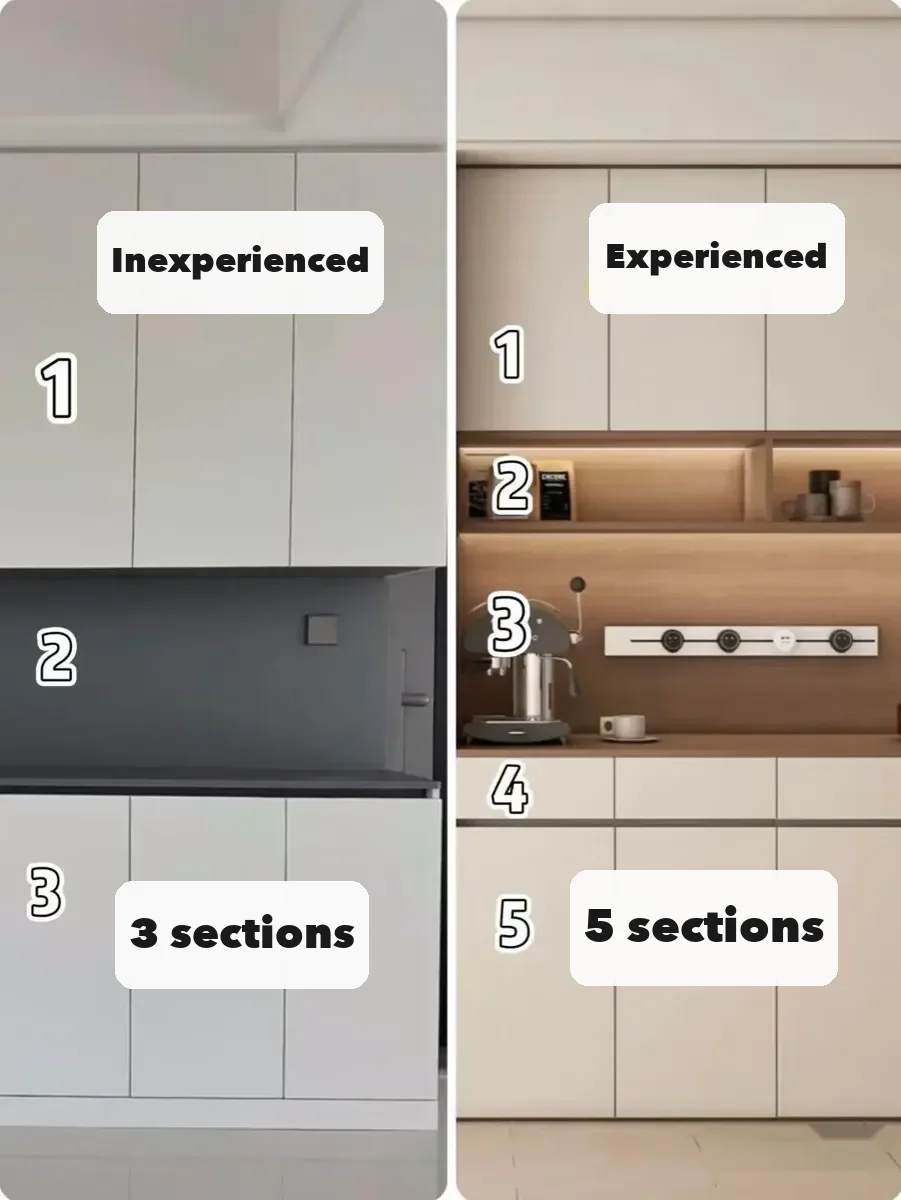
Chinese homeowners protect themselves by holding back the balance and standing in the kitchen on installation day. An overseas buyer has neither lever unless it is built in before the deposit: for an imported kitchen, the signed drawing and the included-items list are the product — the boxes are just their delivery. We would rather spend an extra week on the drawing than a month waiting for a replacement panel to cross the sea.
What board should Chinese kitchen cabinets be made of?
Specify the board type, the board manufacturer and the emissions grade for the carcass, doors and back panels separately — they are often different. A Jiangsu homeowner’s cabinet notes, saved nearly 6,000 times, reduce the confusing trade names to six boards: solid wood; MDF (wood fibre and glue, often used for shaped doors); particleboard (chips and glue, stable); blockboard, sold as “ecological board” (thin veneers over timber strips, soft, not usually for doors); plywood (moisture-resistant, more glue); and OSB, a coarser particleboard. Her advice is to choose on the board maker’s brand rather than the showroom’s, and she ranks Chinese emissions grades as ENF, then Japan’s F4-star, then E0, with E1 no longer worth buying.
Not everyone agrees on which board is “best”. A Chengdu cabinet showroom tells buyers to avoid MDF and plywood and use OSB or particleboard; other posts recommend plywood for kitchen carcasses because it copes better with damp. The honest answer is that each board has a place, and the difference between two quotes is often the board. Our cabinet board explainer compares them, and our guide to formaldehyde rules explains why a Chinese ENF or E0 label is not the same thing as a US CARB Phase 2 / TSCA Title VI certificate. Ask for the board supplier’s test report and, for the US, the composite-wood compliance documents before production — not after.
Wat voegen de reacties toe?
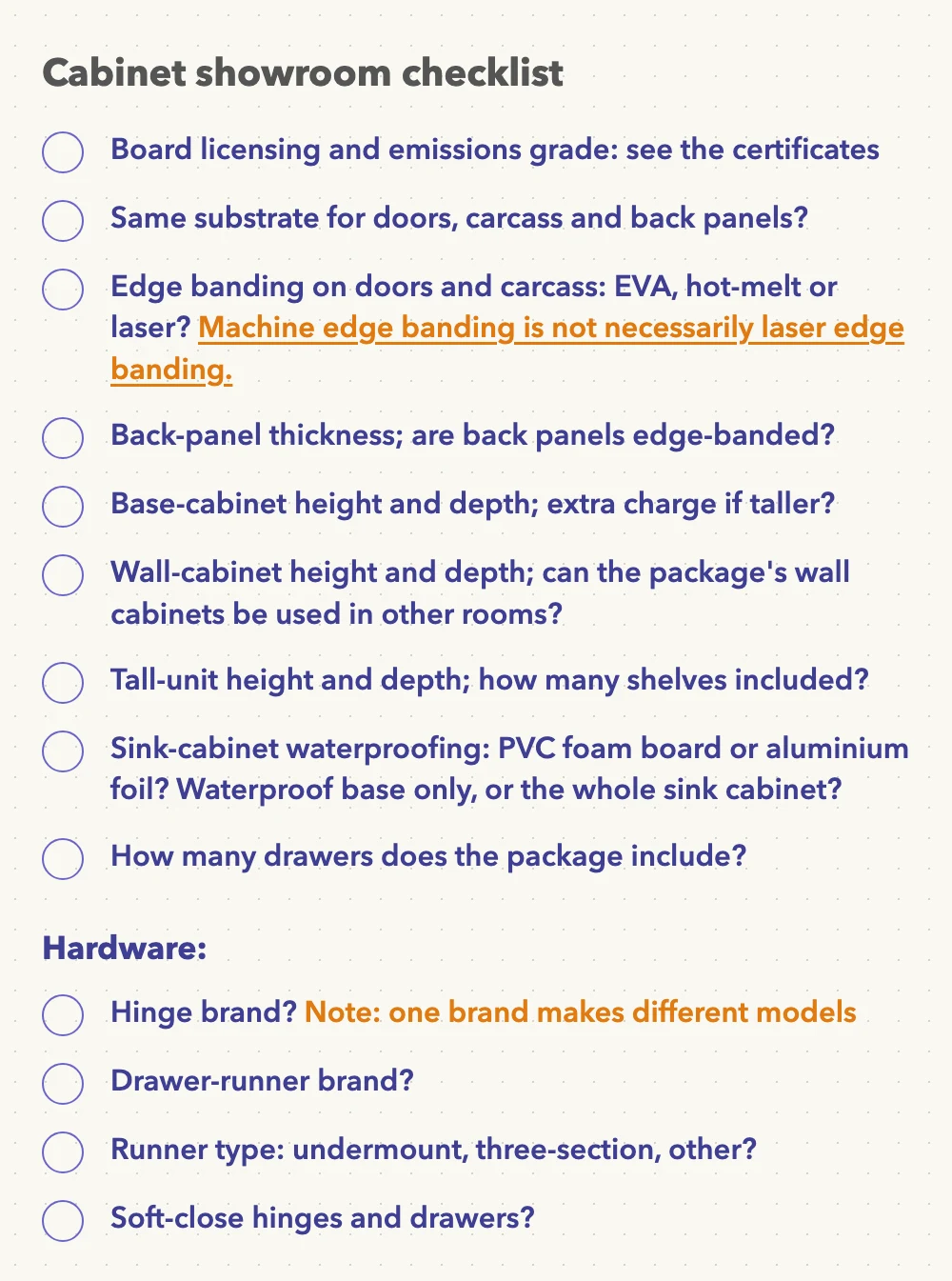
The comments under the Beijing checklist add the payment and scope issues buyers run into.
- Full payment up front. One buyer was told a large national brand requires payment in full before production; another replied that the better-known the brand, the more likely it is to insist on full payment.
- Extras charged separately. A commenter lists the hood enclosure, top filler strip, a better plinth, a thicker worktop, undermount sink work and upgraded drawer runners as items some sellers bill on top.
- Modular versus custom. A reader considering a flat-pack modular kitchen was told it only works if the room’s dimensions happen to suit the modules.
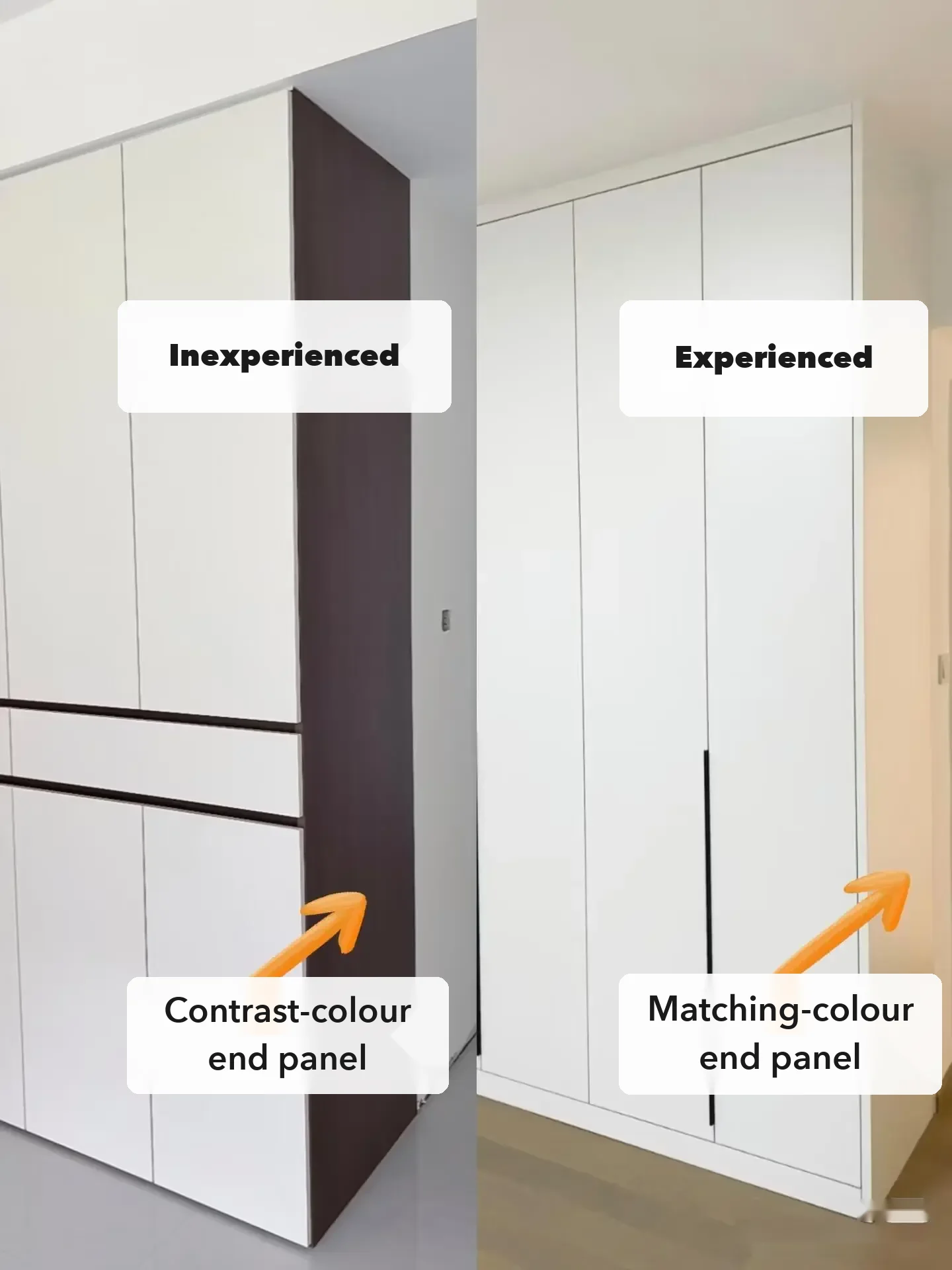
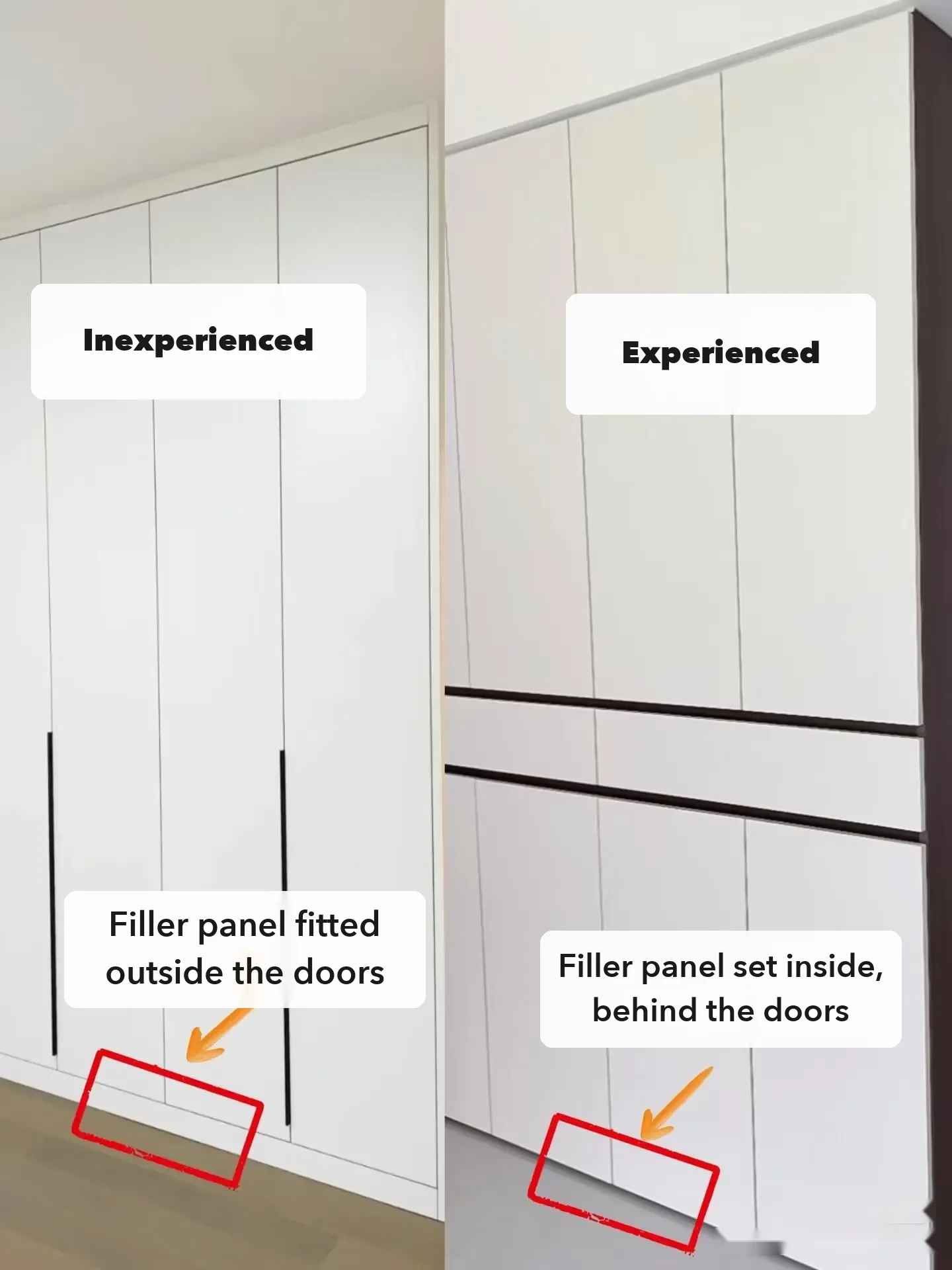
- What an “exposed panel” is. The author explains that when doors and carcasses are different boards, any visible side of a carcass needs a matching panel — a cost that rarely appears on the first quote.
What is hidden inside a Chinese cabinet package price?
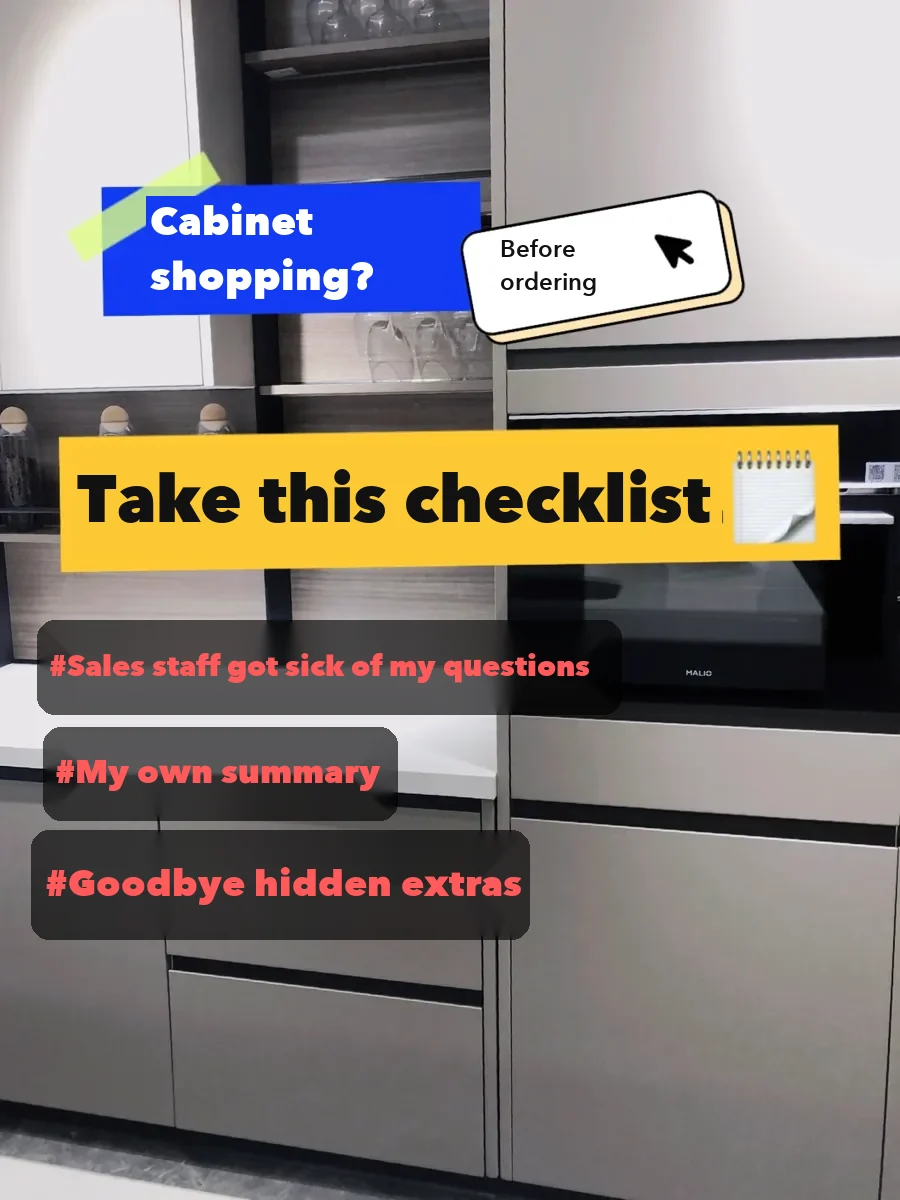
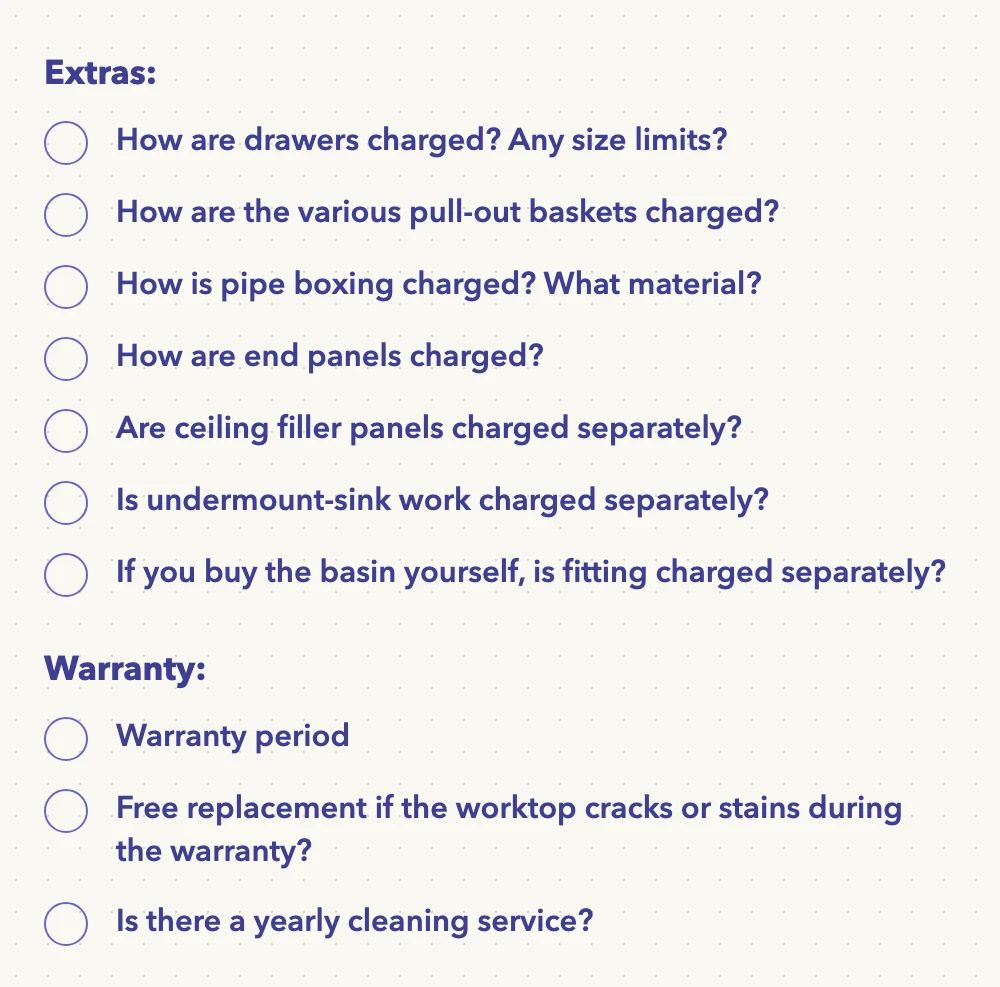
Mostly the things you assume are standard: sizes, drawer runners, worktop thickness, end panels and edge banding. Chinese cabinet firms quote kitchens by the linear metre and wardrobes by projected area, often as a package. A Beijing buyer who took a written checklist to every showroom (the sales staff praised her thoroughness, she writes, then stopped smiling a few minutes later) found that a standard package came with fixed sizes, and that every departure cost money:
- base cabinets raised to 90 cm, or reduced from 65 cm to 60 cm deep for a small kitchen;
- soft-close undermount drawer runners instead of basic three-section slides;
- a different handle-less profile from the one in the package;
- a 2 cm worktop instead of the thinner standard;
- finished end panels on tall units — only two of the brands she spoke to mentioned this cost up front.
Commenters added more items that are often charged separately: the hood enclosure, the top filler strip, a better plinth, a thicker worktop edge and an undermount sink cut-out. For an overseas buyer, each forgotten item is not a small top-up but a missing part on the other side of an ocean. Our list of common problems with kitchen cabinets from China and how each is prevented turns these into contract lines.
How do you measure and draw a kitchen for a Chinese factory?
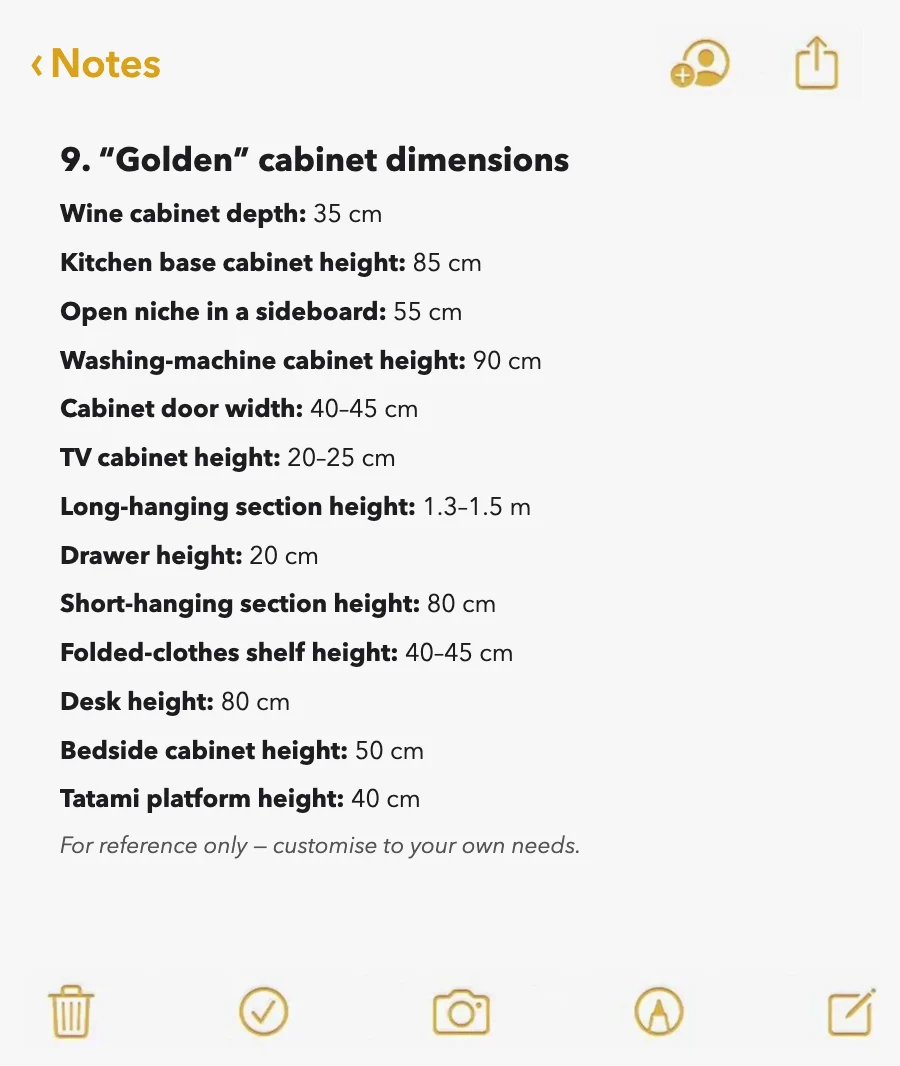
Measure the finished room in millimetres, mark every service point, and approve the factory’s production drawings line by line before any board is cut. The Beijing buyer’s second tip is to check the drawings against the site after measuring, because once a cabinet is wrong the argument is about whose measurement it was. That risk is larger when the factory never sees the room. We ask for wall-to-wall dimensions at three heights, ceiling height at several points, window and door openings, and the exact position of water, drain, gas, sockets and extraction — and for the model numbers of every built-in appliance, because appliance cut-outs are where Chinese and Western standards differ most.
Ons practical guide to cabinet measurements covers tools, tolerances, filler strips and a site-check routine, and the general drawings and sign-off process for custom furniture applies to every cabinet order.
How do you import kitchen cabinets from China?
Confirm the classification and any trade remedies first, then pack, consolidate and ship as flat-packed or assembled units depending on who installs. Wooden kitchen furniture generally falls under HS heading 9403, and our Chapter 94 HS code guide en wooden furniture HS codes explain how the lines split. For US buyers the bigger question is trade remedies: the United States has applied anti-dumping and countervailing duty orders to wooden cabinets and vanities from China since 2020, and they also reach components. We do not quote rates; we ask every US client to confirm scope and exposure with a licensed customs broker before choosing a supplier, and our explainer on antidumpingrechten op kasten en wastafelmeubels lists the questions to ask.
Once the paperwork is clear, cabinets travel like other panel furniture: in export cartons, often alongside other items from the same home. A Consolidatiemagazijn in Foshan lets worktops, appliances bought locally and furniture from other suppliers go in the same container; our shipping guide covers the choice between LCL and FCL.
Who installs Chinese cabinets once they arrive?
A local installer, briefed with the same drawings the factory used, plus spare hardware and touch-up material shipped in the container. The Chengdu installer’s final advice — supervise installation and stop the job the moment something is wrong — assumes the maker is in town. Abroad, the installer is usually someone else, and appliance connections, gas, electrics and local building codes are theirs to confirm, not the factory’s. Our guide to installing Chinese-made cabinets abroad covers the installation pack, labelling by room and the appliance-fit checks to finish before the container is loaded.
Hoe Source Foshan dit aanpakt
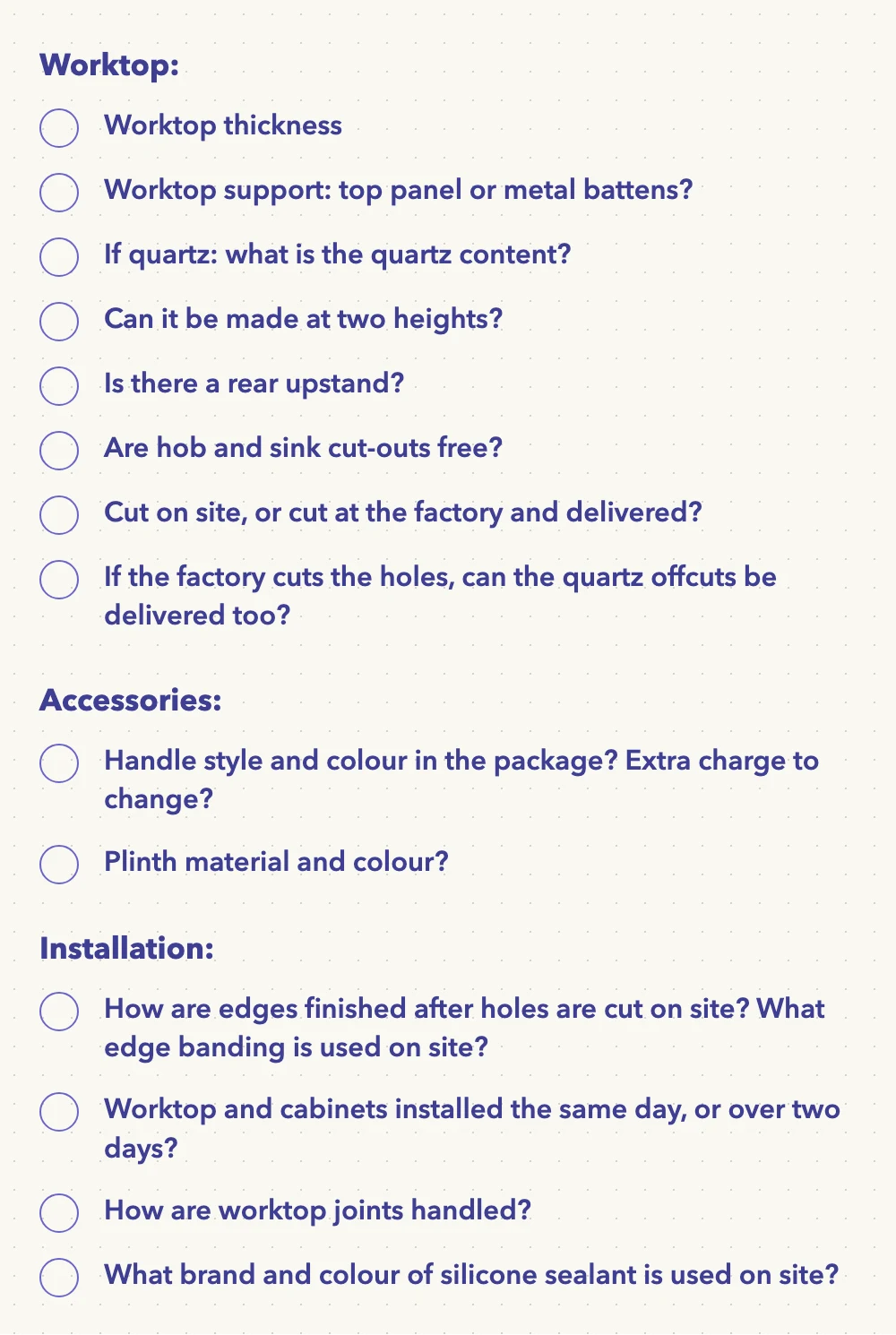
For a kitchen we start from your floor plan and elevations, write one specification — board and emissions grade for carcass, doors and backs, edge banding, hinges and runners, worktop, included items — and collect two or three quotes against it from Foshan cabinet makers. The factory’s production drawings come back to you for sign-off before cutting; production is photographed weekly, and every carcass and door is inspected against the spec before loading, with the balance released only after you approve the photo and video report. Our fee is 3–5% of order value, agreed in writing as a separate line; we take no commissions from factories. We do not give legal or tax advice: duty questions go to your broker before you commit.
If you want the cabinetry designed, made and installed as one job, we recommend Arcaya Living, whose whole-home service covers custom cabinetry from design direction to installation. Its published projects include kitchen and storage cabinetry in the Bay Area and San Jose.
See Arcaya's cabinetry projects · Whole-home customisation service · How delivery and installation work
Veelgestelde vragen
Are kitchen cabinets from China good quality?
They can be, and the quality is set by the specification rather than the country. The same factory can build with branded, low-emission board and PUR edge banding or with cheaper substitutes, so the board, emissions grade, hardware and edge banding need to be written into the order and checked before loading.
How much cheaper are kitchen cabinets from China?
It depends on the finish, the hardware and what the local alternative is; Chinese makers usually price kitchens by the metre and wardrobes by projected area, and the package contents vary. Compare landed cost — factory price, freight, duty, local delivery and installation — rather than the factory quote alone.
Can I import kitchen cabinets from China to the US?
Yes, but wooden cabinets and vanities from China have been subject to US anti-dumping and countervailing duty orders since 2020, including components. Ask a licensed customs broker to confirm scope and current rates for your supplier before you order.
How long do custom kitchen cabinets from China take?
Allow for drawing approval, production and sea freight in sequence; one Hebei factory in this research advertises a production cycle of 15–45 days before shipping. Drawing sign-off is where most delays start, so fix it early.
Do Chinese kitchen cabinets fit Western appliances?
They can be built around any appliance if the model numbers and installation drawings are supplied before production. Chinese standard sizes for hoods, sinks and worktop heights differ from US, UK and European norms, so confirm every cut-out and clearance with your installer.
Should cabinets be shipped assembled or flat-packed?
Flat-packed carcasses are cheaper to ship and easier to protect; assembled units save installation time but take far more container space. Decide with your installer, because the choice changes the packing, labelling and hardware that must travel with the order.
Verder lezen
Bronnen
- Xiaohongshu buyer source note (2025-08-20, 4,577 likes, 153 comments). Bekijk bron
- Xiaohongshu maker/seller source note (2026-04-12, 2,442 likes, 14 comments). Bekijk bron
- Xiaohongshu buyer source note (2021-08-18, 1,539 likes, 63 comments). Bekijk bron
- Xiaohongshu maker/seller source note (2026-09-16, 9 likes, 3 comments). Bekijk bron
Pricing a kitchen from China?
Send your floor plan, elevations and appliance list. We’ll come back with a written cabinet specification and two or three Foshan quotes compared against it.